Druids ETYMOLOGY
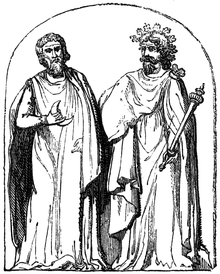
Two Druids, 19th-century engraving based on a 1719 illustration by Bernard de Montfaucon, who said that he was reproducing a bas-relief found at Autun, Burgundy[1]
Etymology
The English word druid derives from Latin druidēs (plural), which was considered by ancient Roman writers to come from the native Gaulish word for these figures.[8][9][10] Other Roman texts employ the form druidae, while the same term was used by Greek ethnographers as δρυΐδης (druidēs).[11][12] Although no extant Romano-Celtic inscription is known to contain the form,[8] the word is cognate with the later insular Celtic words, Old Irish druí 'druid, sorcerer', Old Cornish druw, Middle Welsh dryw 'seer; wren'.[10] Based on all available forms, the hypothetical proto-Celtic word may be reconstructed as dru-wid-s (pl. druwides) meaning "oak-knower". The two elements go back to the Proto-Indo-European roots deru-[13] and weid- "to see".[14] The sense of "oak-knower" or "oak-seer" is supported by Pliny the Elder,[10] who in his Natural History considered the word to contain the Greek noun drýs (δρύς), "oak-tree"[15] and the Greek suffix -idēs (-ιδης).[16] The Welsh word for oak is/was derw.[17][18] Both Old Irish druí and Middle Welsh dryw could refer to the wren,[10] possibly connected with an association of that bird with augury in Irish and Welsh tradition (see also Wren Day).[10][19]
A druid was a member of the high-ranking priestly class in ancient Celtic cultures. Druids were religious leaders as well as legal authorities, adjudicators, lorekeepers, medical professionals and political advisors. Druids left no written accounts. While they were reported to have been literate, they are believed to have been prevented by doctrine from recording their knowledge in written form. Their beliefs and practices are attested in some detail by their contemporaries from other cultures, such as the Romans and the Greeks.
The earliest known references to the druids date to the 4th century BC. The oldest detailed description comes from Julius Caesar's Commentarii de Bello Gallico (50s BCE). They were described by other Roman writers such as Cicero,[2] Tacitus,[3] and Pliny the Elder.[4] Following the Roman invasion of Gaul, the druid orders were suppressed by the Roman government under the 1st-century CE emperors Tiberius and Claudius, and had disappeared from the written record by the 2nd century.
In about 750 AD, the word druid appears in a poem by Blathmac, who wrote about Jesus, saying that he was "better than a prophet, more knowledgeable than every druid, a king who was a bishop and a complete sage."[5] The druids appear in some of the medieval tales from Christianized Ireland like "Táin Bó Cúailnge", where they are largely portrayed as sorcerers who opposed the coming of Christianity.[6] In the wake of the Celtic revival during the 18th and 19th centuries, fraternal and neopagan groups were founded based on ideas about the ancient druids, a movement known as Neo-Druidism. Many popular notions about druids, based on misconceptions of 18th-century scholars, have been largely superseded by more recent study.[7]