Magic, Supernatural
Magic (supernatural)
(Redirected from Magic (paranormal))
This article is about beliefs and actions employed to influence supernatural beings and forces. For illusionism or stage magic, see Magic (illusion).
Magic, sometimes spelled magick,[1] is an ancient practice rooted in rituals, spiritual divinations, and/or cultural lineage—with an intention to invoke, manipulate, or otherwise manifest supernatural forces, beings, or entities in the natural world.[2] It is a categorical yet often ambiguous term which has been used to refer to a wide variety of beliefs and practices, frequently considered separate from both religion and science.[3]
Connotations have varied from positive to negative at times throughout history,[4] Within Western culture, magic has been linked to ideas of the Other,[5] foreignness,[6] and primitivism;[7] indicating that it is "a powerful marker of cultural difference"[8] and likewise, a non-modern phenomenon.[9] During the late nineteenth and early twentieth century, Western intellectuals perceived the practice of magic to be a sign of a primitive mentality and also commonly attributed it to marginalised groups of people.[8]
In modern occultism and neopagan religions, many self-described magicians and witches regularly practice ritual magic;[10] defining magic as a technique for bringing about change in the physical world through the force of one's will. This definition was popularised by Aleister Crowley (1875–1947), an influential British occultist. This view has been incorporated into chaos magic and the new religious movements of Thelema and Wicca.
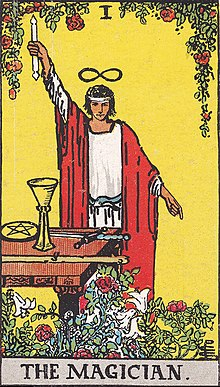
The Magician, an illustration from the Rider–Waite tarot deck first published in 1910
Etymology

One of the earliest surviving accounts of the Persian mágoi was provided by the Greek historian Herodotus.
The English words magic, mage and magician come from
the Latin term magus,
through the Greek μάγος, which is from
the Old Persian maguš. magician).[11]
The Old Persian magu- is derived from the Proto-Indo-European megʰ-magh* (be able).
The Persian term may have led to the Old Sinitic Mγag* (mage or shaman).[12]
The Old Persian form seems to have permeated ancient Semitic languages as the Talmudic Hebrew magosh,
the Aramaic amgusha (magician), and
the Chaldean maghdim (wisdom and philosophy);
from the first century BCE onwards, Syrian magusai gained notoriety as magicians and soothsayers.[13]
During the late-sixth and early-fifth centuries BCE, the term goetia found its way into ancient Greek, where it was used with negative connotations to apply to rites that were regarded as fraudulent, unconventional, and dangerous.[14]
The Latin language adopted this meaning of the term in the first century BCE.
Via Latin, the concept became incorporated into Christian theology during the first century CE.
Early Christians associated magic with demons, and thus regarded it as against Christian religion.
This concept remained pervasive throughout the Middle Ages, when Christian authors categorised a diverse range of practices—such as enchantment, witchcraft, incantations, divination, necromancy, and astrology—under the label "magic".
In early modern Europe, Protestants often claimed that Roman Catholicism was magic rather than religion, and as Christian Europeans began colonizing other parts of the world in the sixteenth century, they labelled the non-Christian beliefs they encountered as magical. In that same period, Italian humanists reinterpreted the term in a positive sense to express the idea of natural magic. Both negative and positive understandings of the term recurred in Western culture over the following centuries.
Since the nineteenth century, academics in various disciplines have employed the term magic but have defined it in different ways and used it in reference to different things. One approach, associated with the anthropologists Edward Tylor (1832–1917) and James G. Frazer (1854–1941), uses the term to describe beliefs in hidden sympathies between objects that allow one to influence the other. Defined in this way, magic is portrayed as the opposite to science. An alternative approach, associated with the sociologist Marcel Mauss (1872–1950) and his uncle Émile Durkheim (1858–1917), employs the term to describe private rites and ceremonies and contrasts it with religion, which it defines as a communal and organised activity. By the 1990s many scholars were rejecting the term's utility for scholarship. They argued that the label drew arbitrary lines between similar beliefs and practices that were alternatively considered religious, and that it constituted ethnocentric to apply the connotations of magic—rooted in Western and Christian history—to other cultures.