Galanthus nivalis
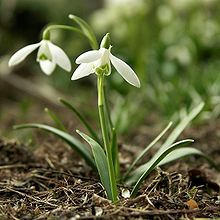
Galanthus nivalis, the snowdrop or common snowdrop, is the best-known and most widespread of the 20 species in its genus, Galanthus. Snowdrops are among the first bulbs to bloom in spring and can form impressive carpets of white in areas where they are native or have been naturalised. They should not be confused with the snowflakes, in the genera Leucojum and Acis.
Naming
The generic name Galanthus, from the Greek gala (milk) and anthos (flower), was given to the genus by Carl Linnaeus in 1735.
He described Galanthus nivalis in his Species Plantarum published in 1753.
The epithet nivalis means "of the snow", referring either to the snow-like flower or the plant's early flowering.[3]
The common name snowdrop first appeared in the 1633 edition of John Gerard's Great Herbal (in the first edition (1597) he described it as the "Timely flowring Bulbus violet").
The derivation of the name is uncertain, although it may have come from the German word Schneetropfen, which was a type of earring popular around that time.[4]
Other British traditional common names include "February fairmaids", "dingle-dangle", "Candlemas bells", "Mary's tapers"[5] and, in parts of Yorkshire, "snow piercers" (like the French name perce-neige).[6]
Distribution and habitat

Distribution map of Galanthus species in Europe and Western Asia. (An attempt at a representation according to the natural place indicated in the respective Wikipedia pages (en, de, ru, fr)
Galanthus nivalis is widely grown in gardens, particularly in northern Europe, and is widely naturalised in woodlands in the regions where it is grown.
It is, however, native to a large area of Europe, from Spain in the west, eastwards to Ukraine.
It is native to
the Czech Republic,
Spain,
Turkey, and
Ukraine.
It is considered naturalised in
Sweden, and
parts of North America =
Utah,
Ohio,
Virginia and
North Carolina).[7][8]

Naturalized snowdrops in Wissahickon Valley Park in early March.
Although often thought of as a British native wild flower, or to have been brought to the British Isles by the Romans, it is now thought that it was probably introduced much later, perhaps around the early sixteenth century.[9]
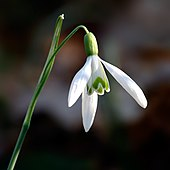
Common snowdrop
Snowdrop gardens
Main article: List of snowdrop gardens
In the UK and Ireland, many gardens open specially in February for visitors to admire the flowers. These displays may attract large numbers of sightseers. Some feature extensive displays of naturalised G. nivalis; others have more specialised collections of many species, forms and cultivars.