Kefir
Origin and etymology
The word kefir, known in Russia and Eastern-European countries since at least 1884,[8] is of North Caucasian origin.[9][10] A Russian borrowing in English, its ultimate origin is unknown. It is thought that the name origin of Kefir comes from "Köpür" in Old Turkic.[10] More likely is another Caucasian origin; compare Georgian კეფირი (k’epiri), Mingrelian ქიფური (kipuri), Ossetian къӕпы (k’æpy), Karachay-Balkar гыпы (gıpı). The p to f transformation may indicate possible transmission to Russian through Arabic كِفِير (kifīr), which would have served as a lingua franca in the Muslim parts of the Caucasus.
Traditional kefir was made in goatskin bags that were hung near a doorway; the bags would be knocked by anyone passing through to keep the milk and kefir grains well mixed.[11] In Karachay-Balkar gıpı, which has connection with gıbıt (wineskin). It was under the name "wineskin" that Karachay kefir was distributed in the second half of the 19th century and at the beginning of the 20th century.[12][13] Kefir spread from the former Soviet Union to the rest of Europe, Canada, Japan, and the United States by the early 21st century.[9][14][15] It has become known in parts of Latin America as búlgaros, or "Bulgarians".
[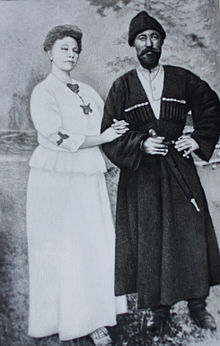 ]
Bekmyrza Baychorov and Irina Sakharova. First distributors of kefir to Russia.
The homeland of kefir is considered to be "the vicinity of Elbrus along the upper reaches of the Kuban".[6]
Fermentation

Kefir grains, a symbiotic matrix of bacteria and yeasts
Traditional kefir is fermented at ambient temperatures, generally overnight.
Fermentation of the lactose yields a sour, carbonated, slightly alcoholic beverage, with a consistency and taste similar to drinkable yogurt.[16]
The kefir grains initiating the fermentation are initially created by auto-aggregations of Lactobacillus kefiranofaciens and Kazachstania turicensis, where multiple biofilm producers cause the surfaces to adhere which form a three dimensional microcolony.[17][18][19]
The biofilm is a matrix of heteropolysaccharides called kefiran, which is composed of equal proportions of glucose and galactose.[9]
It resembles small cauliflower grains, with color ranging from white to creamy yellow.
A complex and highly variable symbiotic community can be found in these grains, which can include
acetic acid bacteria (such as A. aceti and A. rasens),
yeasts (such as Candida kefyr and S. cerevisiae) and
a number of Lactobacillus species, such as
L. parakefiri, L. kefiranofaciens (and subsp. kefirgranum[20]),
L. kefiri,[21] etc.[9]
While some microbes predominate, Lactobacillus species are always present.[22]
The microbe flora can vary between batches of kefir due to factors such as the kefir grains rising out of the milk while fermenting or curds forming around the grains, as well as temperature.[23]
Additionally, Tibetan kefir composition differs from that of
the Russian kefir,
Irish kefir,
Taiwan kefir and
Turkey fermented beverage with kefir.[9]
In recent years, the use of freeze-dried starter culture has become common due to stability of the fermentation result, because the species of microbes are selected in laboratory conditions, as well as easy transportation.[24][25][26]
During fermentation, changes in the composition of ingredients occur.
Lactose, the sugar present in milk, is broken down mostly to lactic acid (25%) by the lactic acid bacteria, which results in acidification.[22]
Propionibacteria further break down some of the lactic acid into propionic acid (these bacteria also carry out the same fermentation in Swiss cheese).
Other substances that contribute to the flavor of kefir are
diacetyl and
acetoin (both of which contribute a "buttery" flavor),
acetaldehyde, and
amino acids resulting from protein breakdown.[27]
Composition
Kefir products contain nutrients in varying amounts from negligible to significant, including
conjugated linoleic acid,[36] in amounts similar to unfermented cow, goat, or sheep milk.[37]
At a pH of 4.2 – 4.6,[38] kefir is composed mainly of water and by-products of the fermentation process, including carbon dioxide and ethanol.[39]
Typical of milk, several dietary minerals are found in kefir, such as
iron,
copper,
manganese, and
zinc in amounts that have not been standardized to a reputable nutrient database.[39]
Also similar to milk,[37] kefir contains vitamins in variable amounts, including vitamin A,
vitamin B~1 (thiamine),
vitamin B~2 (riboflavin),
vitamin B~3 (niacin),
vitamin B~6 (pyridoxine),
vitamin B~9 (folic acid),
vitamin B~12 (cyanocobalamin),
vitamin D, and
vitamin E.[39]
Essential amino acids found in kefir include
lysine, and
valine,[39] as for any milk product.[37]
See also


Other fermented dairy products
- Airag
- Amasi
- Ayran
- Buttermilk
- Chaas
- Chalap
- Cheese
- Cream cheese
- Doogh
- Filmjölk
- Kefir cheese
- Kumis
- Leben
- Labneh
- Lassi
- Matzoon
- Mursik
- Ryazhenka
- Sana [ro]
- Shubat
- Skyr
- Varenets
- Viili
- Yogurt