PROTEIN
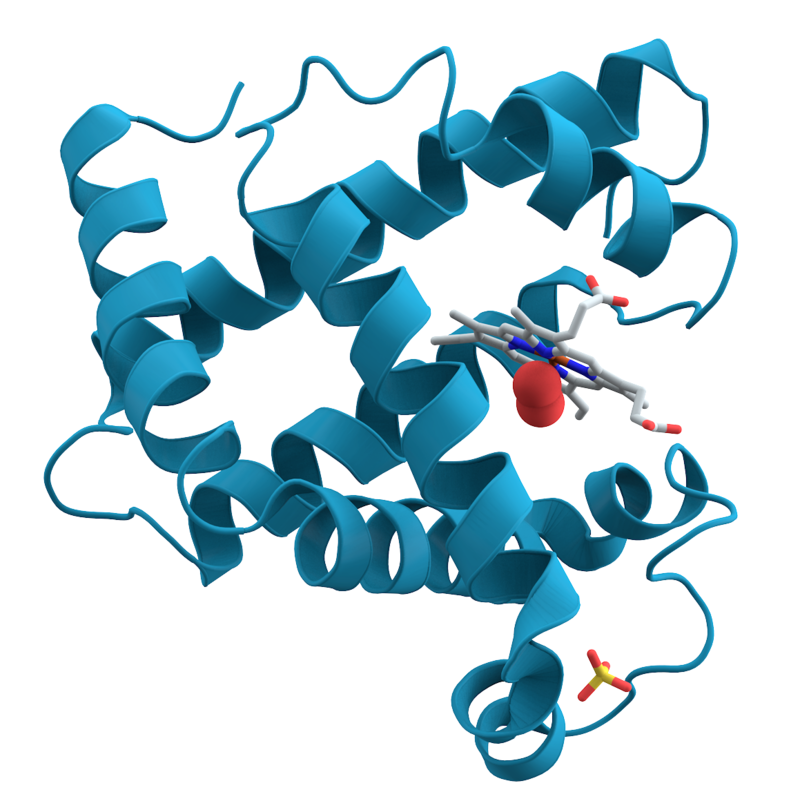
A representation of the 3D structure of the protein myoglobin showing turquoise α-helices. This protein was the first to have its structure solved by X-ray crystallography. Toward the right-center among the coils, a prosthetic group called a heme group (shown in gray) with a bound oxygen molecule (red).
Proteins are large biomolecules and macromolecules that comprise one or more long chains of amino acid residues.
Proteins perform a vast array of functions within organisms, including catalysing metabolic reactions, DNA replication, responding to stimuli, providing structure to cells and organisms, and transporting molecules from one location to another.
Proteins differ from one another primarily in their sequence of amino acids, which is dictated by the nucleotide sequence of their genes, and which usually results in protein folding into a specific 3D structure that determines its activity.
A linear chain of amino acid residues is called a polypeptide.
A protein contains at least one long polypeptide.
Short polypeptides, containing less than 20–30 residues, are rarely considered to be proteins and are commonly called peptides.
The individual amino acid residues are bonded together by peptide bonds and adjacent amino acid residues.
The sequence of amino acid residues in a protein is defined by the sequence of a gene, which is encoded in the genetic code.
In general, the genetic code specifies 20 standard amino acids; but in certain organisms the genetic code can include selenocysteine and—in certain archaea—pyrrolysine.
Shortly after or even during synthesis, the residues in a protein are often chemically modified by post-translational modification, which alters the physical and chemical properties, folding, stability, activity, and ultimately, the function of the proteins.
Some proteins have non-peptide groups attached, which can be called prosthetic groups or cofactors.
Proteins can also work together to achieve a particular function, and they often associate to form stable protein complexes.
Once formed, proteins only exist for a certain period and are then degraded and recycled by the cell's machinery through the process of protein turnover.
A protein's lifespan is measured in terms of its half-life and covers a wide range.
They can exist for minutes or years with an average lifespan of 1–2 days in mammalian cells.
Abnormal or misfolded proteins are degraded more rapidly either due to being targeted for destruction or due to being unstable.
Like other biological macromolecules such as polysaccharides and nucleic acids, proteins are essential parts of organisms and participate in virtually every process within cells.
Many proteins are enzymes that catalyse biochemical reactions and are vital to metabolism.
Proteins also have structural or mechanical functions, such as actin and myosin in muscle and the proteins in the cytoskeleton, which form a system of scaffolding that maintains cell shape.
Other proteins are important in cell signaling, immune responses, cell adhesion, and the cell cycle.
In animals, proteins are needed in the diet to provide the essential amino acids that cannot be synthesized.
Digestion breaks the proteins down for metabolic use.
Proteins may be purified from other cellular components using a variety of techniques such as ultracentrifugation, precipitation, electrophoresis, and chromatography;
the advent of genetic engineering has made possible a number of methods to facilitate purification.
Methods commonly used to study protein structure and function include immunohistochemistry,
nuclear magnetic resonance and
History and etymology
Further information: History of molecular biology
Proteins were recognized as a distinct class of biological molecules in the eighteenth century by Antoine Fourcroy and others, distinguished by the molecules' ability to coagulate or flocculate under treatments with heat or acid.[1]
Noted examples at the time included albumin from egg whites, blood serum albumin, fibrin, and wheat gluten.
Proteins were first described by the Dutch chemist Gerardus Johannes Mulder and named by the Swedish chemist Jöns Jacob Berzelius in 1838.[2][3]
Mulder carried out elemental analysis of common proteins and found that nearly all proteins had the same empirical formula, C400H620N100O120P1S1.[4]
He came to the erroneous conclusion that they might be composed of a single type of (very large) molecule.
The term "protein" to describe these molecules was proposed by Mulder's associate Berzelius; protein is derived from the Greek word πρώτειος (proteios), meaning "primary",[5] "in the lead", or "standing in front",[6] + -in.
Mulder went on to identify the products of protein degradation such as the amino acid leucine for which he found a (nearly correct) molecular weight of 131 Da.[4]
Prior to "protein", other names were used, like "albumins" or "albuminous materials" (Eiweisskörper, in German).[7]
Early nutritional scientists such as the German Carl von Voit believed that protein was the most important nutrient for maintaining the structure of the body, because it was generally believed that "flesh makes flesh."[8]
Karl Heinrich Ritthausen extended known protein forms with the identification of glutamic acid. At the Connecticut Agricultural Experiment Station a detailed review of the vegetable proteins was compiled by Thomas Burr Osborne. Working with Lafayette Mendel and applying Liebig's law of the minimum in feeding laboratory rats, the nutritionally essential amino acids were established. The work was continued and communicated by William Cumming Rose. The understanding of proteins as polypeptides came through the work of Franz Hofmeister and Hermann Emil Fischer in 1902.[9][10] The central role of proteins as enzymes in living organisms was not fully appreciated until 1926, when James B. Sumner showed that the enzyme urease was in fact a protein.[11]
The difficulty in purifying proteins in large quantities made them very difficult for early protein biochemists to study. Hence, early studies focused on proteins that could be purified in large quantities, e.g., those of blood, egg white, various toxins, and digestive/metabolic enzymes obtained from slaughterhouses. In the 1950s, the Armour Hot Dog Co. purified 1 kg of pure bovine pancreatic ribonuclease A and made it freely available to scientists; this gesture helped ribonuclease A become a major target for biochemical study for the following decades.[4]
Linus Pauling is credited with the successful prediction of regular protein secondary structures based on hydrogen bonding, an idea first put forth by William Astbury in 1933.[12] Later work by Walter Kauzmann on denaturation,[13][14] based partly on previous studies by Kaj Linderstrøm-Lang,[15] contributed an understanding of protein folding and structure mediated by hydrophobic interactions.
The first protein to be sequenced was insulin, by Frederick Sanger, in 1949. Sanger correctly determined the amino acid sequence of insulin, thus conclusively demonstrating that proteins consisted of linear polymers of amino acids rather than branched chains, colloids, or cyclols.[16] He won the Nobel Prize for this achievement in 1958.[17]

John Kendrew with model of myoglobin in progress
With the development of X-ray crystallography, it became possible to sequence protein structures.[18]
The first protein structures to be solved were hemoglobin by Max Perutz and myoglobin by John Kendrew, in 1958.[19][20]
The use of computers and increasing computing power also supported the sequencing of complex proteins.
In 1999, Roger Kornberg succeeded in sequencing the highly complex structure of RNA polymerase using high intensity X-rays from synchrotrons.[18]
Since then, cryo-electron microscopy (cryo-EM) of large macromolecular assemblies[21] has been developed.
Cryo-EM uses protein samples that are frozen rather than crystals, and beams of electrons rather than x-rays. It causes less damage to the sample, allowing scientists to obtain more information and analyze larger structures.[18]
Computational protein structure prediction of small protein domains[22] has also helped researchers to approach atomic-level resolution of protein structures.
As of 2017, the Protein Data Bank has over 126,060 atomic-resolution structures of proteins.[23]