WORLD TRADE
International trade - Wikipedia
International trade is the exchange of capital, goods, and services across international borders or territories[1] because there is a need or want of goods or services.[2] (see: World economy)
In most countries, such trade represents a significant share of gross domestic product (GDP).
While international trade has existed throughout history (for example Uttarapatha, Silk Road, Amber Road, scramble for Africa, Atlantic slave trade, salt roads), its economic, social, and political importance has been on the rise in recent centuries.
Carrying out trade at an international level is a complex process when compared to domestic trade.
When trade takes place between two or more states, factors like currency, government policies, economy, judicial system, laws, and markets influence trade.
Statistical services of intergovernmental and supranational organizations and governmental statistical agencies publish official statistics on international trade.
Characteristics of global trade
A product that is transferred or sold from a party in one country to a party in another country is an export from the originating country, and an import to the country receiving that product.
Imports and exports are accounted for in a country's current account in the balance of payments.[3]
Trading globally may give consumers and countries the opportunity to be exposed to new markets and products. Almost every kind of product can be found in the international market, for example: food, clothes, spare parts, oil, jewellery, wine, stocks, currencies, and water. Services are also traded, such as in tourism, banking, consulting, and transportation.

The ancient Silk Road trade routes across Eurasia
Advanced technology (including transportation), globalization, industrialization, outsourcing and multinational corporations have major impacts on the international trade systems
Differences from domestic trade
[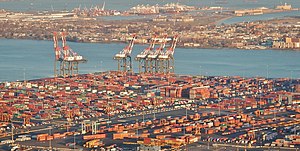 ]
Ports play an important role in facilitating international trade.
The Port of New York and New Jersey grew from the original harbor at the convergence of the Hudson River and the East River at the Upper New York Bay.
International trade is, in principle, not different from domestic trade as the motivation and the behavior of parties involved in a trade do not change fundamentally regardless of whether trade is across a border or not.
However, in practical terms, carrying out trade at an international level is typically a more complex process than domestic trade.
The main difference is that international trade is typically more costly than domestic trade.
This is due to the fact that cross-border trade typically incurs additional costs such as explicit tariffs as well as explicit or implicit non-tariff barriers such as time costs (due to border delays), language and cultural differences, product safety, the legal system, and so on.
Another difference between domestic and international trade is that factors of production such as capital and labor are often more mobile within a country than across countries.
Thus, international trade is mostly restricted to trade in goods and services, and only to a lesser extent to trade in capital, labour, or other factors of production.
Trade in goods and services can serve as a substitute for trade in factors of production.
Instead of importing a factor of production, a country can import goods that make intensive use of that factor of production and thus embody it.
An example of this is the import of labor-intensive goods by the United States from China.
Instead of importing Chinese labor, the United States imports goods that were produced with Chinese labor.
One report in 2010, suggested that international trade was increased when a country hosted a network of immigrants, but the trade effect was weakened when the immigrants became assimilated into their new country.[4]