Nervous system - Definition
Structure
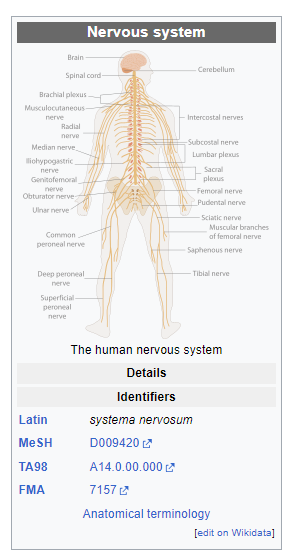
The nervous system derives its name from nerves, which are cylindrical bundles of fibers (the axons of neurons), that emanate from the brain and spinal cord, and branch repeatedly to innervate every part of the body.[5]
Nerves are large enough to have been recognized by the ancient Egyptians, Greeks, and Romans,[6] but their internal structure was not understood until it became possible to examine them using a microscope.[7]
The author Michael Nikoletseas wrote:[8]
"It is difficult to believe that until approximately year 1900 it was not known that neurons are the basic units of the brain (Santiago Ramón y Cajal). Equally surprising is the fact that the concept of chemical transmission in the brain was not known until around 1930 (Henry Hallett Dale and Otto Loewi). We began to understand the basic electrical phenomenon that neurons use in order to communicate among themselves, the action potential, in the 1950s (Alan Lloyd Hodgkin, Andrew Huxley and John Eccles). It was in the 1960s that we became aware of how basic neuronal networks code stimuli and thus basic concepts are possible (David H. Hubel and Torsten Wiesel). The molecular revolution swept across US universities in the 1980s. It was in the 1990s that molecular mechanisms of behavioral phenomena became widely known (Eric Richard Kandel)."
A microscopic examination shows that nerves consist primarily of axons, along with different membranes that wrap around them and segregate them into fascicles.
The neurons that give rise to nerves do not lie entirely within the nerves themselves—their cell bodies reside within the brain, spinal cord, or peripheral ganglia.[5]
All animals more advanced than sponges have nervous systems.
However, even sponges, unicellular animals, and non-animals such as slime molds have cell-to-cell signalling mechanisms that are precursors to those of neurons.[9]
In radially symmetric animals such as the jellyfish and hydra, the nervous system consists of a nerve net, a diffuse network of isolated cells.[10]
In bilaterian animals, which make up the great majority of existing species, the nervous system has a common structure that originated early in the Ediacaran period, over 550 million years ago.[11][12]