Sermon on the Mount
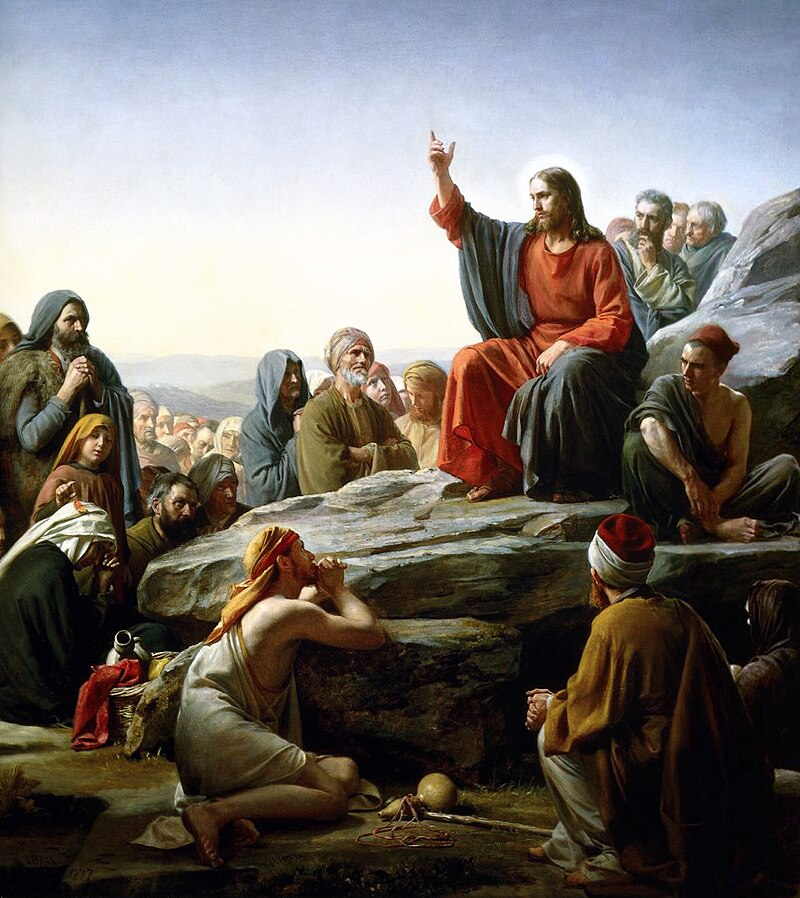
Sermon on the Mount by Carl Bloch (1877)
The Sermon on the Mount (anglicized from the Matthean Vulgate Latin section title: Sermo in monte) is a collection of sayings spoken by Jesus of Nazareth found in the Gospel of Matthew (chapters 5, 6, and 7)[1][2] that emphasizes his moral teachings.
It is the first of five discourses in the Gospel and has been one of the most widely quoted sections of the Gospels.[3]
See also: Ministry of Jesus
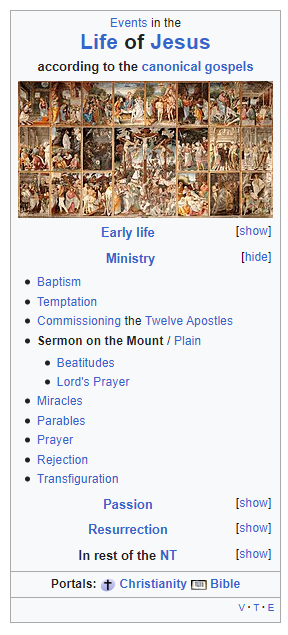
See also: Beatitudes, Salt and Light, Light of the World, Lamp under a bushel, The Mote and the Beam, and Wise and Foolish Builders
While Matthew groups Jesus' teachings into sets of similar material, the same material is scattered when found in Luke.[1] The Sermon on the Mount may be compared with the similar but shorter Sermon on the Plain as recounted by the Gospel of Luke (Luke 6:17–49), which occurs at the same moment in Luke's narrative, and also features Jesus heading up a mountain, but giving the sermon on the way down at a level spot. Some scholars believe that they are the same sermon, while others hold that Jesus frequently preached similar themes in different places.[39]
See also
- Gospel harmony
- Jesus in Christianity
- Life of Jesus in the New Testament
- The Kingdom of God Is Within You, 1894 Leo Tolstoy book
- Sermon on the Plain - Wikipedia
In Christianity, the Sermon on the Plain refers to a set of teachings by Jesus in the Gospel of Luke, in 6:20–49.[1] This sermon may be compared to the longer Sermon on the Mount in the Gospel of Matthew.[2]
Luke 6:12–20a details the events leading to the sermon. In it, Jesus spent the night on a mountain praying to God. Two days later, he gathered his disciples and selected 12 of them, whom he named Apostles. On the way down from the mountain, he stood at "a level place" (ἐπὶ τόπου πεδινοῦ, epi topou pedinou) where a throng of people had gathered. After curing those with "unclean spirits", Jesus began what is now called the Sermon on the Plain.
Notable messages in the Sermon include:
- The beatitudes and woes (6:20–26)
- Love your enemies and turn the other cheek (6:27–36)
- Treat others the way you want to be treated (6:31)
- Don't judge and you won't be judged, don't condemn and you won't be condemned, forgive and you will be forgiven, give and you will receive (6:37–38)
- Can the blind lead the blind? Disciples are not above their teacher (6:39-40a)
- Remove the log from your own eye before attending to the splinter in your friend's (40b-42)
- A good tree does not produce bad fruit and a bad tree cannot produce good fruit, each tree is known by its fruit (43–45)
- Why do you call me *Lord, Lord* yet not do what I command? (46)
- Whoever follows these words of mine builds on rock and will survive, whoever does not builds on sand and will be destroyed (47–49)
In Luke 7:1 after Jesus had said everything he had to say to the crowd, he went to Capernaum, which in Lukan chronology he had not visited since Luke 4:31.[1]
See also
References
- ^ Jump up to:^a ^b The Bible Knowledge Background Commentary: Matthew-Luke, Volume 1 by Craig A. Evans 2003 ISBN 0-7814-3868-3 Sermon on the Plain: pages 151–161
- Luke by Sharon H. Ringe 1995 ISBN 0-664-25259-1 pages 90–97