Eileithyia
Origins
According to F. Willets, the goddess shows a clear connection to a pre-existing Minoan goddess, as well as an earlier Neolithic concept.
Eileithyia's guidance in childbirth may give influence of the first midwife.[14]
To Homer, she is "the goddess of childbirth".[15]
The Iliad pictures Eileithyia alone, or sometimes multiplied, as the Eileithyiai:
And even as when the sharp dart striketh a woman in travail, [270] the piercing dart that the Eilithyiae, the goddesses of childbirth, send—even the daughters of Hera that have in their keeping bitter pangs;[16]
— Iliad 11.269–272
Hesiod (c. 700 BC) described Eileithyia as a daughter of Hera by Zeus (Theogony 921)[17]—and the Bibliotheca (Roman-era) and Diodorus Siculus (c. 90–27 BC) (5.72.5) agreed.
Also, a poem at the Greek Anthology Book 6, mention Eileithyia as Hera's daughter.[18] But Pausanias, writing in the 2nd century AD, reported another early source (now lost): "The Lycian Olen, an earlier poet, who composed for the Delians, among other hymns, one to Eileithyia, styles her as 'the clever spinner', clearly identifying her with the Fates, thus making her older than Cronus."[19]
Being the youngest born to Gaia, Cronus was a Titan of the first generation and he was identified as the father of Zeus.
Likewise, the meticulously accurate mythographer Pindar (522–443 BC) also makes no mention of Zeus:
Eleithuia, seated beside the deep-thinking Fates, hear me, creator of offspring, child of Hera great in strength.
— Seventh Nemean Ode, Line 1, translated by Diane Arnson Svarlien, 1990
Later, for the Classical Greeks, "She is closely associated with Artemis and Hera," Burkert asserts, "but develops no character of her own".[20]
In the Orphic Hymn to Prothyraeia, virginal Artemis is given an epithet relating to the goddess of childbirth, making the divine huntress also "she who comes to the aid of women in childbirth":[21]
When racked with labour pangs, and sore distressed
the sex invoke thee, as the soul's sure rest;
for thou Eileithyia alone canst give relief to pain,
which art attempts to ease, but tries in vain.
Artemis Eileithyia, venerable power,
who bringest relief in labour's dreadful hour.
— Orphic Hymn 2, to Prothyraeia, as translated by Thomas Taylor, 1792.
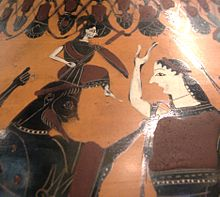
Eileithyia is commonly in classical Greek art most often depicted assisting childbirth. Vase-painters, when illustrating the birth of Athena from Zeus' head, may show two assisting Eileithyiai, with their hands raised in the epiphany gesture. The Beauty of Durrës, a large 4th-century B.C.E. mosaic shows the head figure of a woman, probably portrays the goddess Eileithyia.[22]
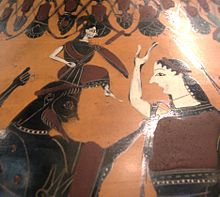
The birth of Athena from the head of Zeus, with Eileithyia on the right.
Eileithyia or Ilithyia (/ɪlɪˈθaɪ.ə/;[1] Greek: Εἰλείθυια; Ἐλεύθυια (Eleuthyia) in Crete, also Ἐλευθία (Eleuthia) or Ἐλυσία (Elysia) in Laconia and Messene, and Ἐλευθώ (Eleuthō) in literature)[2] was the Greek goddess of childbirth and midwifery,[3] and the daughter of Zeus and Hera. In the cave of Amnisos (Crete) she was related with the annual birth of the divine child, and her cult is connected with Enesidaon (the earth shaker), who was the chthonic aspect of the god Poseidon. It is possible that her cult is related with the cult of Eleusis.[4] In his Seventh Nemean Ode, Pindar refers to her as the maid to or seated beside the Moirai (Fates) and responsible for the creation of offspring. Her son was Sosipolis, who was worshiped at Elis.[5]
Etymology
The earliest form of the name is the Mycenaean Greek e-re-u-ti-ja, written in the Linear B syllabic script.[6] Ilithyia is the latinisation of Εἰλείθυια.
The etymology of the name is uncertain, but debated among scholars. R. S. P. Beekes suggests a non-Indo-European etymology,[7] and Nilsson believes that the name is Pre-Greek.[2] 19th-century scholars suggested that the name is Greek, derived from the verb eleutho (ἐλεύθω), "to bring", the goddess thus meaning The Bringer.[8]
Walter Burkert believes that Eileithyia is the Greek goddess of birth and that her name is pure Greek.[9]
However, the relation with the Greek prefix ἐλεύθ is uncertain, because the prefix appears in some pre-Greek toponyms like Ἐλευθέρνα (Eleutherna); therefore it is possible that the name is pre-Greek.[10]
Her name Ἐλυσία (Elysia) in Laconia and Messene probably relates her with the month Eleusinios and Eleusis.[11][12]
Nilsson also believes that the name "Eleusis" is pre-Greek.[13]