Corruption
Corruption is a form of dishonesty or a criminal offense which is undertaken by a person or an organization which is entrusted in a position of authority, in order to acquire illicit benefits or abuse power for one's personal gain.
Corruption may involve many activities which include bribery, influence peddling and the embezzlement and it may also involve practices which are legal in many countries.[1]
Political corruption occurs when an office-holder or other governmental employee acts with an official capacity for personal gain.
Corruption is most common in kleptocracies, oligarchies, narco-states, and mafia states.[citation ^needed]
Corruption and crime are endemic sociological occurrences which appear with regular frequency in virtually all countries on a global scale in varying degrees and proportions.
Recent data suggests corruption is on the rise.[2]
Each individual nation allocates domestic resources for the control and regulation of corruption and the deterrence of crime.
Strategies which are undertaken in order to counter corruption are often summarized under the umbrella term anti-corruption.[3]
Additionally, global initiatives like the United Nations Sustainable Development Goal 16 also have a targeted goal which is supposed to substantially reduce corruption in all of its forms.[4]
Definitions and scales
[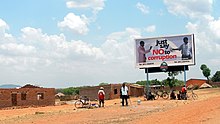
A billboard in Zambia exhorting the public to "Just say no to corruption".
Stephen D. Morris,[5] a professor of politics, wrote that political corruption is the illegitimate use of public power to benefit a private interest.
Economist Ian Senior defined corruption as an action to secretly provide a good or a service to a third party to influence certain actions which benefit the corrupt, a third party, or both in which the corrupt agent has authority.[6]
World Bank economist Daniel Kaufmann[7] extended the concept to include "legal corruption" in which power is abused within the confines of the law—as those with power often have the ability to make laws for their protection.
The effect of corruption in infrastructure is to increase costs and construction time, lower the quality and decrease the benefit.[8]
Corruption is a complex phenomenon and can occur on different scales.[9]
Corruption ranges from small favors between a small number of people (petty corruption),[10] to corruption that affects the government on a large scale (grand corruption), and corruption that is so prevalent that it is part of the everyday structure of society, including corruption as one of the symptoms of organized crime (systemic corruption).
A number of indicators and tools have been developed which can measure different forms of corruption with increasing accuracy;[11][12] but when those are impractical, one study suggests looking at bodyfat as a rough guide after finding that obesity of cabinet ministers in post-Soviet states was highly correlated with more accurate measures of corruption.[13][14]