Mary Magdalene
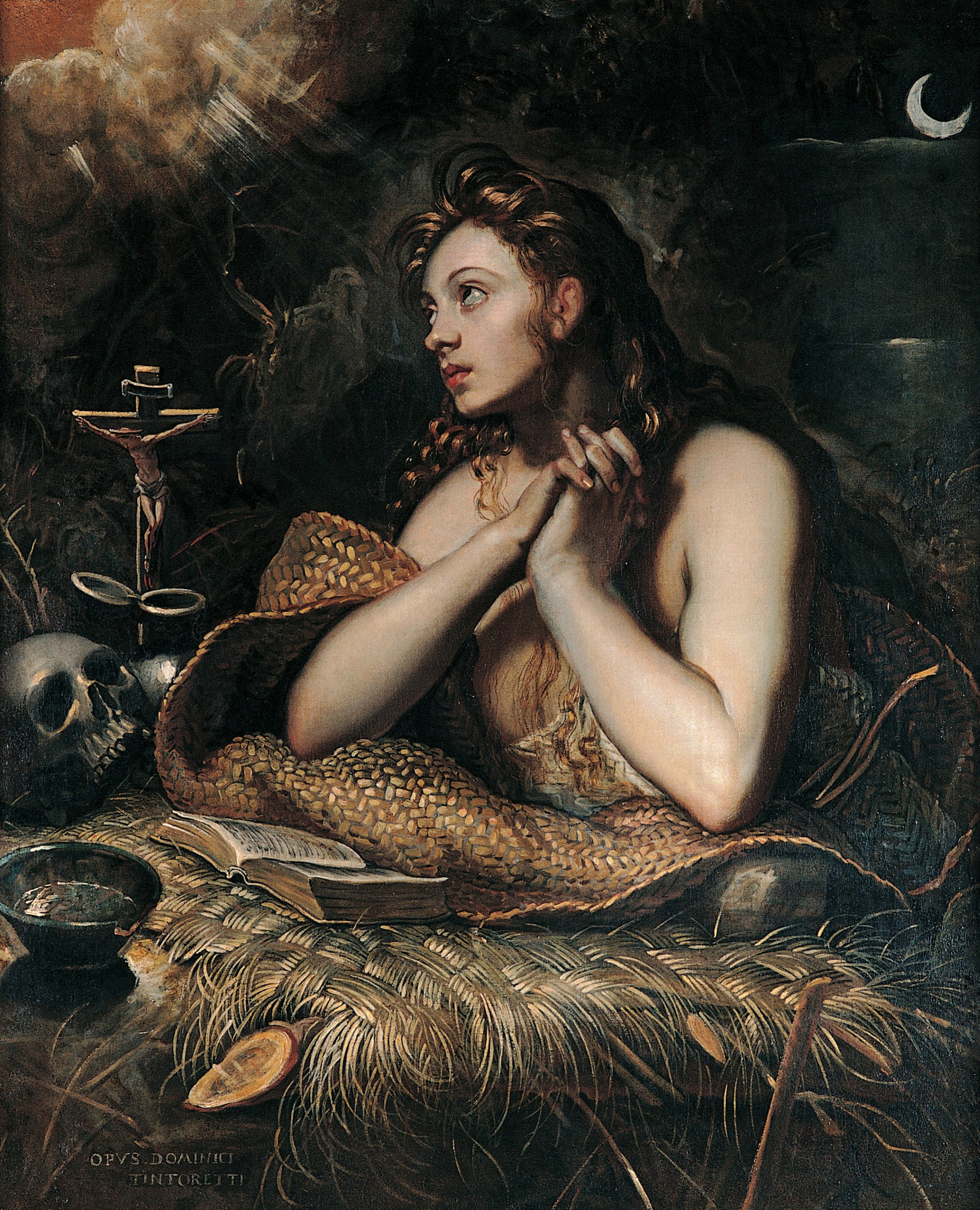
Mary Magdalene[a] (sometimes called Mary of Magdala, or simply the Magdalene, Magdalena or the Madeleine) was a woman who, according to the four canonical gospels, traveled with Jesus as one of his followers and was a witness to his crucifixion and resurrection.[1]
She is
mentioned by name twelve times in the canonical gospels,
more than most of the apostles and
more than any other woman in the gospels,
other than Jesus's family.
Mary's epithet Magdalene may be a toponymic surname, meaning that she came from the town of Magdala, a fishing town on the western shore of the Sea of Galilee in Roman Judea.
The Gospel of Luke chapter 8 lists Mary Magdalene as one of the women who traveled with Jesus and helped support his ministry "out of their resources", indicating that she was probably wealthy.
The same passage also states that seven demons had been driven out of her, a statement which is repeated from Mark 16.
In all the four canonical gospels, Mary Magdalene was a witness to the crucifixion of Jesus and, in the Synoptic Gospels, she was also present at his burial.
All the four gospels identified her, either alone or as a member of a larger group of women which includes Jesus's mother, as the first to witness the empty tomb,[1] and, either alone or as a member of a group, as the first to witness Jesus's resurrection.[2]
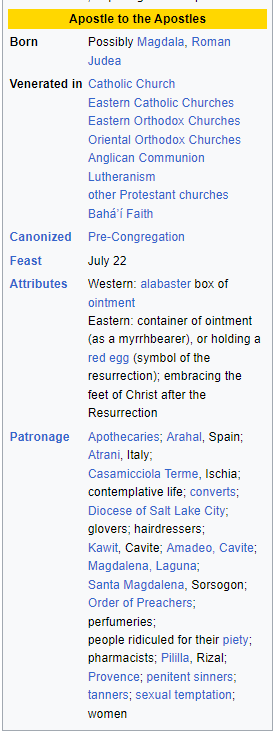
Mary Magdalene is considered to be a saint by the Catholic, Eastern Orthodox, Anglican, and Lutheran denominations.
In 2016, Pope Francis raised the level of liturgical memory on July 22 from memorial to feast, and for her to be referred to as the "Apostle of the apostles".[3]
Other Protestant churches honor her as a heroine of the faith.
The Eastern Orthodox churches also commemorate her on the Sunday of the Myrrhbearers, the Orthodox equivalent of one of the Western Three Marys traditions.
Erroneous portrayal of Mary Magdalene as a prostitute
The portrayal of Mary Magdalene as a prostitute began in 591, when Pope Gregory I conflated Mary Magdalene, who was introduced in Luke 8:2, with Mary of Bethany (Luke 10:39) and the unnamed "sinful woman" who anointed Jesus's feet in Luke 7:36–50.
Pope Gregory's Easter sermon resulted in a widespread belief that Mary Magdalene was a repentant prostitute or promiscuous woman.[1][4]
Elaborate medieval legends from Western Europe then emerged, which told exaggerated tales of Mary Magdalene's wealth and beauty, as well as of her alleged journey to southern Gaul (modern-day France).
The identification of Mary Magdalene with Mary of Bethany and the unnamed "sinful woman" was still a major controversy in the years leading up to the Reformation, and some Protestant leaders rejected it.
During the Counter-Reformation, the Catholic Church emphasized Mary Magdalene as a symbol of penance.
In 1969, Pope Paul VI removed the identification of Mary Magdalene with Mary of Bethany and the "sinful woman" from the General Roman Calendar, but the view of her as a former prostitute has persisted in popular culture.
Mary Magdalene's portrayal in Gnostic writings
Because she was the first to witness Jesus's resurrection, Mary Magdalene is known in some Christian traditions as the "apostle to the apostles".
She is a central figure in later Gnostic Christian writings, including the Dialogue of the Savior, the Pistis Sophia, the Gospel of Thomas, the Gospel of Philip, and the Gospel of Mary.
These texts portray her as an apostle, as Jesus's closest and most beloved disciple and the only one who truly understood his teachings.
In the Gnostic texts, or Gnostic gospels, Mary's closeness to Jesus results in tension with another disciple, Peter, due to her sex and Peter's envy of the special teachings given to her.
In the Gospel of Philip's text she is described as Jesus's companion, as the disciple Jesus loved the most and the one Jesus kissed on the mouth,[5] which has led some people to conclude that she and Jesus were in a relationship. Some fiction portrays her as the wife of Jesus.
Life[edit]
It is widely accepted among secular historians that, like Jesus, Mary Magdalene was a real historical figure.[6][7][8] Nonetheless, very little is known about her life.[9] Unlike Paul the Apostle, Mary Magdalene left behind no known writings of her own.[10] She was never mentioned in any of the Pauline epistles or in any of the general epistles.[11][12] The earliest and most reliable sources about her life are the three Synoptic Gospels of Mark, Matthew, and Luke, which were all written during the first century AD.[13][14][15]
During Jesus's ministry[edit]
 Photograph taken c. 1900 of al-Majdal, a village standing among the ruins of Magdala, Mary Magdalene's hometown[16][17][18]
Mary Magdalene's epithet Magdalene (ἡ Μαγδαληνή; literally "the Magdalene") most likely means that she came from Magdala,[16][17][b] a village on the western shore of the Sea of Galilee that was primarily known in antiquity as a fishing town.[16][19][20] Mary was, by far, the most common Jewish given name for girls and women during the first century,[16][c][21] so it was necessary for the authors of the gospels to call her Magdalene in order to distinguish her from the other women named Mary who followed Jesus.[16] Although the Gospel of Mark, reputed by scholars to be the earliest surviving gospel, does not mention Mary Magdalene until Jesus's crucifixion,[22] the Gospel of Luke 8:2–3[23] provides a brief summary of her role during his ministry:[24]
Soon afterwards he went on through cities and villages, proclaiming and bringing the good news of the kingdom of God. The twelve were with him, as well as some women who had been cured of evil spirits and infirmities: Mary, called Magdalene, from whom seven demons had gone out, and Joanna, the wife of Herod's steward Chuza, and Susanna, and many others, who provided for them out of their resources.
— Luke 8:1–3[25]
[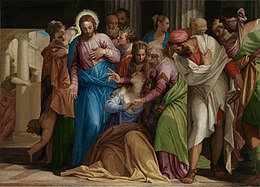 ](https://en.wikipedia.org/wiki/File:Paolo_Veronese,_The_Conversion_of_Mary_Magdalene.jpg)The Conversion of Mary Magdalene (c. 1548) by Paolo Veronese
According to the Gospel of Luke,[26] Jesus exorcised "seven demons" from Mary Magdalene.[27][28][29] That seven demons had possessed Mary is repeated in Mark 16:9,[30][31] part of the "longer ending" of that gospel – this is not found in the earliest manuscripts and is possibly a second-century addition to the original text, possibly based on the Gospel of Luke.[31][32] In the first century, demons were believed widely to cause physical and psychological illness.[33][27][28] Bruce Chilton, a scholar of early Christianity, states that the reference to the number of demons being "seven" may mean that Mary had to undergo seven exorcisms, probably over a long period of time, due to the first six being partially or wholly unsuccessful.[29]
Bart D. Ehrman, a New Testament scholar and historian of early Christianity, contends that the number seven may be merely symbolic,[28] since, in Jewish tradition, seven was the number of completion,[28] so that Mary was possessed by seven demons may simply mean she was completely overwhelmed by their power.[28] In either case, Mary must have suffered from severe emotional or psychological trauma for an exorcism of this kind to have been perceived as necessary.[27][28] Consequently, her devotion to Jesus resulting from this healing must have been very strong.[16][34][35] The Gospels' writers normally relish giving dramatic descriptions of Jesus's public exorcisms, with the possessed person wailing, thrashing, and tearing his or her clothes in front of a crowd.[36] By contrast, that Mary's exorcism receives little attention may indicate that either Jesus performed it privately or that the recorders did not perceive it as particularly dramatic.[36]
Since Mary is listed as one of the women who supported Jesus's ministry financially, she must have been relatively wealthy.[16][37] The places where she and the other women are mentioned throughout the gospels indicate strongly that they were vital to Jesus's ministry[38][39][40][41] and that Mary Magdalene always appears first, whenever she is listed in the Synoptic Gospels as a member of a group of women, indicates that she was seen as the most important out of all of them.[42][43][44] Carla Ricci notes that, in lists of the disciples, Mary Magdalene occupies a similar position among Jesus's female followers as Simon Peter does among the male apostles.[44]
That women played such an active and important role in Jesus's ministry was not entirely radical or even unique;[39][41] inscriptions from a synagogue in Aphrodisias in Asia Minor from around the same time period reveal that many of the major donors to the synagogue were women.[39] Jesus's ministry did bring women greater liberation than they would typically have held in mainstream Jewish society.[45][41]
The Fifth Gospel (Das fünfte Evangelium), first published in Germany in 1993, is a novel by Philipp Vandenberg.
The book deals with the discovery of a Coptic parchment that contains a gospel written by the son of Jesus and Mary Magdalene. The book was made famous by Dan Brown in his novel The Da Vinci Code, which was written 10 years later.
Donovan Joyce's novel The Jesus Scroll, first published in 1972, proposes that Jesus married Mary Magdalene and that at least one child was born of this union.
In 1982, this hypothesis was advanced again in Richard Leigh, Henry Lincoln and Michael Baigent's The Holy Blood and the Holy Grail. This book, Dan Brown writes, is one of the volumes in the library of Leigh Teabing, a character in Brown's The Da Vinci Code.
In 2012, the disclosure of the debated contents of the so-called "Gospel of Jesus' wife", written in Coptic and perhaps dating to the 2nd century, has brought to the forefront the issue of the alleged relationship between Jesus and Mary Magdalene.