Sekhmet
In Egyptian mythology, Sekhmet (/ˈsɛkˌmɛt/[1] or Sachmis /ˈsækmɪs/, from Ancient Egyptian: 𓌂𓐍𓏏𓁐, romanized: Saḫmat[2][3]; Coptic: Ⲥⲁⲭⲙⲓ, romanized: Sakhmi), is a warrior goddess as well as goddess of medicine.
Sekhmet is also a solar deity, sometimes given the epithet 'the eye of Ra'.
She is often associated with the goddesses Hathor and Bastet.
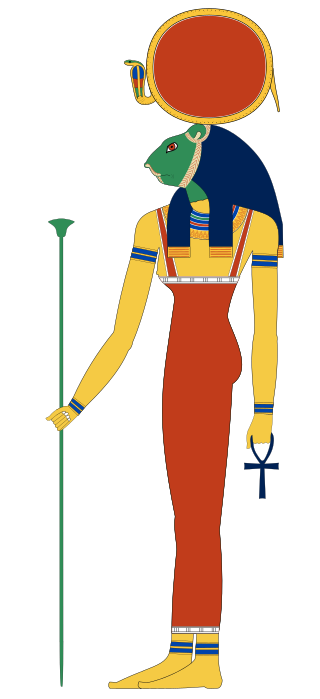
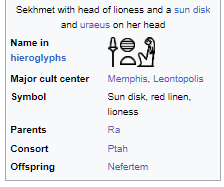
NOTE: ONLY ONE PARENT; NO MOTHER
Roles
Sekhmet is the daughter of the sun god, Ra, and is among the more important of the goddesses in the Egyptian Pantheon.
Sekhmet acted as the vengeful manifestation of Ra's power, the Eye of Ra.
Sekhmet is said to breathe fire, and the hot winds of the desert were likened to her breath.
She is also believed to cause plagues (which were described as being her servants or messengers) although she is also called upon to ward off disease and heal the sick.[4]

Wall relief of Sekhmet, Temple of Kom Ombo
In a myth about the end of Ra's rule on the earth, Ra sends the goddess Hathor, in the form of Sekhmet, to destroy mortals who conspired against him.
In the myth, Sekhmet's blood-lust was not quenched at the end of battle and this led to her going on a bloody rampage that laid Egypt to waste and almost destroyed all of humanity.
To stop her, Ra and the other gods devised a plan.
They poured out a lake of beer dyed with red ochre or so that it resembled blood.
Mistaking the beer for blood, Sekhmet drank it all and became so drunk that she gave up on the slaughter and returned peacefully to Ra.[5]
The same myth was also described in the prognosis texts of the Calendar of Lucky and Unlucky Days of papyrus Cairo 86637.[6]
| Part of a series on |
|---|
| Ancient Egyptian religion |
 |
In other versions of this story, Sekhmet grew angered at the deception and left Egypt, diminishing the power of the sun.
This threatened the power and security of the world—thus, she was persuaded by the god Thoth to return and restore the sun to its full glory.[7]
She was among the more important of the goddesses in Ancient Egypt due to her acting as the vengeful manifestation of Ra's power.
Sekhmet's feline attributes and her iconography sometimes makes it difficult to differentiate Sekhmet from other feline goddesses – mainly Bastet.
[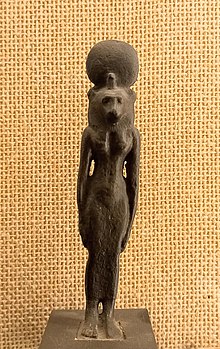 ]
Sekhmet, Albert Hall Museum, jaipur, India
Sekhmet was considered the wife of the god Ptah and mother of his son Nefertum.
She was also said to be the mother of the lion-headed war god, Maahes.
She was also considered to be the sister of the cat goddess Bastet.[8]
The lion-headed goddess Sekhmet is the most represented deity in most Egyptian collections worldwide.
Many amulets depict her image and her numerous statues abound in Egyptian art.
Many of her statues can be found in museums and archaeological sites, and her presence testifies to the historical and cultural importance of this goddess.