Torn Fibercap
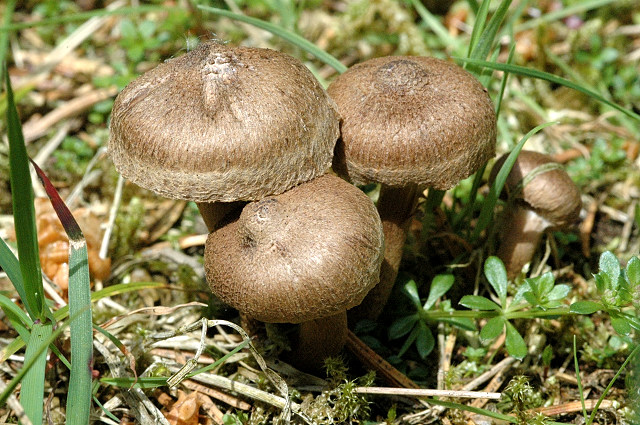
Inocybe lacera, commonly known as the Torn Fibercap, is a species of mushroom belonging to the family Inocybaceae. This species is notable for its distinctive appearance and its toxic properties.
Identification
Identifying Inocybe lacera involves examining several key characteristics:
Cap
- Shape: The cap is initially conical or bell-shaped, becoming more convex with age. It often has a pronounced umbo (a central bump).
- Size: Typically ranges from 2 to 5 cm in diameter.
- Color: The cap color varies from brown to grayish-brown, often with a fibrous or scaly surface that appears torn or lacerated, hence the name "lacera."
- Texture: The surface is dry and fibrous, with a tendency to crack or split as it matures.
Gills
- Attachment: The gills are adnexed to adnate, meaning they are broadly attached to the stem.
- Color: Initially white or pale, turning to a grayish-brown as the spores mature.
- Spacing: The gills are closely spaced.
Stem
- Size: The stem is slender, measuring 3 to 8 cm in length and 0.3 to 0.8 cm in thickness.
- Color: Similar to the cap, the stem is brownish and fibrous.
- Texture: The stem is often covered with fine fibrils and may have a bulbous base.
Spore Print
- Color: The spore print is brown, which is a common trait among Inocybe species.
Habitat
Inocybe lacera is commonly found in a variety of habitats, including:
- Woodlands: Prefers deciduous and mixed forests, often growing in association with hardwood trees like oak and beech.
- Grasslands: Can also be found in grassy areas, particularly those with rich, calcareous soil.
- Season: Fruiting typically occurs from late summer to autumn.
This species is mycorrhizal, forming symbiotic relationships with the roots of trees, which is crucial for nutrient exchange and soil health.
Toxicology
One of the most critical aspects of Inocybe lacera is its toxicity. This mushroom contains muscarine, a potent toxin that can cause severe symptoms if ingested.
Symptoms of Muscarine Poisoning
- Early Symptoms: Nausea, vomiting, abdominal cramps, and diarrhea.
- Later Symptoms: Excessive salivation, sweating, and tearing. In severe cases, it can lead to difficulty breathing, decreased heart rate, and even death if not treated promptly.
Treatment
Immediate medical attention is required for muscarine poisoning. Treatment typically involves the administration of atropine, an antidote that counteracts the effects of muscarine.
Ecological Significance
Despite its toxicity, Inocybe lacera plays a vital role in its ecosystem:
- Mycorrhizal Relationships: By forming mycorrhizal associations with trees, it helps in nutrient uptake, particularly phosphorus, which is essential for plant growth.
- Soil Health: Contributes to soil structure and fertility through the decomposition of organic matter.
- Biodiversity: Supports a diverse range of organisms, including insects and other fungi, by contributing to the complex web of forest floor interactions.