Yellow Toadflax
See also: Linaria (genus)
Profile
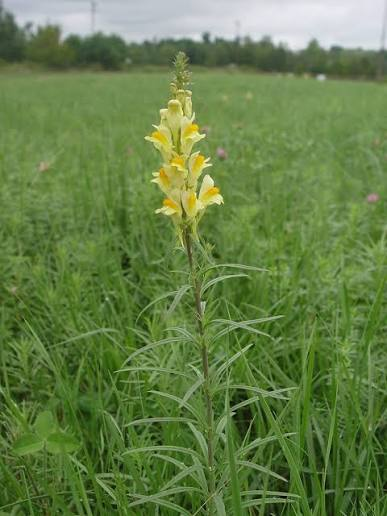
Identification cues
Scientific name: Linaria vulgaris Mill. (yellow toadflax; butter-and-eggs)
- Habit: Perennial herb, usually upright and somewhat bushy, commonly about 1–3 ft (30–90 cm) tall; spreads by creeping roots and rhizomes and may form colonies.
- Stems: Slender, erect, generally smooth, and often branched toward the upper portion; the plant may appear gray-green or blue-green from its narrow leaves.
- Leaves: Numerous, alternate, narrow, linear to lance-shaped, entire, and sessile (without obvious stalks); typically blue-green and somewhat thick or waxy. Leaves are usually arranged densely along the stems.
- Flowers: Bright yellow, two-lipped, snapdragon-like flowers borne in terminal racemes. The lower lip commonly shows an orange to orange-yellow spot or palate.
- Flower spur: Each flower has a conspicuous, slender, backward-pointing nectar spur; this is one of the most useful field marks.
- Blooming period: Generally late spring through fall, varying with climate and elevation.
- Fruit: A dry, rounded capsule that releases numerous small seeds.
- Habitat: Roadsides, fields, disturbed ground, pastures, gardens, waste places, and other open sunny sites; often associated with dry or moderately moist, well-drained soils.
Quick field check
Look for the combination of dense narrow blue-green leaves, yellow snapdragon-like flowers with an orange palate, and a long rear-pointing spur. A colony-forming habit from creeping underground roots further supports the identification.
Distinguishing cautions
- Do not identify the plant by flower color alone; compare the spur, orange palate, leaf shape, and growth habit together.
- Similar garden snapdragons (Antirrhinum spp.) have similar flower architecture but are generally broader-leaved and lack the characteristic yellow-toadflax combination of narrow blue-green foliage and long spur.
- Yellow toadflax can be invasive or noxious in some regions. Confirm identification with a current regional flora or herbarium resource before harvesting.
Medicinal uses
Medicinal Parts: the fresh or dried herb
Constituents
Iridoide monoterpenes; chief component - antirrhinoside
Flavonoids; including others linarin, pectolinarin, linariin (pectolinarigenin-7- rhamnoglucoside- acetate)
Arones; including among others aureusin, bracteatin-6- )- glucoside
Quinazoline alkaloids; peganine (vasicin)
Effects
The main active agents are the flavon glycosides linarin and pectolinarin, pectin, phytosterol, tannic acid, and vitamin C. It is anti-inflammatory. Diaphoretic and diuretic effects have been documented.
Uses
Used internally to aid digestion problems and urinary tract disorders. Externally, the herb is used for hemorrhoids, ablution of festering wounds, skin rashes, and ulcus cruris (leg ulcers)
Flowers are edible.
Prep & Dose
The powdered form and the extract are used as a diuretic and mild laxative (infusion). Externally its used as a poultice.
Infusion: 1 to 2 teaspoonfuls and 2 to 4 cups water.
Daily Dosage: drink the infusion throughout the day
Safety note
Traditional-use information is not a substitute for clinical evidence. Internal use and medicinal dosing should be approached cautiously, especially during pregnancy or breastfeeding, in children, with kidney or urinary disorders, or when taking medicines; seek qualified medical advice before use.