Titanium Dioxide
See also: Titanium Dioxide Nanoparticles
Titanium dioxide (TiO2) is a fine white powder that occurs naturally. It's also known as titanium(IV) oxide or titania.
Titanium dioxide is used as a white pigment in many products, including:
Paper, Ceramics, Rubber, Textiles, Paints, Inks, Cosmetics, Sunscreens, Plastics.
It may be found in muffins, queso and milk.
Titanium dioxide is the whitest and brightest of all known pigments. It's also used as a dye to help products achieve a certain appearance, including whitening a product.
The FDA considers titanium dioxide safe, but high intake could be harmful. It appears to have low skin penetration but inhalation is a concern.
Titanium dioxide doesn't penetrate healthy skin. Studies indicate that it doesn't damage or disturb the systematic functions of a human being. However, some experts have raised concerns about ultra-fine or nano-sized TiO2 particles that may seep into the human skin's deeper layers.
It is used in toothpaste to make it white.
(source)
A 2012 study sought to estimate how much titanium dioxide the average person consumed through their diet each day. These estimates varied widely depending on age. The average adult consumed around 0.5 milligrams of titanium dioxide per 1 kilogram of body weight. Toddlers consumed more than 1-2 milligrams per kilogram of body weight. Those were just the averages; they found some kids could consume several hundred milligrams per day which translates into 13 milligrams per kilograms of body weight or more.
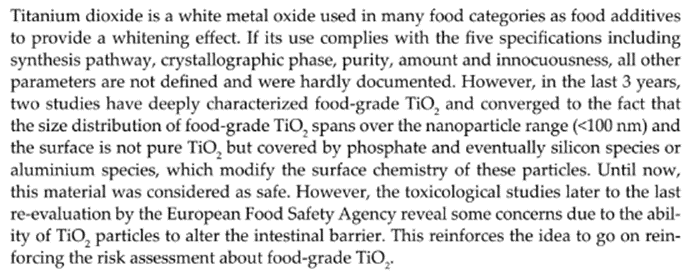
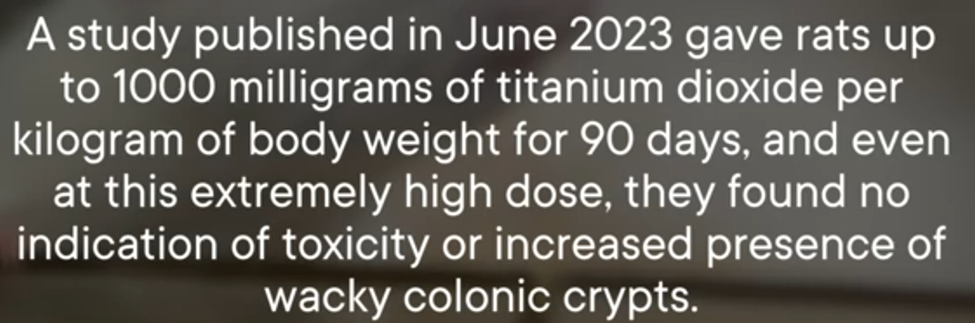
In 2017 a research team studied how eating titanium dioxide at 10 mg/kilogram affected rats. The good news, no lung cancer. Bad news, colon cancer. There were intestinal effects: increased presence of dendritic cells, decreased numbers of regulatory T-cells and fewer T helper cells resulting in increased inflammation. It decreased the amount of interferon gamma which helps kick the immune system into action when you get sick and inhibit tumor growth. Less interferon gamma means a less effective immune system. The titanium dioxide also made the gut environment a pre-cancerous cell nursery, damaging healthy cells while sparing the pre-cancerous cells. Other changes occurred as well. The intestines have small crevices called crypts, which are very important for the absorption of nutrients and water among other things. After exposure to titanium dioxide, rats developed aberrant crypts and lesions which can be an early warning sign for cancer.
Further studies showed it not only accumulates in the body but can damage DNA and compromise chromosomal integrity.
In May 2021, the European Food Safety Authority announced that titanium dioxide was no longer safe to consume as a food additive. Titanium dioxide is still legal for use in food in the U.S., but a European ban of titanium dioxide in food took effect in 2022.
The Environmental Defense Fund has officially petitioned the FDA to repeal the regulation that allows titanium dioxide.
In February 2023, California Assembly Bill 418 (AB 418) was introduced to ban four common food additives, including titanium dioxide (TiO2). The bill was nicknamed the "Skittles Ban" because it included TiO2, which is used to make the rainbow-hued candy.
The state Senate removed TiO2 from the list of banned additives and agreed to delay implementation of the bill until 2027. The FDA filed a color additive petition that proposes to repeal 21 CFR 73.575, which permits the use of titanium dioxide in food.
The FDA's stance that TiO2 is safe was the reason for its removal from the bill. The International Agency for Research on Cancer (IARC) has listed titanium dioxide as a Group 2B carcinogen, which means it may be carcinogenic but lacks sufficient animal and human research. Not all studies found the same health effects.
Safe alternatives to color foods white include calcium carbonate. Duncan donuts stopped using it.
Critical review of the safety assessment of titanium dioxide additives in food