Scratch Collapse Test
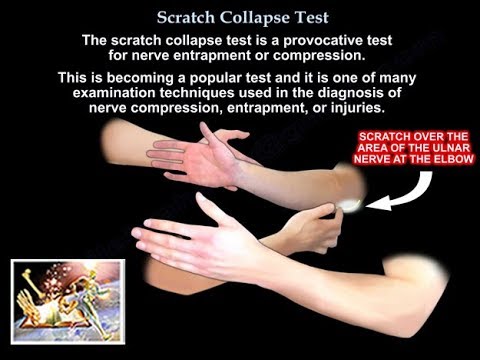
The Scratch Collapse Test (SCT) is a clinical diagnostic tool used primarily to identify nerve entrapment or compression syndromes. It is a relatively simple and non-invasive test that can be performed in a clinical setting to help pinpoint the location of nerve compression, particularly in cases where traditional diagnostic methods may not provide clear results. This test is often used in conjunction with other diagnostic techniques to confirm the presence of nerve entrapment.
Understanding Nerve Entrapment
Nerve entrapment, also known as nerve compression, occurs when a nerve is compressed or pinched by surrounding tissues such as bones, muscles, or tendons. This can lead to symptoms such as pain, tingling, numbness, or weakness in the affected area. Common conditions associated with nerve entrapment include carpal tunnel syndrome, cubital tunnel syndrome, and thoracic outlet syndrome.
The Mechanism of the Scratch Collapse Test
The Scratch Collapse Test is based on the principle of a temporary loss of muscle resistance following a light scratch or stroke over the skin above the suspected site of nerve compression. The test is performed as follows:
- Initial Muscle Resistance Test: The patient is asked to resist an external force applied by the examiner, typically by maintaining a specific arm or hand position.
- Scratch or Stroke: The examiner lightly scratches or strokes the skin over the area where nerve compression is suspected.
- Re-evaluation of Muscle Resistance: Immediately after the scratch, the examiner repeats the muscle resistance test. A positive result is indicated by a temporary collapse or weakening of the muscle resistance.
The temporary collapse in muscle resistance is thought to be due to a reflexive response triggered by the sensory input from the scratch, which temporarily disrupts the motor control of the affected muscle group.
Clinical Applications
The Scratch Collapse Test is particularly useful in diagnosing:
- Carpal Tunnel Syndrome: Compression of the median nerve at the wrist.
- Cubital Tunnel Syndrome: Compression of the ulnar nerve at the elbow.
- Radial Tunnel Syndrome: Compression of the radial nerve in the forearm.
- Thoracic Outlet Syndrome: Compression of nerves or blood vessels between the collarbone and the first rib.
The test can help localize the site of compression, which is crucial for planning appropriate treatment strategies.
Advantages of the Scratch Collapse Test
- Non-Invasive: The test does not require any special equipment or invasive procedures.
- Quick and Easy: It can be performed quickly in a clinical setting without causing discomfort to the patient.
- Cost-Effective: As it does not require expensive equipment or imaging, it is a cost-effective diagnostic tool.
- Complementary: It can be used alongside other diagnostic methods, such as nerve conduction studies or imaging, to provide a more comprehensive assessment.
Limitations and Considerations
While the Scratch Collapse Test is a valuable tool, it is not without limitations:
- Subjectivity: The test relies on the examiner's interpretation of muscle resistance, which can be subjective.
- Variability: Results can vary depending on the examiner's technique and the patient's response.
- False Positives/Negatives: There is a potential for false positive or negative results, which may lead to misdiagnosis if not corroborated with other findings.