Ackee
Constituents:
Range: Western and central tropical Africa - Senegal to Cameroon and Gabon.
THE ACKEE FRUIT (BLIGHIA SAPIDA) AND ITS ASSOCIATED TOXIC EFFECTS
Edibility:When fresh or roasted, the seeds and more especially their arils are considered a great delicacy. The seeds are a shiny jet-black,, 3 in each fruit. The aril of each seed is white and fleshy, with a high content of oil; and when cooked, is pleasantly nutty in flavor. The arils, because of their oil, easily go rancid. he tree was named after Captain Bligh, who brought it to Jamaica from Africa in 1793
Toxicity: For people who are undernourished or malnourished, the food parts mentioned above are dangerously poisonous, particularly arils of unripe fruits or those that are rancid. Two hypoglycemic factors have been isolated from the seeds and arils, and cause what is known as a "vomiting sickness," children being especially subject to it In most cases and usually within 12 hours, one or more periods of violent vomiting are followed by convulsions, coma and death. The most prominent finding is a severe hypoglycemia in the victims. Even though people in a normal state of health seem to have no problem with the plant, the dangers are too serious not to use great caution with it.
Wikipedia:
The ackee, also known as achee, ackee apple or ayee (Blighia sapida) is a member of the Sapindaceae (soapberry family), as are the lychee and the longan. It is native to tropical West Africa in Cameroon, Gabon, São Tomé and Príncipe, Benin, Burkina Faso, Ivory Coast, Gambia, Ghana, Guinea, Guinea-Bissau, Mali, Nigeria, Senegal, Sierra Leone and Togo. In Yorùbá it is known as íṣin.
The scientific name honours Captain William Bligh who took the fruit from Jamaica to the Royal Botanic Gardens in Kew, England in 1793 and introduced it to science. The common name is derived from the West African Akan akye fufo.
The fruit was imported to Jamaica from West Africa (probably on a slave ship) before 1778. Since then it has become a major feature of various Caribbean cuisines, and is also cultivated in tropical and subtropical areas elsewhere around the world.
Ackee is an evergreen tree that grows about 10 metres tall, with a short trunk and a dense crown.
The leaves are paripinnately compound,15–30 centimetres (5.9–11.8 in) long, with 6–10 elliptical to obovate-oblong leathery leaflets. Each leaflet is 8–12 centimetres (3.1–4.7 in) long and 5–8 centimetres (2.0–3.1 in) wide.
The inflorescences are fragrant, up to 20 cm long, with unisexual flowers that bloom during warm months.[5] Each flower has five greenish-white petals
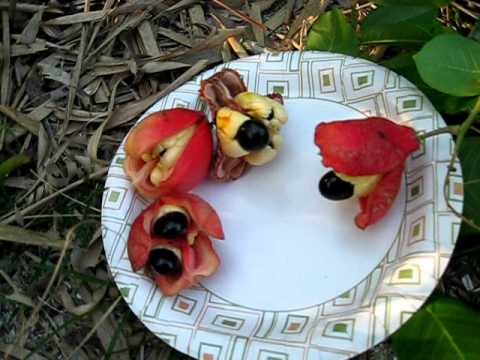
The fruit is pear-shaped. When it ripens, it turns from green to a bright red to yellow-orange, and splits open to reveal three large, shiny black seeds, each partly surrounded by soft, creamy or spongy, white to yellow flesh—the aril. The fruit typically weighs 100–200 grams (3.5–7.1 oz).
- Leaves, upper and lower surface.
- Inflorescence.
- Fruit as it splits upon ripening.
- Showing ripe fruit and seeds with their arils.
- Part of ripe fruit, two seeds with their arils still attached .
- Ripe seeds with their arils (dorsal view and in longitudinal section).
Cultivation and uses
See also: List of Jamaican dishes
Ackee and saltfish, a traditional Jamaican dish
Although native to West Africa, the use of ackee in food is especially prominent in Jamaican cuisine. Ackee is the national fruit of Jamaica, and ackee and saltfish is the national dish. Ackee and codfish is ranked number two in the world by National Geographic survey of national dishes. Recently, ackee wine has been introduced in Jamaica and though it has resulted in a majority of curious and adventurous Jamaicans gravitating towards the newly introduced product it still has not appealed to others.
Ackee was introduced to Jamaica and later to Haiti, Cuba, Barbados and others. It was later introduced to Florida in the United States.
Ackee pods should be allowed to ripen on the tree before picking. Prior to cooking, the ackee arils are cleaned and washed. The arils are then boiled for approximately 5 minutes and the water discarded. The dried seeds, fruit, bark, and leaves are used medicinally.
Toxicity
The unripened or inedible portions of the fruit contain the toxins hypoglycin A and hypoglycin B. Hypoglycin A is found in both the seeds and the arils, while hypoglycin B is found only in the seeds.[4] Hypoglycin is converted in the body to methylene cyclopropyl acetic acid (MCPA). Hypoglycin and MCPA are both toxic. MCPA inhibits several enzymes involved in the breakdown of acyl CoA compounds. Hypoglycin binds irreversibly to coenzyme A, carnitine and carnitine acyltransferases I and II reducing their bioavailability and consequently inhibiting beta oxidation of fatty acids. Beta oxidation normally provides the body with ATP, NADH, and acetyl CoA which is used to supplement the energy produced by glycolysis. Glucose stores are consequently depleted leading to hypoglycemia. Clinically, this condition is called Jamaican vomiting sickness. These effects occur only when the unripe fruit is consumed.
Economic importance
The ackee fruit is canned and is a major export product in Jamaica. In 2005, the ackee industry of Jamaica was valued at J$ 400 million (approximately $4.5 million in US). The importing of canned ackee into the U.S. has at times been restricted due to unripe ackee arilli being included. However, it is currently allowed, provided that the amount of hypoglycin present meets the standards of the Food and Drug Administration. In 2005, the first commercial shipments of canned ackee from Haiti were approved by the United States FDA for shipment to the US market.
A canning plant in Port-au-Prince, Haiti, is supplied with fruit from three commercial orchards on the outskirts of the city.
Articles/Studies
Hypoglycin A and B, two biologically active polypeptides from Blighia sapida