Caraway
See also: Carum (genus)
Videos

Overview
Part Used: the fruit
The root, when improved by culture, resembles the parsnip, and is used as food in Northern Europe
Caraway is a biennial plant, native to south-eastern Europe, and now grows in the wild and in cultivation all over Europe and temperate Asia. It is not native to Britain, and has become naturalized in the USA. It is an umbellifer, like cumin and coriander, and grows to about 60 cm (2 ft) in height. Its leaves are feathery, rather like carrot leaves (Umbelliferae is the carrot family), and umbels of white or pink small flowers are followed by the seed fruit. These are sickle-shaped and striped, the shape dictating the confusion with cumin (the tastes are essentially quite dissimilar). The plant self-seeds easily, and it is found wild in France in the Vosges, and in Alsace, near to Germany. It is cultivated for culinary use, particularly in Holland, Germany, Austria and Russia.
The name in English is thought to derive from the Arabic al-karwiya or al-karawiya, which became in Old Spanish alcarahueya. Because it is known as carvi in French, Lemery, a seventeenth-century botanist, decided that the name originated from the Carie province in Asia Minor where caraway was thought to originate (but that was probably cumin – the confusions are many). Another species exists, C. copticum or Ajowan, and this is used in Indian cooking and native medicine; the seeds are rich in thymol.
Fossilized caraway seeds have been found in Neolithic dwellings in Switzerland, and in Mesolithic sites, so it was in use up to 8,000 years ago. The Ancient Egyptians used the spice in religious ritual, and in cooking to make foods like bread and onions more digestible. Theophrastus recorded a recipe for oysters, eaten with caraway for the same reason; another culinary expert, Etimus, cooked lentils with caraway and thyme. The Romans ate caraway seeds after meals to sweeten their breath, and in cakes with other seeds to ease digestion. Caraway seeds are frequently offered after an Indian meal to sweeten the breath.
The School of Salerno and St Hildegarde considered caraway to be carminative, a stimulant, a diuretic, emmenagogic, galactagogic and stomachic.
It can be found growing wild in the United States. Look for it in the summer or fall. The height of the plant really helps pick it out from the surroundings. Mature wild caraway is going to be just about waist-height. There aren’t a lot of plants that have a mature height that barely comes to the waist, so remember that. When you’re looking for it to harvest the seeds, it’ll be brown, and luckily enough, the caraway seemed to go brown faster than the other plants in the area in the early summer. The height, relatively early browning, combined with the wavy, irregular umbels made them stick out like a sore thumb.
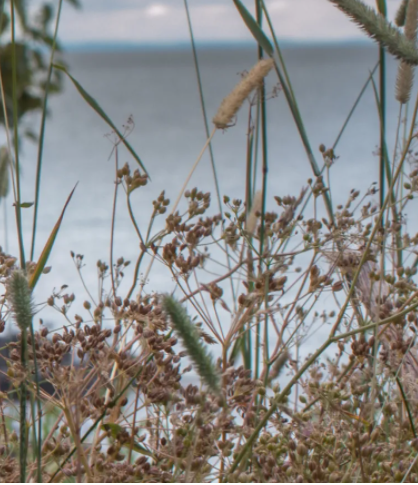
When the plants are mature, the seeds will fall off if you brush up against a plant. Take a paper grocery bag, or a bucket attached to the waist or belt. Grasp the stem gently, and bend it over the container, and gently shake the umbel or rub the seeds between your fingers to remove them. In the best patch, you can get about 2 cups of caraway seeds an hour like this.
Constituents:
In the berries: Volatile oil, fatty oil, polysaccharides, proteins, furocoumarins (traces)
In volatile oil: in particular D- (+)- carvone and D-(+)- limonene; carvone 45-50%, carvene 30%, limonene 20%),
tannins, resin, protein
Listing in Duke's Phytochemical Database
Effects
In animal tests it had a spasmolytic effect. The antimicrobial effect has been demonstrated against bacillus, pseudomonas, aspergillus and candida species; dermatomyces are also inhibited
Tissue State Relevance
Caraway is warming, aromatic, carminative, antispasmodic, antimicrobial, and antioxidant.
Its strongest tissue‑state relevance is:
- Cold / Depression — strongest
- Damp / Stagnation — strong
- Wind / Tension — moderate
- Heat / Excitation — moderate (when heat = inflammation or infection)
- Dry / Atrophy — low
Grounded Pharmacology
- Essential oil rich in carvone and limonene (dominant monoterpenes) MedCrave online
- Broad‑spectrum antimicrobial activity against Gram‑positive and Gram‑negative bacteria MedCrave online
- Strong antioxidant activity (free‑radical scavenging, enzyme modulation) MedCrave online
- Traditional use as carminative, appetizer, galactagogue, and for indigestion, pneumonia, IBS, anti‑colic pmc.ncbi.nlm.nih.gov
- Demonstrated antihyperlipidemic, hepatoprotective, anticancer actions in Unani and modern pharmacology ijfmr.com
These actions define its tissue‑state relevance.
Tissue‑State Mapping
1. Cold / Depression — strongest relevance
Signs: cold gut, sluggish digestion, low metabolic tone, dull pain.
Why:
- Caraway is a warming aromatic; carvone and limonene stimulate digestive secretions and circulation.
- Traditional use as carminative, appetizer, anti‑colic, and for functional dyspepsia reflects warming activation of cold/depressed GI tissues. pmc.ncbi.nlm.nih.gov
Interpretation:
Caraway warms and activates cold, stagnant digestive tissues.
2. Damp / Stagnation — strong relevance
Signs: bloating, gas, sluggish gut, microbial overgrowth, heaviness.
Why:
- Broad‑spectrum antimicrobial activity reduces damp microbial load. MedCrave online
- Traditional use for indigestion, IBS, anti‑colic, and anti‑obesity formulas indicates movement of damp stagnation. pmc.ncbi.nlm.nih.gov
- Hepatoprotective and antihyperlipidemic actions support metabolic flow. ijfmr.com
Interpretation:
Caraway dries dampness and moves stagnation, especially in the GI tract.
3. Wind / Tension — moderate relevance
Signs: spasms, cramping, gripping pain.
Why:
- Carminative aromatics reduce smooth‑muscle spasm and gas‑related tension.
- Clinical use for IBS symptom relief (topical caraway oil) reflects antispasmodic action. pmc.ncbi.nlm.nih.gov
Interpretation:
Caraway relaxes tension when it is digestive and gas‑driven.
4. Heat / Excitation — moderate relevance
Signs: inflammatory irritation, mild infection, oxidative stress.
Why:
- Strong antioxidant activity (phenolics, flavonoids) reduces inflammatory excitation. ijfmr.com
- Antimicrobial effects help clear infectious heat. MedCrave online
Interpretation:
Caraway cools inflammatory heat, but is not a strongly cooling herb.
5. Dry / Atrophy — low relevance
Signs: dryness, thin tissues, chronic depletion.
Why:
- Caraway is aromatic, drying, and stimulating, not moistening or trophorestorative.
- Antioxidants offer protection but not rebuilding. ijfmr.com
Interpretation:
Useful only when atrophy is secondary to stagnation or inflammation.
Summary Table
| Tissue State | Relevance | Why |
|---|---|---|
| Cold / Depression | Strongest | Warming aromatic; carminative; stimulates digestion |
| Damp / Stagnation | Strong | Antimicrobial; anti‑colic; metabolic‑moving |
| Wind / Tension | Moderate | Antispasmodic; reduces cramping and gas |
| Heat / Excitation | Moderate | Antioxidant; antimicrobial |
| Dry / Atrophy | Low | Not moistening; only protective |
USES
Approved by Commission E:
- Dyspeptic compliaints
Used for gastrointestinal cramps, flatulence and feelings of fullness, as well as nervous cardiac-gastric complaints. In folk, medicine, Caraway is used to improve lactation in nursing mothers, as an emmenagogue, and to settle the stomach. The essential oil is used as constituent in mouthwashes and bath additives.
This herb is virtually identical with Fennel, in its nature, functions and uses with the following differences:
- Caraway has more emphasis for treating the stomach and intestines with its antispasmodic, stimulant, antifermentative and carminative properties. It is stronger than Anise or Fennel for intestines Qi constraintand *intestines damp cold*syndromes.
- Caraway essential oil is used externally as antiparasiticin parasitic skin conditions;and treats injuries, contusions, etc. with swelling and pain
- Caraway is less strong than Fennel in treating the varieties of urinary complaints
The Physiomedical Dispensatory by William Cook, M.D., 1869
The seeds are much used by cooks and confectioners, and are the medicinal part. They contain from four and a half to five percent of volatile oil, on which their properties depend. This oil is nearly colorless, when new; but age turns it pale yellow, and finally reddish brown. It is obtained by distillation, is lighter than water, and is freely dissolved by alcohol.
Properties and Uses: The oil, or its alcoholic solution, is a pleasant aromatic adjuvant to cathartics of a griping nature. It is a good carminative in colics and flatulence, but is seldom employed alone. Dose, one to five drops. The oil may be prepared into a medicated water; or the seeds may be infused.
Preparations/Dose
Caraway's full potential can only unfold when its essential oil is used. This is taken internally or massaged into the skin over the affected part externally with a base oil. A poultice should be used for external injuries or parasites.
Infusion of crushed fruits; 1 tsp per cup of water
Daily Dosage: The average single dose of oil is 2 to 3 drops on sugar; caraway, 1 to 5 gm. The average daily dose of oil is 3 to 6 doprs; caraway, 1.5 to 6 gm
Culinary
ROOT
Very small, but it has the same aromatic components that the seeds do. You can use it to infuse an aquavit made with the whole caraway plant. See that below.
LEAVES
To be used like carrot leaves. The flavor is mild, and reminiscent of garden carrot leaves. It doesn’t taste strong like the seeds, its more vegetal. These need to be cooked to become soft, like you would carrot leaves. These are what is used to make the traditional Karvekalsuppe, or Norwegian caraway soup.
MATURE SEED
The caraway we know and love. You can use them just like caraway from the store. Dehydrate it after picking.
GREEN SEED
Just like coriander, the seeds of caraway are great fresh, and can be used with a little heavier hand (a little) than the mature seeds. I like to preserve them in brine and hold in the cooler for preservation. A solution of 5% brine (5% grams of salt for every 5 grams of water) worked well, afterwords they can be dried off and sprinkled on things, with an intense flavor similar to fresh. Excellent with raw meat and cured fish, especially lox.
Source: Forager Chef