Dermal Tissue System

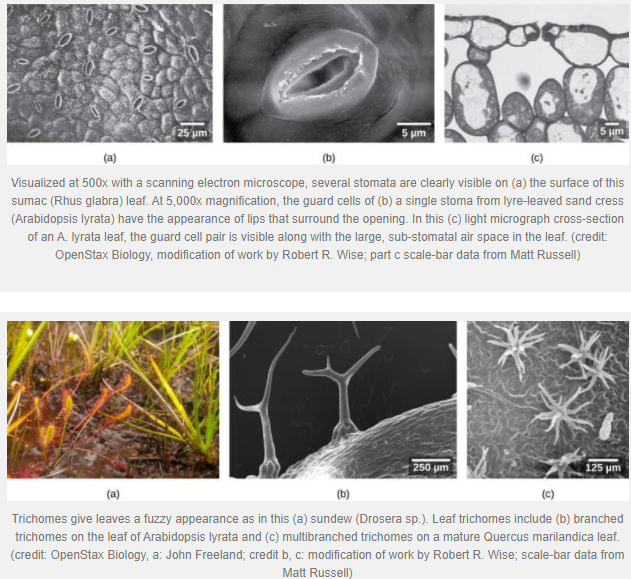
Dermal tissue covers and protects the plant, and controls gas exchange and water absorption (in roots). Dermal tissue of the stems and leaves is covered by a waxy cuticle that prevents evaporative water loss. Stomata are specialized pores that allow gas exchange through holes in the cuticle.
Dermal Tissue Cells:
- Epidermal cells
- Stomata or more accurately, guard cells
- Trichomes
The outer layer of tissue surrounding the entire plant is called the epidermis, usually comprised of a single layer of epidermal cells which provide protection and have other specialized adaptations in different plant organs.
In the root, the epidermis aids in absorption of water and minerals. Root hairs, which are extensions of root epidermal cells, increase the surface area of the root, greatly contributing to the absorption of water and minerals.
In the stem and leaves, epidermal cells are coated in a waxy substance called a cuticlewhich prevents water loss through evaporation. The cuticle is NOT present on root epidermis and is the same as the Casparian strip, which is present in the roots. To permit gas exchange for photosynthesis and respiration, the epidermis of the leaf and stem also contains openings known as stomata(singular: stoma). Two cells, known as guard cells, surround each leaf stoma, controlling its opening and closing and thus regulating the uptake of carbon dioxide and the release of oxygen and water vapor. Stems and leaves may also have trichomes, hair-like structures on the epidermal surface, that help to reduce transpiration (the loss of water by aboveground plant parts), increase solar reflectance, and store compounds that defend the leaves against predation by herbivores.