Bogbean / Bog Bean
At Risk
See also Menyanthes (genus)
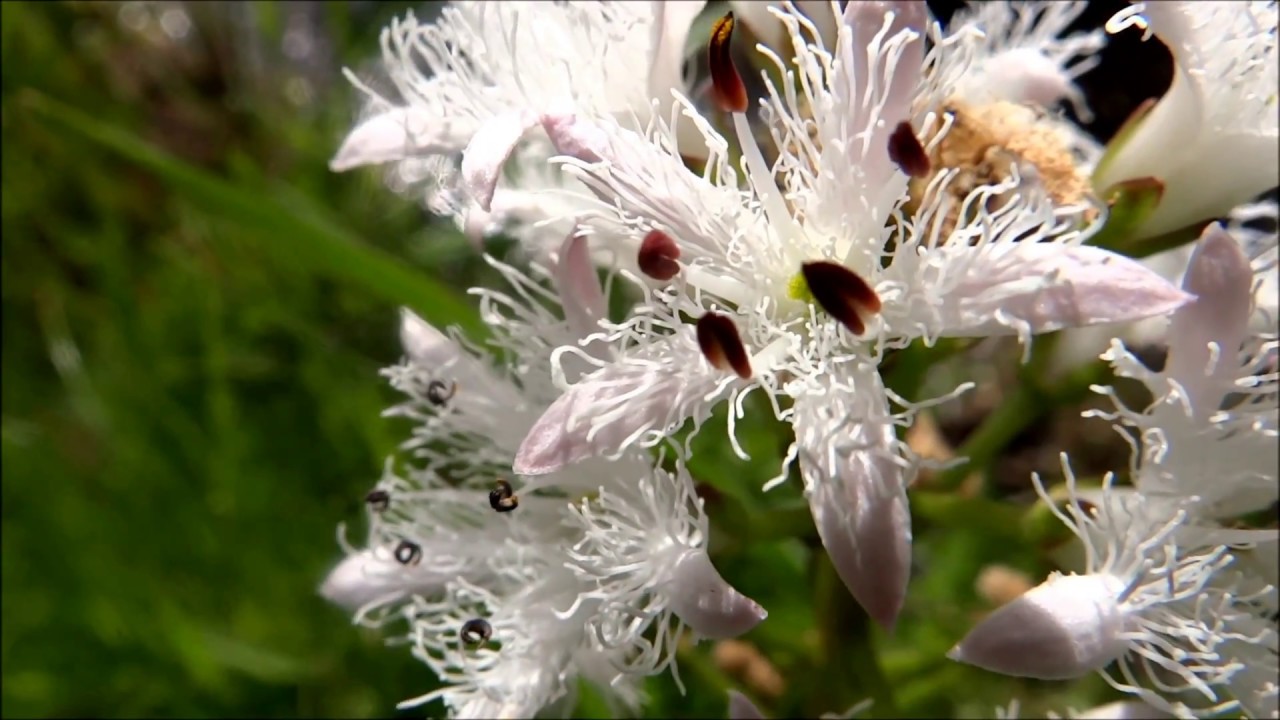
It is considered to be a diagnostic species for a type of wetland called a fen—what most people would disregard as a swamp. Its distribution includes Asia, Europe and North America, and it plays a role in stabilizing the soil with its thick roots and cleaning the water (as many wetland species do) in these habitats. It has trifoliate leaves (like a clover) and erect racemes of white flowers, which are beautiful with their “fuzziness”. The Buckbean is rarely used as a famine food, as it has a very acrid taste which needs treated before making palatable enough to eat through cooking, drying, grinding, washing and other methods. Its bitterness has also been used as a flavoring, however, as it has sometimes been used as a substitute for hops for making beer and also for the characteristic flavor in schnapps. In fact, Buckbean leaves are considered GRAS in the USA as a flavoring
Part used: the leaf
Constituents:
*Iridoide monoterpenes; *chief components 7', 8'-dihydrofoliamenthin, additionally including among others sweroside, loganin, menthiafolin, folionmenthin
Pyrridine alkaloids: (gentianin, gentialutin, etc.),
Flavonoids: including among others rutin, hyperoside, hyperin, trifolin
bitter glycoside menyanthin
Hydroxycoumarins: scopoletin
Caffeic acid derivatives
Triterpene glycosides: lupeol, beta-amyrenol, betulin, betulinic acid, alph-spinasterol, stigmast-7-enol
Also cholin, trifolioside, phytosterin, essential oil, ceryl alcohol, carotene, ascorbic & other acid, tannins, acids, saponins, glucosides, fatty oil with palmitinic acids, manganese, iodine
Effects
The drug stimulates saliva and gastric juice secretion. Anantimicrobial effect has been demonstrated in vitro.
Qualities: very bitter, cold, dry; stimulating, restoring, sinking movement
Tropism;l iver, gall bladder, lungs, intestines, kidneys
Ground: Sanguine krasis; Charming/Yang Ming Earth biotypes, Hematic/Sulphuric/Brown Iris & Mixed/Phosphoric/Grey
Uses
Approved by Commission E
- Dyspetic complaints
- Loss of appetite
The Buckbean is also a bitter that is related to one of the main famous bitter herbs called Gentian. It is used in a similar way, as a digestive, carminative, astringent, anti-inflammatory, stomachic, and tonic. However, it may also have a cathartic effect and cause vomiting, especially if used fresh instead of dried. It is used herbally, usually in combination with other herbs for conditions associated with weight loss and lack of vitality, but not for people with diarrhea. The Buckbean is also known in traditional Chinese medicine (TCM) as one of the “sleeping herbs”, or “herbs that calm consciousness”, and used in states of insomnia and restlessness.
Chinese Medicine: Insomnia, weak stomach and intestines, spleen disorders, intermittent fever, headache, breathing difficulties, amenorrhea, ear ache, jaundice, edema, gout, scabies and furuncles are among the applications.
1. CLEARS HEAT, TRANSFORMS DAMP AND RESOLVES FEVER; PROMOTES BOWEL MOVEMENT AND REMOVES STAGNANCY; DREDGES THE LIVER AND GALLBLADDER, PROMOTES BILE AND LYMPH FLOW
liver & gallbladder damp heat with headache, nausea, painful flanks, lymph swelling
MIGRAINE after meals
REMITTENT FEVER in the Shao Yang stage
liver Qi stagnation with constipation, jaundice, water retention
intestines Qi stagnationwith chronic constipation
INTESTINAL PARASITES
2. DREDGES THE KIDNEYS, PROMOTES URINATION AND CLEANSING, CLEARS TOXINS AND BENEFITS THE SKIN; STIMULATES THE UTERUS AND PROMOTES THE MENSES
liver Qi stagnation & general toxemia with skin eruptions
CHRONIC RHEUMATISM
fire toxin with sores, boils, abscesses, feverishness
uterus Qi stagnation with delayed or stopped menstruation
3. STIMULATES THE LUNGS AND EXPELS PHLEGM; OPENS THE CHEST AND RELIEVES WHEEZING
lung phlegm damp with copious thin white phlegm, wheezing
WHEEZING & ASTHMATIC BREATHING in all conditions
4. RESTORES THE STOMACH AND INTESTINES/SPLEEN, AWAKENS THA APPETITE AND RESTORES STRENGTH
Spleen Qi deficiency with fatigue, no appetite, colic, gas
EXHAUSTION due to overwork, anemia, fever, chronic illness, etc.
Physio-Medical Therapeutics, Materia Medica and Pharmacy BY T. J. LYLE, A.M.M. 1897
The herb is a mild, stimulating tonic, influencing the secernents and glandular system. Large doses are somewhat nauseating but are thoroughly hepatic and cholagogue. It also increases the flow of urine. In its way it is valuable as an antiperiodic and an alterative. It cleanses the secernents and relieves the glandular system generally. It will be found useful in scrofula or where there is any impurity in the blood current. It is also quite useful in rheumatism, scurvy, skin diseases, and dropsy, where hepatic, alternative, diuretic and tonic influences are needed to be thoroughly felt.
The Physiomedical Dispensatory by William Cook, M.D., 1869
Properties and Uses: The root of buck-bean is relaxing and stimulating, of the tonic character– the stimulating property predominating. Its action is allied to that of the gentiana ochroleuca, but is not so intense. Its main influence is expended on the glandular structures, promoting the flow of bile and urine, acting fairly on the bowels and skin, and in large quantities sometimes proving emetic, as boneset does. The principal use made of it is as a tonic in company with alterants for such maladies as dropsy, scrofula, jaundice, and general biliousness. Considerable doses will so effectually purge the liver, gall cyst, and bowels, at the same time sustaining the strength and the outward circulation, that it is a quite popular remedy for intermittents through Michigan and other sections where it abounds, and was formerly in much repute in Europe. The article deserves more attention than has recently been paid to it by the profession. Dose of the powder, as a tonic and gentle hepatic laxative, five to ten grains three times a day. Water and diluted alcohol extract its virtues; and it is probable that a fluid extract would be an excellent preparation. The solid extract in doses of five grains, is still valued highly as an antiperiodic, in Germany.
It seems almost superfluous to put stress upon the use of any agent in ague, for which almost every person has a “sure cure.” The buck-bean, however, is worthy of investigation; for while it is not an antiperiodic in the sense of cinchona, it sustains the liver, spleen, and portal circulation to decided advantage in those cases where bark and its preparations cause too great cerebral excitement.
NOTES -- HOLMES
The names of this plant, so descriptive of its preference for damp, boggy places as they are, belie any therapeutic uses of Bogbean in conditions of fluid imbalance. An exception Bogbean may be, but it shows that one has to proceed carefully, and not literally, when making therapeutic inferences from an herb's geographic or cosmic formative environment. When trying to understand plants in this light, energetic and functional considerations should always be foremost; and literal transpositions of meaning from a plant's formative potential to its actual substance are simplistic and naive. Too many plants have already suffered misinterpretation in this way.
Bogbean should be seen in first place as a cooling, cleansing, detoxifying remedy with an overall draining function. One of its main names is Fever trefoil (Fieberklee in German), after all. According to all traditional texts, clearing heat caused by stagnant phlegm, bile and lymph, and the concomitant toxemia is where it excels. As with Wormwood, conditions of liver damp heat, fire toxin and other liver-spleen-intestinal obstructions are removed through its energetic downward-moving bitter pungent activities (the result of glycosides, alkaloids and essential oils acting in concert). Cleansing is also carried out on the kidney-blood level, but how far this extends into the interstitial level for rheumatic complaints, as with its bitter cousin, Dandelion, remains a moot point. Definitely the entire lymphatics are drained and lung and uterine elimination stirred to action. As a lung remedy with stimulant expectorantand anti-asthmatic properties, Bogbean has much in common with Shi gan, rhizoma Belamcandae, from the Chinese materia medica. Both are used for lung phlegm and fire toxin syndromes.
Taken small quantities, Bogbean serves as a bitter stimulating tonic,a Spleen Qi tonic in other words. Its bitter glycosides, although not as intense as those found in Gentian, Wormwood and Centaury, nevertheless ensure effective digestive stimulation on the liver-stomach axis, generating systemic strengthening results.