Bergapten
Bergapten (5-methoxypsoralen) is a psoralen (also known as furocoumarins) found in bergamot essential oil, in other citrus essential oils, and in grapefruit juice. It is the chemical in bergamot oil that causes phototoxicity. Bergapten-free bergamot essential oil or synthetics are now used in perfumery.
Bergapten exerts inhibitory effects on diabetes-related osteoporosis.
In Grapefruit juice, bergapten and its derivatives have been found to inhibit a number of cytochrome p-450 enzyme isoforms including CYP3A4, CYP2D6, and cYP2C9. The flavonoid co-constituent naringenin and its glycoside naringen are also known to inhibit a number of other CYP isoforms. If a person is taking pharmaceuticals which are broken down by any of these specific enzymes, they may be advised to avoid drinking grapefruit juice so that excessive levels of the drugs do not accumulate in the body. On the other hand, the furanocoumarins in Grapefuit juice have therapeutic potential: they have demonstrated significant antibacterial activity, inhibiting pathogenicity and the formation of biofilms by species including Escherichia coli, Salmonella typhimurium, and Pseudomonas aeruginosa. In addition, pharmaceutical-grade furanocoumarins including xanthotoxin (synonym: 8-methoxypsoralen) and bergapten (synonym: 5-methoxypsoralen) have been used along with UV-A light as a treatment for severe psoriasis and vitiligo (PUVA therapy – the P stands for psoralens). (-Ganora)
Actions
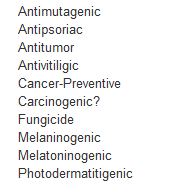
Human Biological Effects
Bergapten (also known as 5-methoxypsoralen or 5-MOP) is a natural linear furanocoumarin structurally related to bergamottin. It occurs widely in members of the Rutaceae and Apiaceae families—particularly in bergamot oil, limes, parsnips, and celery.
1. Photosensitization and PUVA Interaction
- DNA Intercalation & Cross-Linking: Bergapten is a potent photosensitizing agent. When absorbed into human tissues and exposed to long-wave ultraviolet light (UVA, 320–400 nm), bergapten intercalates into the double helix of cellular DNA.
- Covalent Adducts: Upon UVA photon absorption, it forms covalent monoadducts and interstrand cross-links with pyrimidine bases (specifically thymine and cytosine), temporarily halting DNA replication and cellular mitosis. Historically and clinically, this mechanism underpins its application in photochemotherapy (PUVA therapy) for hyperproliferative skin disorders like severe psoriasis and vitiligo.
2. Phototoxicity and Dermal Erythema
- Inflammatory Cascade: Uncontrolled dermal exposure to bergapten-rich plant oils (such as expressed bergamot or lime oil) followed by sunlight triggers acute phototoxic dermatitis (often called phytophotodermatitis or "berloque dermatitis"). This manifests as painful erythema, blistering, and subsequent hyperpigmentation due to light-induced melanocyte stimulation.
3. Enzyme Inhibition & Xenobiotic Metabolism
- CYP450 Suppression: Like bergamottin, bergapten acts as an inhibitor of several human cytochrome P450 enzymes (including CYP2A6 and CYP3A4 isoforms), impacting the hepatic and intestinal clearance of co-administered drugs.
4. Anti-Inflammatory and Anticancer Properties
- Signaling Modulation: In experimental settings, bergapten demonstrates anti-inflammatory activity by suppressing pro-inflammatory cytokines (such as TNF-\(\alpha\) and IL-1\(\beta\)) and modulating cellular antioxidant defenses (protecting neural or peripheral tissues from specific neurotoxic insults).
- Antiproliferative Actions: It exhibits tumor-suppressive properties in various human cancer models—including estrogen receptor-alpha (ER\(\alpha\)) breast cancer cells—by downregulating survival signals and inhibiting aberrant cellular proliferation.
Solubility Profile
- Aqueous Insolubility: Bergapten is lipophilic (fat-soluble) and highly hydrophobic. Its solubility in pure water is extremely low—roughly $\sim$5 \(\mu\)g/mL (or less than \(1\text{ mg/mL}\) in cold or boiling water), rendering plain water completely ineffective for extracting or dissolving significant amounts.
- Organic & Alcohol Solubility: It dissolves moderately in absolute ethanol (roughly 1 part in 60) and readily partitions into polar organic solvents such as chloroform, benzene, glacial acetic acid, acetone, and fixed plant oils.
Studies
- Content of CYP3A4 inhibitors, naringin, naringenin and bergapten in grapefruit and grapefruit juice products
- The pharmacokinetics, bioavailability and excretion of bergapten after oral and intravenous administration in rats using high performance liquid chromatography with fluorescence detection.
Allergies
Antifungal
Genotoxicity of bergapten and bergamot oil in Saccharomyces cerevisiae
Cancer
- Bergapten inhibits liver carcinogenesis by modulating LXR/PI3K/Akt and IDOL/LDLR pathways.
- Bergapten drives autophagy through the up-regulation of PTEN expression in breast cancer cells.
- Bergapten induces ER depletion in breast cancer cells through SMAD4-mediated ubiquitination.
- Breast cancer cell survival signal is affected by bergapten combined with an ultraviolet irradiation.
Gastrointestinal Effects
Protective effect of bergapten in acetic acid-induced colitis.
Neuroprotective
Osteoarthritis
Bergapten alleviates osteoarthritis by regulating the ANP32A/ATM signaling pathway.
Osteoporosis
- Methoxsalen and Bergapten Prevent Diabetes-Induced Osteoporosis by the Suppression of Osteoclastogenic Gene Expression in Mice.
- Bergapten prevents lipopolysaccharide mediated osteoclast formation, bone resorption and osteoclast survival.
- Bergapten exerts inhibitory effects on diabetes-related osteoporosis via the regulation of the PI3K/AKT, JNK/MAPK and NF-kappaB signaling pathways in osteoprotegerin knockout mice.
Psoriasis
5‐Methoxypsoralen (Bergapten) in photochemotherapy of psoriasis