Aggrenox
Used to reduce risk of stroke:

Aggrenox generic substitute Plavix vs Aggrenox

Aggrenox or Dipyridamole & Aspirin Information (dosing, side effects, patient counseling)

Aspirin/Dipyridamole (Aggrenox) Oral Capsule Counseling
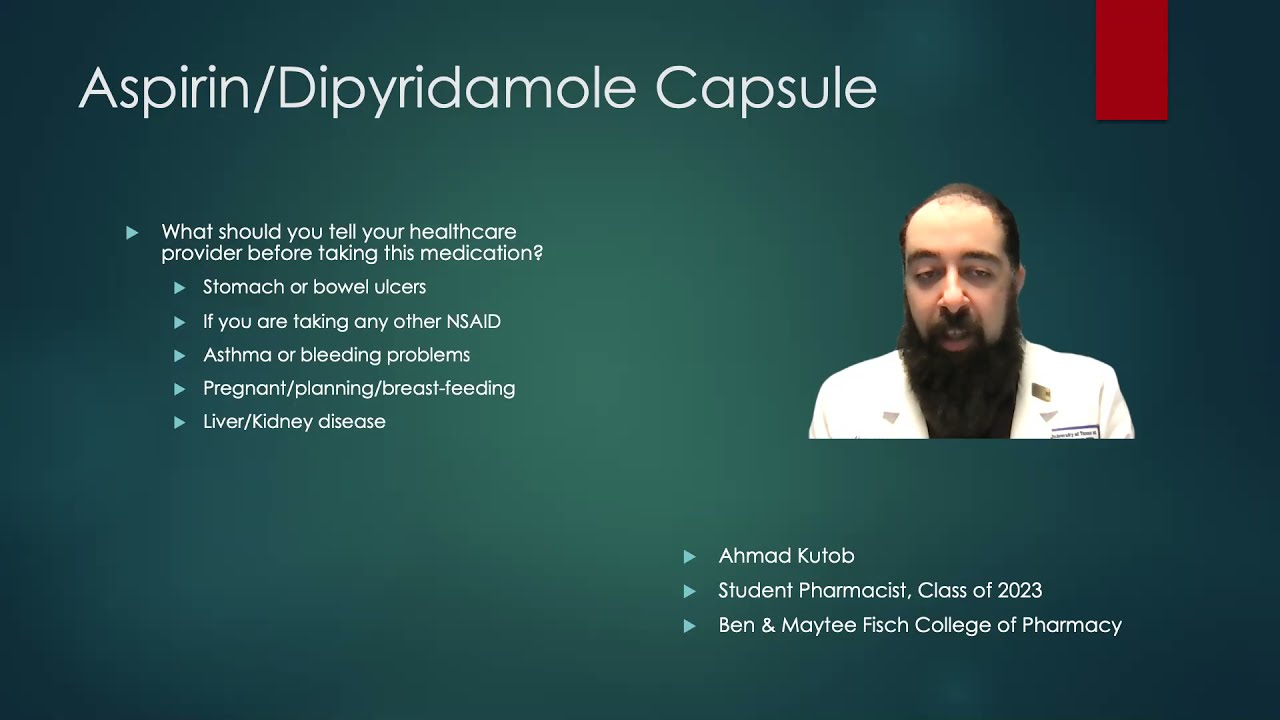
Aggrenox contains a combination of aspirin and dipyridamole. Aspirin belongs to a group of drugs called salicylates (sa-LIS-il-ates). It works by reducing substances in the body that cause pain, fever, and inflammation.
Dipyridamole keeps platelets in your blood from sticking together to form clots.
Aggrenox is used to reduce the risk of stroke in people who have had blood clots or a "mini-stroke" (also called a transient ischemic attack or TIA).
Aggrenox is supplied as a capsule containing 200mg dipyridamole in extended-release pellets and a round white tablet incorporating immediate-release aspirin 25mg.
Important information
You should not use Aggrenox if you have asthma or polyps in your nose, or if you are allergic to aspirin or an NSAID (nonsteroidal anti-inflammatory drug).
Aggrenox can increase your risk of bleeding, which can be severe or life-threatening. Call your doctor or seek emergency medical attention if you have bleeding that will not stop, if you have black or bloody stools, or if you cough up blood or vomit that looks like coffee grounds.
Do not use any other over-the-counter pain medication without first asking your doctor or pharmacist. Aspirin, salicylates, and NSAIDs (non-steroidal anti-inflammatory drugs) are contained in many medicines available over the counter. If you take certain products together you may accidentally take too much of a certain type of drug. Read the label of any other medicine you are using to see if it contains aspirin, ibuprofen, naproxen, ketoprofen, magnesium and/or choline salicylate. Aspirin should not be given to a child or teenager who has a fever, especially if the child also has flu symptoms or chicken pox. Aspirin can cause a serious and sometimes fatal condition called Reye's syndrome in children.
Avoid drinking alcohol while you are taking Aggrenox. Alcohol may increase your risk of stomach bleeding. If you drink more than three alcoholic beverages per day, do not take Aggrenox without your doctor's advice.
Before taking this medicine
You should not use Aggrenox if you are allergic to aspirin or dipyridamole, or if you have:
- asthma;
- polyps in your nose; or
- a history of asthma attack or severe allergic reaction after taking aspirin or an NSAID (nonsteroidal anti-inflammatory drug) such as Advil, Motrin, Aleve, Orudis, Indocin, Lodine, Voltaren, Toradol, Mobic, Relafen, Feldene, and others.
Do not give this medicine to a child or teenager with a fever, flu symptoms, or chicken pox. Aspirin can cause Reye's syndrome, a serious and sometimes fatal condition in children.
To make sure Aggrenox is safe for you, tell your doctor if you have:
- a history of stomach ulcers or bleeding;
- a bleeding or blood clotting disorder such as hemophilia;
- heart disease, congestive heart failure;
- coronary artery disease (hardened arteries);
- liver disease;
- kidney disease;
- low blood pressure; or
- myasthenia gravis.
Taking aspirin during late pregnancy may cause bleeding in the mother or the baby during delivery. Tell your doctor if you are pregnant or plan to become pregnant while taking Aggrenox.
Aspirin and dipyridamole can pass into breast milk and may harm a nursing baby. Tell your doctor if you are breast-feeding a baby.