Arrowleaf Butterfly Pea
Constituents
The Arrowleaf Butterfly Pea, scientifically known as Centrosema sagittatum, is a plant species belonging to the Fabaceae family. This perennial vine is native to the tropical and subtropical regions of the Americas, where it thrives in a variety of habitats, including grasslands, forests, and disturbed areas.
Botanical Description
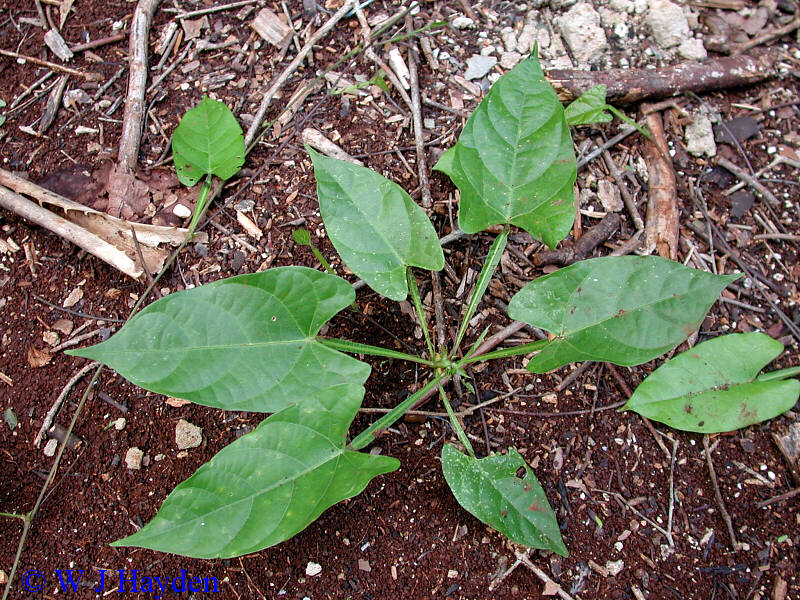
The Arrowleaf Butterfly Pea is a climbing vine that can reach lengths of up to 3 meters. It is characterized by its slender, twining stems and trifoliate leaves. Each leaf consists of three leaflets, which are typically lanceolate to ovate in shape, with a pointed tip that resembles an arrowhead—hence the common name "Arrowleaf." The leaflets are usually 3-7 cm long and 1-3 cm wide, with a smooth or slightly hairy surface.
One of the most striking features of this plant is its flowers. The flowers are large, showy, and butterfly-shaped, measuring about 3-5 cm in diameter. They are typically purple or lavender, although white and pink variations can also be found. The flowers are borne singly or in clusters on long peduncles, and they bloom from late spring to early fall. The fruit is a flattened, elongated pod that contains several seeds.
Ecological Role
The Arrowleaf Butterfly Pea plays a significant role in its ecosystem. As a member of the Fabaceae family, it has the ability to fix atmospheric nitrogen through a symbiotic relationship with Rhizobium bacteria in its root nodules. This nitrogen-fixing capability enriches the soil, making it more fertile and promoting the growth of other plants. This is particularly beneficial in degraded or nutrient-poor soils.
Additionally, the flowers of Centrosema sagittatum are an important nectar source for various pollinators, including bees, butterflies, and hummingbirds. The plant's dense foliage provides habitat and shelter for small animals and insects. Its seeds are also a food source for birds and other wildlife.
Uses and Benefits
The Arrowleaf Butterfly Pea has several uses and benefits, both ecological and practical:
- Soil Improvement: Due to its nitrogen-fixing ability, it is often used in agroforestry and sustainable agriculture practices to improve soil fertility.
- Erosion Control: Its extensive root system helps stabilize soil, making it useful for erosion control on slopes and embankments.
- Forage: The plant is palatable to livestock and can be used as forage. It is particularly valuable in tropical and subtropical regions where other forage options may be limited.
- Ornamental: With its attractive flowers and lush foliage, the Arrowleaf Butterfly Pea is also grown as an ornamental plant in gardens and landscapes.
Cultivation and Care
Cultivating Centrosema sagittatum is relatively straightforward, provided the right conditions are met. Here are some tips for successful growth:
- Climate: This plant prefers warm, tropical, or subtropical climates. It can tolerate a range of temperatures but is sensitive to frost.
- Soil: It thrives in well-drained soils with a pH range of 5.5 to 7.5. While it can grow in poor soils, it performs best in fertile, loamy soils.
- Watering: Regular watering is essential, especially during the establishment phase. Once established, it is relatively drought-tolerant.
- Light: Full sun to partial shade is ideal for optimal growth and flowering.
- Propagation: The plant can be propagated from seeds or cuttings. Seeds should be scarified or soaked in water for 24 hours before planting to enhance germination.
Challenges and Considerations
While the Arrowleaf Butterfly Pea is generally easy to grow, there are a few challenges and considerations to keep in mind:
- Invasiveness: In some regions, Centrosema sagittatum can become invasive, outcompeting native vegetation. It is important to monitor its growth and manage its spread.
- Pests and Diseases: The plant is relatively resistant to pests and diseases, but it can occasionally be affected by root rot, especially in poorly drained soils.