Hazel Dodder
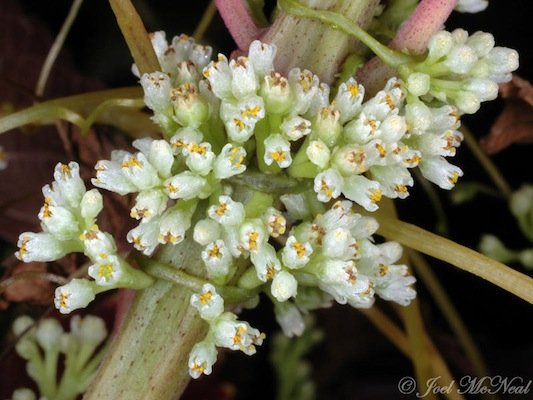
Cuscuta coryli, commonly known as hazel dodder, is a parasitic plant belonging to the genus Cuscuta. This intriguing plant lacks chlorophyll, making it unable to photosynthesize and thus reliant on other host plants for its nutrients.
Appearance and Characteristics
Hazel dodder is a slender, twining vine with thin, thread-like stems that wrap around the host plant. The plant lacks leaves, as it does not need them for photosynthesis. Instead, it has small, scale-like structures along its stem that aid in attaching itself to the host plant. The stems of Cuscuta coryli can range in color from yellow to orange, giving it a distinctive and eye-catching appearance.
Habitat and Distribution
Cuscuta coryli can be found in various habitats, including forests, meadows, and grasslands. It is native to Europe and parts of Asia, where it parasitizes a wide range of host plants, including hazel trees (Corylus spp.), from which it derives its common name. Hazel dodder has also been introduced to other regions around the world, where it can be considered an invasive species due to its parasitic nature.
Life Cycle
The life cycle of Cuscuta coryli is both fascinating and complex. The plant begins its life as a seed that germinates in the soil. Once the seedling emerges, it must quickly find a suitable host plant to attach itself to. The dodder plant uses its specialized structures to locate a host, after which it wraps itself around the host's stem and begins to extract nutrients.
As the hazel dodder grows and matures, it forms connections called haustoria that penetrate the host plant's vascular system. Through these haustoria, the dodder plant absorbs water, sugars, and other essential nutrients from the host, effectively leeching off its resources. This parasitic relationship can be detrimental to the host plant, as it may weaken and eventually die due to the constant nutrient drain.
Ecological Impact
While hazel dodder may be considered a pest due to its parasitic nature, it also plays a role in the ecosystem. As a parasite, Cuscuta coryli can influence the growth and survival of its host plants, potentially shaping plant communities in its habitat. Additionally, the presence of dodder can serve as a bioindicator of environmental conditions, as certain species of dodder are sensitive to changes in temperature and moisture levels.