False Sowthistle
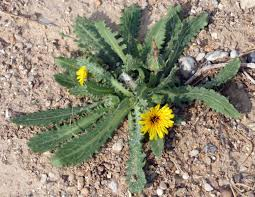
False Sowthistle, scientifically known as Reichardia tingitana, is a fascinating plant species that belongs to the Asteraceae family. This plant is often recognized for its distinctive appearance and adaptability to various environments.
Characteristics
Reichardia tingitana is an annual herbaceous plant that can grow up to 60 cm in height. It is characterized by its bright yellow flowers, which resemble those of the dandelion. The plant has a rosette of basal leaves that are deeply lobed and can be quite variable in shape. The leaves are typically green but may have a bluish tint. The stems are erect and can be branched, supporting the flower heads that bloom from spring to early summer.
The flowers of False Sowthistle are composite, consisting of numerous small florets that form a dense, flat-topped cluster. Each floret is tubular and has a strap-shaped corolla, contributing to the overall daisy-like appearance. The fruit is an achene, which is a small, dry, one-seeded fruit that does not open at maturity. These achenes are equipped with a pappus, a tuft of fine hairs that aids in wind dispersal.
Habitat and Distribution
False Sowthistle is native to the Mediterranean region, where it thrives in a variety of habitats. It is commonly found in coastal areas, grasslands, and disturbed sites such as roadsides and agricultural fields. The plant is well-adapted to sandy and rocky soils, often flourishing in areas with full sun exposure.
Due to its adaptability, Reichardia tingitana has spread beyond its native range and can now be found in various parts of the world, including parts of Europe, North Africa, and the Middle East. It is considered a naturalized species in some regions, where it has established stable populations outside its native habitat.
Uses and Benefits
Ethnobotanical and folk‑medicine uses of Reichardia tingitana center on its role as a traditional desert‑region remedy for digestive discomfort, inflammation, and minor eye ailments. The plant is native to Mediterranean and West Asian drylands, where it has long been used as a readily available wild herb.
Core Folk‑Medicine Uses (Middle East & Arabian Peninsula)
Ethnobotanical records from the region show that the leaves are used traditionally to treat:
- Constipation GBIF
- Colic / abdominal discomfort GBIF
- Inflamed eyes (topical or wash preparations) GBIF
These uses align with the plant’s availability in arid and saline habitats where simple, accessible herbal remedies are culturally important.
Broader Traditional & Herbal Uses (Contemporary folk herbalism)
Modern herbal‑folk sources also describe additional uses, though these are not part of the older ethnobotanical record and should be considered contemporary interpretations:
- Anti‑inflammatory applications (leaves and stems) Agric4Profits.com
- Support for arthritis and inflammatory pain (inferred from anti‑inflammatory use) Agric4Profits.com
- General digestive soothing (traditional colic use expanded) Agric4Profits.com
These modern uses are consistent with the plant’s documented antioxidant and antimicrobial activity, which has been demonstrated in laboratory studies of methanolic extracts. MDPI
Ethnobotanical Context & Cultural Relevance
- Reichardia tingitana grows in arid deserts, shrub‑steppes, saline soils, and sandy depressions across the Middle East and Mediterranean. GBIF
- Its availability in harsh environments makes it a common household or pastoral remedy, especially in rural communities.
- The plant is known as false sowthistle, and its tender leaves are sometimes used as wild edible greens, which often overlaps with medicinal use in traditional food‑as‑medicine systems.
Summary
Traditional uses: constipation, colic, inflamed eyes
Contemporary folk uses: anti‑inflammatory, digestive soothing, arthritis support
Scientific support: antioxidant, antimicrobial, cytotoxic, and larvicidal activity in extracts (laboratory studies)
Edible Plant:
The young leaves of Reichardia tingitana are edible and can be consumed raw or cooked. They are often used in salads or as a cooked green, similar to spinach. The leaves have a mild, slightly bitter taste that can add a unique flavor to dishes.
Forage Plant:
The plant can serve as forage for livestock, particularly in regions where other forage options are limited. Its ability to grow in poor soils makes it a valuable resource in arid and semi-arid areas.
Ecological Significance
False Sowthistle plays a role in its ecosystem by providing food and habitat for various organisms. The flowers attract pollinators such as bees and butterflies, which are essential for the pollination of many plant species. Additionally, the seeds are a food source for birds and small mammals.
The plant's ability to thrive in disturbed environments makes it an important pioneer species. It can quickly colonize bare or degraded land, helping to stabilize the soil and prevent erosion. This characteristic is particularly beneficial in areas that have been impacted by human activities or natural disturbances.
Challenges and Considerations
Despite its benefits, False Sowthistle can also pose challenges in certain contexts:
- Invasive Potential: In some regions, Reichardia tingitana is considered an invasive species. Its ability to spread rapidly and compete with native vegetation can lead to ecological imbalances. Management strategies may be necessary to control its spread in sensitive areas.
- Agricultural Impact: In agricultural settings, False Sowthistle can become a weed, competing with crops for resources such as light, water, and nutrients. Effective weed management practices are essential to minimize its impact on crop yields.