Chirality & Stereochemistry
Chirality and Stereochemistry R S Enantiomers Diastereomers Meso Tutorial Series
Chirality and Stereochemistry Practice Problems

Chirality and stereochemistry are fundamental concepts in organic chemistry that play a crucial role in the structure and function of molecules. These concepts are essential for understanding the three-dimensional arrangement of atoms in molecules and how this arrangement affects their chemical behavior and interactions.
In chemistry there are two concepts:
Chiral molecules
Chiral centers (chiral atoms, they tend to be carbon atoms). usually carbons bonded to 4 different groups
Example:
Mirror image : 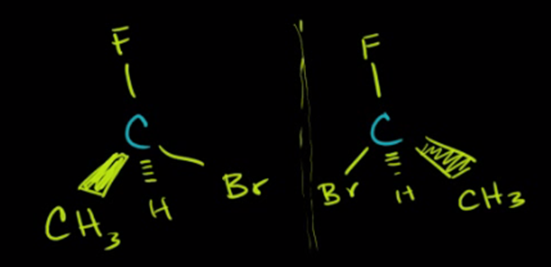
Chirality: The Essence of Molecular Handedness
Chirality is a property of a molecule that makes it non-superimposable on its mirror image, much like how left and right hands are mirror images but cannot be perfectly aligned. A molecule is considered chiral if it has at least one chiral center, typically a carbon atom bonded to four different substituents. This carbon is often referred to as an asymmetric carbon or stereocenter.
Identifying Chiral Centers
To determine if a molecule is chiral, one must identify its chiral centers. Here are the steps to identify chiral centers:
- Locate Carbon Atoms: Examine the carbon atoms in the molecule.
- Check for Four Different Groups: Identify if the carbon atom is bonded to four distinct groups or atoms.
- Assess Symmetry: Ensure that the molecule lacks an internal plane of symmetry.
If a carbon atom meets these criteria, it is a chiral center, and the molecule is likely chiral.
Stereochemistry: The Study of Spatial Arrangement
Stereochemistry involves the study of the spatial arrangement of atoms within molecules and how this arrangement influences their chemical properties and reactions. It is a broader concept that encompasses chirality and other types of isomerism.
Types of Stereoisomers
Stereoisomers are molecules with the same molecular formula and sequence of bonded atoms but differ in the three-dimensional orientations of their atoms. The main types of stereoisomers include:
- Enantiomers: These are pairs of chiral molecules that are non-superimposable mirror images of each other. Enantiomers have identical physical properties except for their interaction with plane-polarized light and reactions in chiral environments.
- Diastereomers: These are stereoisomers that are not mirror images of each other. They have different physical and chemical properties and can be separated by conventional means.
Importance of Stereochemistry
Stereochemistry is crucial in various fields, including pharmaceuticals, where the activity of a drug can depend on its stereochemistry. For example, one enantiomer of a drug may be therapeutically active, while the other could be inactive or even harmful.
Assigning Configuration: R/S System
The R/S system is a method used to assign absolute configuration to chiral centers. This system helps in distinguishing between different enantiomers. The steps to assign R or S configuration are as follows:
- Assign Priorities: Rank the four substituents attached to the chiral center based on atomic number, with the highest atomic number receiving the highest priority.
- Orient the Molecule: Position the molecule so that the lowest priority group is directed away from you.
- Determine the Sequence: Observe the sequence of the remaining three groups. If the sequence is clockwise, the configuration is R (rectus). If counterclockwise, it is S (sinister).
Chirality in Nature and Industry
Chirality is a pervasive phenomenon in nature and industry. Many biological molecules, such as amino acids and sugars, are chiral and exist predominantly in one enantiomeric form. This chirality is crucial for biological function, as enzymes and receptors are often chiral and interact selectively with one enantiomer over the other.
In the pharmaceutical industry, the chirality of drugs is of paramount importance. The thalidomide tragedy in the 1960s highlighted the significance of chirality, as one enantiomer of the drug caused severe birth defects, while the other was effective as a sedative.
Chirality Could Kill Us All, If We Let It
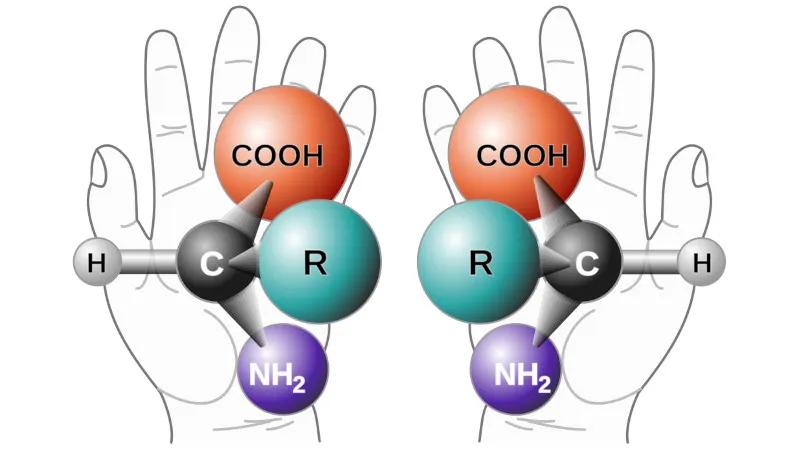
In our high school chemistry classes we all learn about chirality, the property of organic molecules in which two chemically identical molecules can have different structures that are mirror images of each other. This can lead to their exhibiting different properties, and one aspect of chirality is causing significant concerns in the field of synthetic biology. The prospect of so-called mirror organisms is leading to calls from a group of prominent scientists for research in the field to be curtailed due to the risks they would present.
Chirality is baked into all life; our DNA is formed of right-handed molecules while our proteins are left handed. The “mirror” organisms would reverse either or both of these, and could in theory be used to improve biochemical production processes. The concern is that these organisms would evade both the immune systems of all natural life forms, and any human defences such as antibiotics, thus posing an existential risk to life. It’s estimated that the capacity to produce such a life form lies more than a decade away, and the scientists wish to forestall that by starting the conversation early. They are calling for a halt to research likely to result in these organisms, and a commitment from funding bodies not to support such research.
Warnings of the dangers from scientific advances are as old as science itself, and it’s safe to say that many such prophecies have come from dubious sources and proved not to have a basis in fact. But this one, given the body of opinion behind it, is perhaps one that should be heeded.