Wasps
Wasps are the wolves of the insect world, one of their preferred foods are caterpillars.
They go for green & brown caterpillars.
There are 3 groups of Wasps
- Social Wasps
- Solitary Wasps
- Parasitic Wasps
Social Wasps
The type most of us experience.
Social wasps such as the hornets, yellowjackets and paper wasps live in colonies in a fashion similar to the honey bees and ants. Most of the wasps in a colony are workers; i.e., the nest queen's nonreproductive daughters that build the nest, gather food and care for the queen's offspring.
Hornets build the familiar large nests of a paper-like material made from chewed wood mixed with saliva. Nests contain many tiers of cells covered by the outer shell with a single opening at the bottom. Hornet nests are usually located in wooded areas, attached to a tree branch, but may be attached to shrubs, utility poles or house siding. Each nest has only a few hundred workers that are about an inch long and dark with white, light yellow or cream colored markings on the abdomen, thorax, and face. Hornets can be aroused to sting in great numbers, but only when the nest is disturbed or threatened.
Yellowjackets are honey bee size (about 1/2 to 3/4 inch long) and black with bright yellow markings. (Honey bees are golden or brown.) Yellowjackets build paper nests similar to hornets but either in the ground, a log or landscape timber or building wall or attic. Yellowjackets are commonly observed hovering back and forth at the small nest opening or around garbage cans and other areas where they forage for food. Nests may contain up to 5,000 workers, most of which never travel more than a few hundred yards from the nest while looking for food. Yellowjacket stings are quite painful, but the wasps are usually not aggressive except when disturbed at the nest.
Paper wasps build the familiar umbrella shaped nests found hanging by a short stalk on the undersides of building eaves. Only a single tier of cells is constructed and there is no external covering over the nest. Each colony normally contains fewer than 25 wasps, but late in the season, the number may swell to over 100. Paper wasps are slightly longer and more slender than yellowjackets, and color is variable among the many species.
A social wasp colony lasts only 1 year. Paper wasps, hornets, and yellowjackets build a new nest from scratch each year and do not reuse the previous year's nest. The only wasps to overwinter are the fertilized queens. All the workers from a colony die with the first frosts.
(Source)
Solitary Wasps
Solitary wasps (also called hunting wasps) are a group of related insects primarily consisting of the thread-waisted wasps (Sphecidae) and digger wasps (Crabronidae).
They have the following characteristics:
- Smooth and shiny body; few hairs.
- Body ranges from slender to stout.
- Vary in size from less than 1/2 inch long to 1-1/2 inches long.
- Vary in color: black and yellow, black and orange, iridescent black or purple.
Insects that may be confused with solitary wasps

Typical bee
Some solitary wasps may be confused with bees. However, bees have hairy bodies and legs, and often are seen carrying balls of pollen on their hind legs. Solitary wasps have few hairs on their bodies or legs.
Solitary wasps, especially digger wasps, may also be mistaken for yellowjackets, although most solitary wasps are larger than yellowjackets.
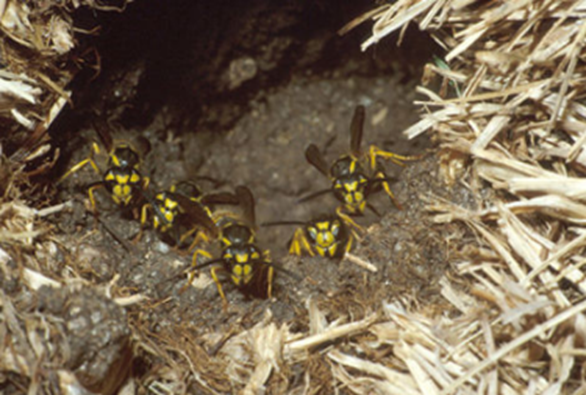
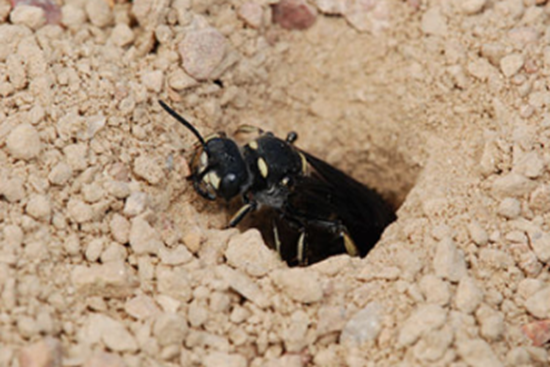
Solitary wasps and yellowjackets both build nests in the ground. Ground-nesting solitary wasps often build nests in groups with each wasp having its own individual nest. Yellowjackets live together in one nest with many workers going in and out of the single nest opening.
Ground Nesting Yellow Jackets:
Typical Solitary Wasp Nest
Importance of solitary wasps
Natural control
Solitary wasps prey on insects or spiders which helps keep those arthropod populations in check.
Pollination
Solitary wasps can move pollen when they visit flowering plants. Although wasps are not as efficient pollinators as bees, pollen grains can stick to a wasp’s body and transfer between flowers.
Nuisance
Solitary wasps can be a nuisance and cause concern when they nest in lawns or gardens, especially when large numbers are present. They can potentially sting to protect themselves.