Plant embryogenesis

The text below is adapted from OpenStax Biology 32.2
How do each of these adult plant tissues arise from a fertilized ovule?
The zygote divides asymmetrically into an apical cell which will go on to become the embryo, and a suspensor which functions like an umbilical cord to provide nutrients from from maternal to embryonic tissue. Prior to fertilization, there is a gradient of a plant hormone called auxin across the ovule, with higher concentrations of auxin in the region that will become the apical cell. The asymmetric cell division segregates auxin into the apical cell, establishing the apical/basal axis (analogous to the anterior/posterior axis in animals). Thus early plant development, much like early development in many animal species, begins with segregation of cytoplasmic determinants in the very first cell division.
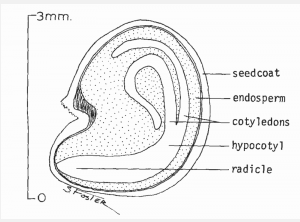
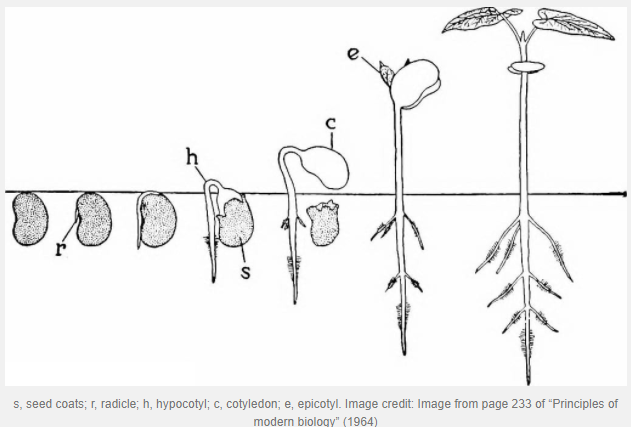
Through multiple rounds of cell division followed by differentiation, the apical cell ultimately gives rise to the cotyledons, the hypocotyl, and the radicle.The cotyledons, or embryonic leaves, will become the first leaves of the plants upon germination. Monocots tend to have a single cotyledon, while dicots tend to have two cotyledons (in fact, the number of cotyledons present is what gives them the prefix “mono-” or “di-“). The part of the plant that grows above the cotyledons is called the epicotyl (“above-cotyl”). The hypocotyl (“below-cotyl”) will become the future stem, and the radicle, or embryonic root, will give rise to future roots.
The images below shows the general structures and processes involved in seed germination: