Endometrial Hyperplasia
Wikipedia
Endometrial hyperplasia is a condition of excessive proliferation of the cells of the endometrium, or inner lining of theuterus.
Most cases of endometrial hyperplasia result from high levels of estrogens, combined with insufficient levels of theprogesterone-like hormones which ordinarily counteract estrogen's proliferative effects on this tissue. This may occur in a number of settings, including obesity, polycystic ovary syndrome, estrogen producing tumours (e.g. granulosa cell tumour) and certain formulations of estrogen replacement therapy. Endometrial hyperplasia is a significant risk factor for the development or even co-existence of endometrial cancer, so careful monitoring and treatment of women with this disorder is essential.
CLASSIFICATION
Like other hyperplastic disorders, endometrial hyperplasia initially represents a physiological response of endometrial tissue to the growth-promoting actions of estrogen. However, the gland-forming cells of a hyperplastic endometrium may also undergo changes over time which predispose them to cancerous transformation. Several histopathologysubtypes of endometrial hyperplasia are recognisable to the pathologist, with different therapeutic and prognosticimplications The most commonly used classification system for endometrial hyperplasia is the World Health Organization system, which has four categories: simple hyperplasia without atypia, complex hyperplasia without atypia, simple atypical hyperplasia and complex atypical hyperplasia.
- Endometrial hyperplasia (simple or complex) - Irregularity and cystic expansion of glands (simple) or crowding and budding of glands (complex) without worrisome changes in the appearance of individual gland cells. In one study, 1.6% of patients diagnosed with these abnormalities eventually developed endometrial cancer.
- Atypical endometrial hyperplasia (simple or complex) - Simple or complex architectural changes, with worrisome (atypical) changes in gland cells, including cell stratification, tufting, loss of nuclear polarity, enlarged nuclei, and an increase in mitotic activity. These changes are similar to those seen in true cancer cells, but atypical hyperplasia does not show invasion into the connective tissues, the defining characteristic of cancer. The previously mentioned study found that 22% of patients with atypical hyperplasia eventually developed cancer.
Diagnosis
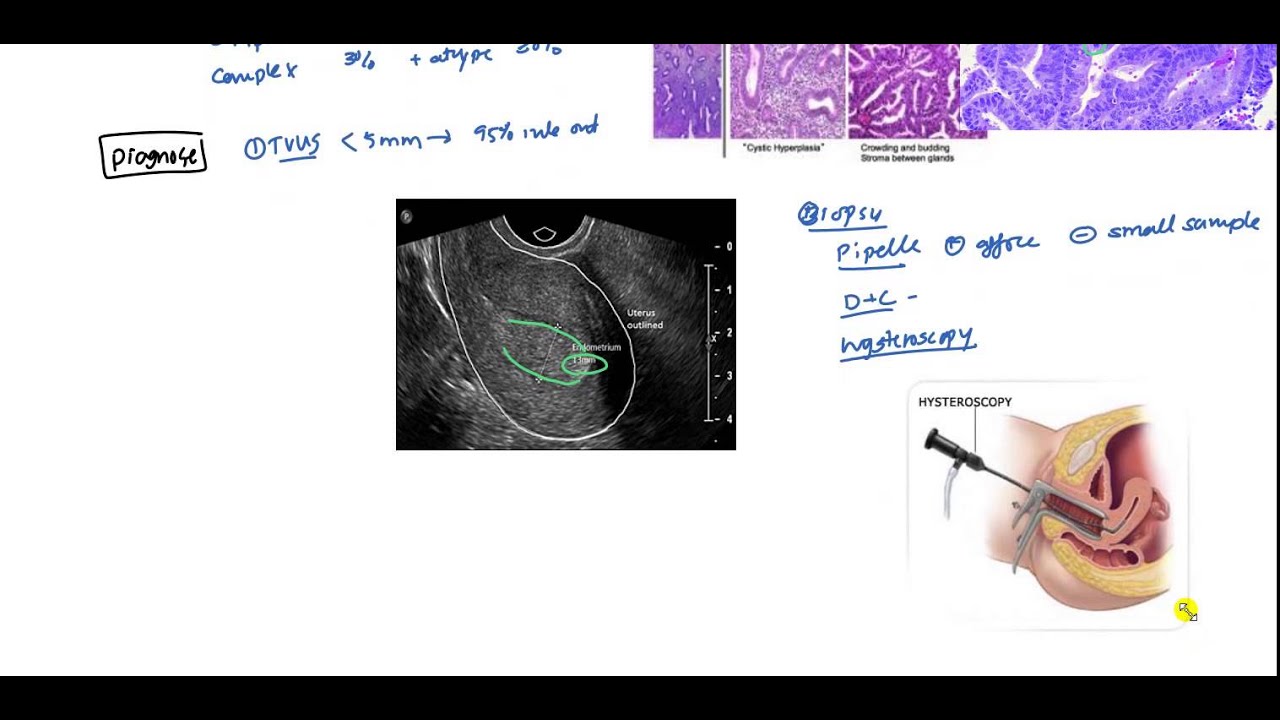
Diagnosis of endometrial hyperplasia can be made by endometrial biopsy which is done in the office setting or through curettage of the uterine cavity to obtain endometrial tissue for histopathologic analysis. A workup for endometrial disease may be prompted by abnormal uterine bleeding, or the presence of atypical glandular cells on a pap smear.
Treatment
Treatment of endometrial hyperplasia is individualized, and may include hormonal therapy, such as cyclic or continuous progestin therapy, or hysterectomy
Articles/Studies
Risk Factors
- Tamoxifen treatment for breast cancer results in one-third of all patients developing endometrial polyps, hyperplasia, metaplasia, consistent with an estrogen-agonist effect.
- Tamoxifen increases the risk of endometrial hyperplasia and carcinoma in breast cancer patients.
- Adverse Long-term Metabolic and Endometrial Consequences in Women with Polycystic Ovarian Syndrome: A Report of Two Cases.
- Determination of Heavy Metal Concentrations in Normal and Pathological Human EndometrialBiopsies and In Vitro Regulation of Gene Expression by Metals in the Ishikawa and Hec-1bEndometrial Cell Line.
Treatment
New surgical approach for women at risk of ovarian cancer (https://www.sciencedaily.com/releases/2020/08/200824105555.htm)