Steeplebush
Plant ID on GoBotany
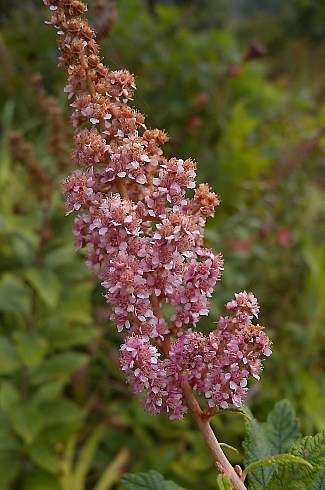
Steeplebush, scientifically known as Spiraea tomentosa, is a deciduous shrub that belongs to the Rosaceae family. This plant is native to North America and is commonly found in wetlands, meadows, and along stream banks. It is also known by other names such as Hardhack and Meadowsweet. Steeplebush is appreciated for its attractive pink to purple flower spikes and its ability to thrive in moist environments.
Description
Steeplebush is a medium-sized shrub that typically grows to a height of 2 to 4 feet, although it can occasionally reach up to 6 feet. The plant has a dense, upright growth habit with multiple stems arising from the base. The stems are covered with fine, woolly hairs, giving them a tomentose (fuzzy) appearance, which is reflected in the species name tomentosa.
Leaves
The leaves of Steeplebush are simple, alternate, and oblong to lanceolate in shape. They measure about 1 to 3 inches in length and have serrated margins. The upper surface of the leaves is dark green and smooth, while the underside is lighter in color and covered with fine hairs. In the fall, the leaves turn a beautiful yellow to orange color, adding to the plant's ornamental value.
Flowers
One of the most striking features of Steeplebush is its flowers. The plant produces dense, cone-shaped flower spikes that can be up to 8 inches long. The flowers are small, about 1/4 inch in diameter, and are typically pink to purple in color. They bloom from mid-summer to early fall, attracting a variety of pollinators, including bees, butterflies, and other insects.
Fruit
After the flowering period, Steeplebush produces small, dry, brown seed capsules that persist into the winter. These capsules contain tiny seeds that are dispersed by wind and water, allowing the plant to colonize new areas.
Habitat and Distribution
Steeplebush is commonly found in wetland areas, including marshes, bogs, and along the edges of streams and ponds. It prefers full sun to partial shade and thrives in moist, acidic soils. The plant is tolerant of poor drainage and can even withstand periodic flooding. Steeplebush is native to the eastern United States and Canada, ranging from Newfoundland to Georgia and west to Minnesota and Missouri.
Ecological Importance
Steeplebush plays a significant role in wetland ecosystems. Its dense growth habit helps to stabilize soil and prevent erosion along stream banks and in wetland areas. The plant also provides habitat and food for a variety of wildlife. The flowers attract pollinators, while the dense foliage offers cover for small mammals and birds. Additionally, the seeds are a food source for some bird species.
Cultivation and Uses
Steeplebush is relatively easy to cultivate and can be a valuable addition to gardens, especially in areas with moist soils. Here are some tips for growing Steeplebush:
- Planting: Choose a location with full sun to partial shade and moist, well-drained soil. Steeplebush can be planted in the spring or fall.
- Watering: Keep the soil consistently moist, especially during dry periods. Steeplebush is tolerant of wet conditions but does not thrive in dry soils.
- Pruning: Prune the plant in late winter or early spring to remove dead or damaged stems and to maintain its shape. Steeplebush can be cut back to the ground if necessary.
- Propagation: Steeplebush can be propagated by seed, division, or cuttings. Seeds should be sown in the fall, while divisions and cuttings can be taken in the spring.
In addition to its ornamental value, Steeplebush has been used in traditional medicine by Native American tribes. The plant was used to treat a variety of ailments, including diarrhea, fever, and skin conditions. However, it is important to note that the medicinal use of Steeplebush should be approached with caution and under the guidance of a qualified healthcare professional.
Physio-Medical Therapeutics, Materia Medica and Pharmacy BY T. J. LYLE, A.M.M. 1897
The roots and leaves are a bitter mild, stimulating tonic astringent, useful in diarrhoea, cholera and bowel complaints. It may also be used as a tonic and astringent injection in female complaints
The Physiomedical Dispensatory by William Cook, M.D., 1869
Small shrubs, several species of which are much cultivated, and assorted into numerous varieties, as pretty ornamental plants. Stems numerous, two to three feet high, slender, purplish, and downy. Leaves opposite, ovate-lanceolate, minutely serrate, dark-green above, gray and very woolly beneath. Flowers in dense, terminal spicate racemes, calyx and corolla five-parted, corolla light-red. Pods woolly, remaining throughout the winter, and the seeds eaten by snow-birds. July. Very common in low grounds through New England, and extending southward.
Properties and Uses: The root is a tonic and astringent, of rather strong powers, of a pleasant odor and taste, and usually well received by the stomach. It is used in sub-acute and chronic diarrhea, especially that of a scrofulous character where the assimilative organs are at fault; and may be used in hemorrhages and other cases to which astringent tonics are suited. The leaves are said to be even better than the root. An ounce to a pint of boiling water makes a good infusion, of which a fluid ounce or more may be given from three to six times a day.
SPIREA OPULIFOLIA, nine bark, is a shrub from five to ten feet high, growing mostly by river banks on rocky soils. Not woolly. Branches slender, recurved, crowded toward the extremities with small white flowers in umbel-like corymbs. Leaves roundish, slightly heart- shaped, somewhat three-lobed. Pods three to five, inflated, membranous, purplish. The old bark separates in a number of thin layers. The leaves of this shrub are mildly astringent, tonic, a little demulcent, and rather soothing in character. They make a much pleasanter remedy than the root of the above species, and one that can be employed for a larger range of cases where an astringent is needed. In sub-acute dysentery and diarrhea, it is an admirable agent.