Peruvian Dodder / Bluntleaf dodder

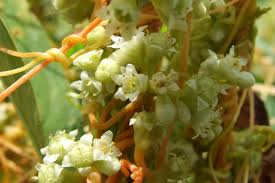
Cuscuta obtusiflora, commonly known as the Peruvian dodder or bluntleaf dodder, is a unique and intriguing parasitic plant that belongs to the Convolvulaceae family. This plant is native to North America and can be found in various habitats, including deserts, grasslands, and open woodlands.
Characteristics
One of the most distinctive features of Cuscuta obtusiflora is its thread-like, twining stems that wrap around the host plant to extract water and nutrients. These stems can range in color from yellow to orange, giving the plant a striking appearance. The leaves of Cuscuta obtusiflora are reduced to tiny scales since the plant does not photosynthesize. Instead, it obtains its nutrients by penetrating the host plant's vascular system using specialized structures called haustoria.
Habitat
Cuscuta obtusiflora thrives in arid and semi-arid regions, making it well-adapted to desert environments. It can be found in sandy soils, rocky areas, and disturbed habitats. This parasitic plant has a wide distribution across North America, with populations occurring in states such as Arizona, California, Nevada, and Texas. Despite its parasitic nature, Cuscuta obtusiflora plays a crucial role in its ecosystem by interacting with various host plants and contributing to the overall biodiversity of the region.
Life Cycle
The life cycle of Cuscuta obtusiflora begins with the germination of its tiny seeds in the soil. Once the seedling emerges, it must quickly find a suitable host plant to establish a connection and start extracting nutrients. The dodder plant's stem coils around the host plant, forming haustoria that penetrate the host's tissues. Over time, Cuscuta obtusiflora grows and spreads, producing flowers that are small, white, and bell-shaped. These flowers attract pollinators, such as bees and butterflies, facilitating the plant's reproductive process.