Complete Blood Count (CBC)
Lab tests online
Return to Cardiac Disorders Menu
VIDEOS:
Part 1
Part 2
Part 3
Are Complete Blood Count (CBC) Evaluations Important?

How to Interpret a CBC (complete blood count) (Hematopathology & Hematology with Dr. Jeanette Ramos)
A Look Inside the CBC
Personalized blood count could lead to early intervention for common diseases
A complete blood count (CBC), also known as a complete blood cell count, full blood count (FBC), or full blood exam (FBE), is a blood panel requested by a doctor or other medical professional that gives information about the cells in a patient's blood, such as the cell count for each cell type and the concentrations of various proteins and minerals. A scientist or lab technician performs the requested testing and provides the requesting medical professional with the results of the CBC.
Blood counts of various types have been used for clinical purposes since the 19th century. Automated equipment to carry out complete blood counts was developed in the 1950s and 1960s.[1]
The cells that circulate in the bloodstream are generally divided into three types: white blood cells (leukocytes), red blood cells (erythrocytes), and platelets (thrombocytes). Abnormally high or low counts may indicate the presence of many forms of disease, and hence blood counts are amongst the most commonly performed blood tests in medicine, as they can provide an overview of a patient's general health status. A CBC is routinely performed during annualphysical examinations in some jurisdictions.
WBC (white blood cell) leukocyte count
Normal range: 4,300 to 10,800 cmm
White blood cells help fight infections, so a high white blood cell count could be helpful for identifying infections. It may also indicate leukemia, which can cause an increase in the number of white blood cells. On the other hand, too few white blood cells could be caused by certain medications or health disorders.
WBC (white blood cell) differential count
Normal range:
| • | Neutrophils40 | % to 60% of the total |
|---|---|---|
| • | Lymphocytes20 | % to 40% |
| • | Monocytes2 | % to 8% |
| • | Eosinophils1 | % to 4% |
| • | Basophils0.5 | % to 1% |
This test measures the numbers, shapes, and sizes of various types of white blood cells listed above. The WBC differential count also shows if the numbers of different cells are in proper proportion to each other. Irregularities in this test could signal an infection, inflammation, autoimmune disorders, anemia, or other health concerns.
RBC (red blood cell) erythrocyte count
Normal range: 4.2 to 5.9 million cmm
We have millions of red blood cells in our bodies, and this test measures the number of RBCs in a specific amount of blood. It helps us determine the total number of RBCs and gives us an idea of their lifespan, but it does not indicate where problems originate. So if there are irregularities, other tests will be required.
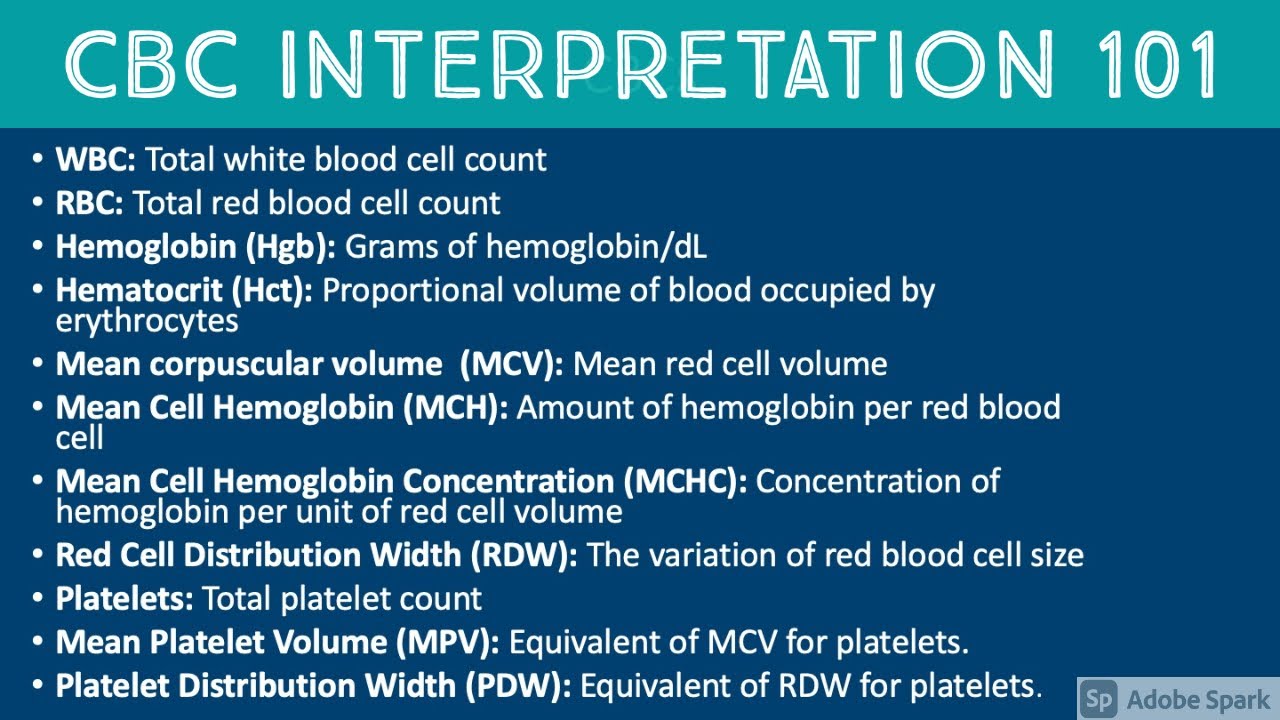
Hematocrit (Hct)
Normal range: 45% to 52% for men; 37% to 48% for women
Useful for diagnosing anemia, this test determines how much of the total blood volume in the body consists of red blood cells.
Hemoglobin (Hgb)
Normal range: 13 to 18 g/dL for men; 12 to 16 g/dL for women
Red blood cells contain hemoglobin, which makes blood bright red. More importantly, hemoglobin delivers oxygen from the lungs to the entire body; then it returns to the lungs with carbon dioxide, which we exhale. Healthy hemoglobin levels vary by gender. Low levels of hemoglobin may indicate anemia.
Mean corpuscular volume (MCV)
Normal range: 80 to 100 femtoliters
This test measures the average volume of red blood cells, or the average amount of space each red blood cell fills. Irregularities could indicate anemia and/or chronic fatigue syndrome.
Mean corpuscular hemoglobin (MCH)
Normal range: 27 to 32 picograms
This test measures the average amount of hemoglobin in the typical red blood cell. Results that are too high could signal anemia, while those too low may indicate a nutritional deficiency.
Mean corpuscular hemoglobin concentration (MCHC)
Normal range: 28% to 36%
The MCHC test reports the average concentration of hemoglobin in a specific amount of red blood cells. Here again, we are looking for indications of anemia if the count is low, or possible nutritional deficiencies if it’s high.
Red cell distribution width (RDW or RCDW)
Normal range: 11% to 15%
With this test, we get an idea of the shape and size of red blood cells. In this case, “width” refers to a measurement of distribution, not the size of the cells. Liver disease, anemia, nutritional deficiencies, and a number of health conditions could cause high or low RDW results.
Platelet count
Normal range: 150,000 to 400,000 mL
Platelets are small portions of cells involved in blood clotting. Too many or too few platelets can affect clotting in different ways. The number of platelets may also indicate a health condition.
Mean Platelet Volume (MPV)
Normal range: 7.5 to 11.5 femtoliters
This test measures and calculates the average size of platelets. Higher MPVs mean the platelets are larger, which could put an individual at risk for a heart attack or stroke. Lower MPVs indicate smaller platelets, meaning the person is at risk for a bleeding disorder.
In many reports the initial list of items under the “Test Name” column show the results of the CBC, or complete blood count. The CBC focuses on the health of the three types of blood cells—red blood cells, white blood cells, and platelets—by measuring their amounts, size, and volume, plus a few other things. It’s a broad screening tool that helps your doctor identify infections and allergies, or diagnose potential diseases and conditions such as anemia and leukemia. Items that are commonly measured in the CBC include:
White Blood Cell (WBC)
Often the first CBC test shown is the White blood cell count. White blood cells, also called leukocytes, are a major component of the body’s immune system. Your body produces more WBCs when you have an infection or allergic reaction. There are five major types of WBCs (covered below), but many lab reports list the test results for each of these at the bottom of the CBC results.
Red Blood Cell (RBC)
Red blood cells often appear next on the report. RBCs deliver oxygen to tissues throughout the body. High RBC counts can be the result of dehydration, kidney problems, or a heart condition. Low RBC counts can indicate anemia, nutritional deficiency, bone marrow damage, or kidney problems. Smokers, grab your gum/carrot sticks/nicotine patches because here’s another reason to quit: Smoking can significantly damage your RBCs.
Hemoglobin, Hematocrit, Mean Corpuscular Value (MCV), Mean Corpuscular Hemoglobin (MCH)
These test results often appear under the RBC section because they further examine the health and function of your red blood cells. Hemoglobin is the protein in red blood cells that carries oxygen. It’s measured to help determine if your organs and tissues are receiving enough O2. Hematocrit results show the volume of blood taken up by red blood cells, which helps determine if you have too high or too low an RBC count. Blood cells are often referred to as corpuscles, so the mean corpuscular value measures the average size of red blood cells. A vitamin B12 deficiency or anemia may be indicated by abnormal-size RBCs. Mean corpuscular hemoglobin measures the average amount of hemoglobin inside red blood cells (sadly, for would-be Jedi it does not measure your midi chlorians), and it’s often evaluated in association with the mean corpuscular hemoglobin concentration (MCHC), which measures the average percentage of hemoglobin in the red blood cells.
Platelets and Mean Platelet Value (MPV)
These two tests usually appear next. Platelets are fragments of blood cells. They help wounds heal and prevent excessive bleeding by forming clots. Low platelet count (below 150,000 platelets per microliter, mcL) can indicate risk for excessive bleeding, while a high count (400,000 or above) may show a risk for blood clots. The mean platelet value test measures the average amount of platelets and can reveal subtle disorders when platelet counts are normal.
Basophils, Eosinophils, Neutrophils, Lymphocytes, and Monocytes
Oddly, the results for the five types of white blood cells—basophils, eosinophils, neutrophils, lymphocytes, and monocytes—often appear below the list of red blood cell results. The amounts and the health of these cells are helpful in identifying infections and allergies. For example, neutrophils are like the EMT of your blood; they’re a type of immune cell that are among the first to arrive at the site of an infection. And basophils are a type of immune cell that has small particles with enzymes that are released during allergic reactions and asthma.