Pyruvate dehydrogenase complex
Pyruvate Dehydrogenase: Why Carbs Leave Your Thiamin Working Overtime
Regulation
The Pyruvate Dehydrogenase Complex (PDC) is a crucial enzyme complex in cellular metabolism, playing a pivotal role in the conversion of pyruvate into acetyl-CoA, a key molecule in the citric acid cycle (Krebs cycle). This process is essential for the production of ATP, the energy currency of the cell. Understanding the structure, function, and regulation of the PDC is fundamental to comprehending how cells generate energy from carbohydrates.
Structure of the Pyruvate Dehydrogenase Complex
The PDC is a large multi-enzyme complex composed of three core enzymes:
- Pyruvate Dehydrogenase (E1): This enzyme catalyzes the decarboxylation of pyruvate, releasing carbon dioxide and forming a hydroxyethyl-TPP intermediate.
- Dihydrolipoamide Acetyltransferase (E2): This enzyme transfers the acetyl group from the hydroxyethyl-TPP intermediate to coenzyme A, forming acetyl-CoA.
- Dihydrolipoamide Dehydrogenase (E3): This enzyme reoxidizes the lipoamide group of E2, using NAD+ as an electron acceptor, which is reduced to NADH.
Additionally, the PDC includes several regulatory enzymes and cofactors:
- Thiamine pyrophosphate (TPP): A cofactor for E1.
- Lipoic acid: A cofactor for E2.
- FAD (Flavin adenine dinucleotide): A cofactor for E3.
- NAD+ (Nicotinamide adenine dinucleotide): An electron acceptor for E3.
Function of the Pyruvate Dehydrogenase Complex
The primary function of the PDC is to convert pyruvate, derived from glycolysis, into acetyl-CoA, which can then enter the citric acid cycle. This conversion is a critical link between glycolysis and the citric acid cycle, facilitating the complete oxidation of glucose to carbon dioxide and water, and the production of ATP.
The reaction catalyzed by the PDC can be summarized as follows:
Pyruvate + CoA + NAD+ → Acetyl-CoA + CO2 + NADH + H+Regulation of the Pyruvate Dehydrogenase Complex
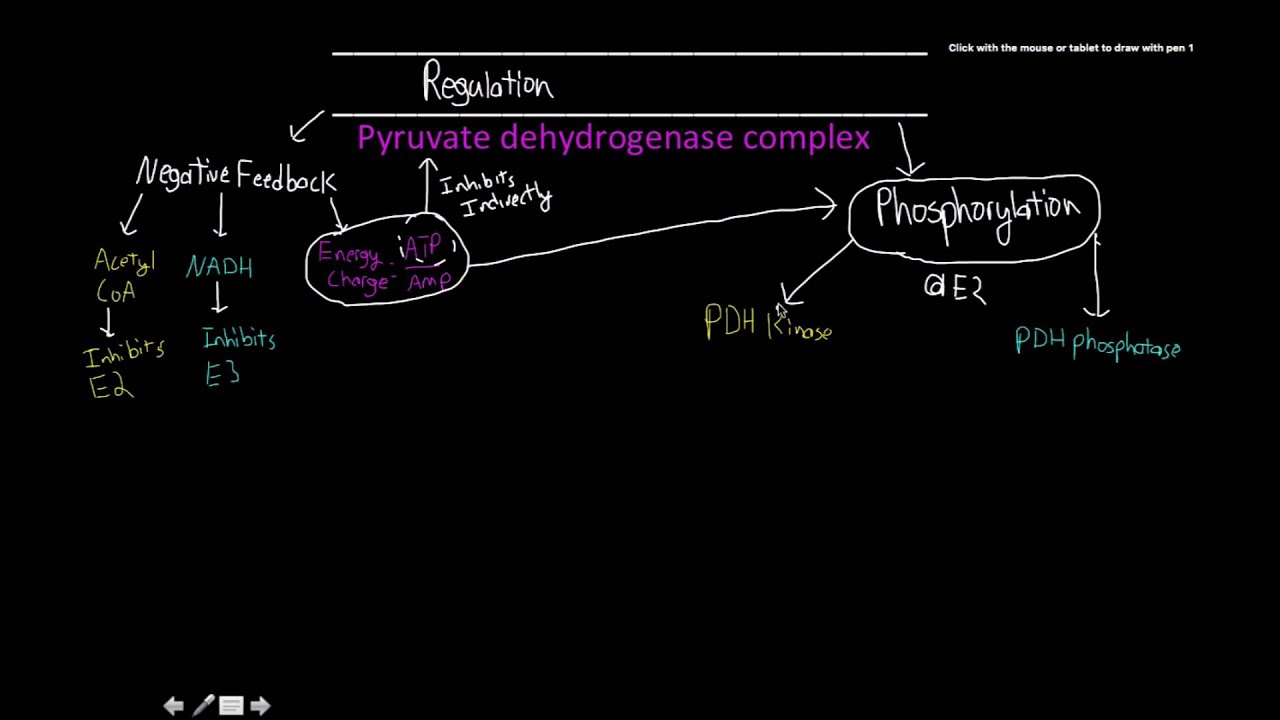
The activity of the PDC is tightly regulated to ensure that energy production is matched to the cell's needs. Regulation occurs at multiple levels:
Allosteric Regulation
- Inhibitors: High levels of ATP, NADH, and acetyl-CoA inhibit the PDC, signaling that the cell has sufficient energy and reducing the conversion of pyruvate to acetyl-CoA.
- Activators: High levels of ADP and pyruvate activate the PDC, indicating a need for more energy production.
Covalent Modification
- Phosphorylation: The PDC is inactivated by phosphorylation of the E1 subunit by pyruvate dehydrogenase kinase (PDK). This kinase is activated by high levels of ATP, NADH, and acetyl-CoA.
- Dephosphorylation: The PDC is reactivated by dephosphorylation of the E1 subunit by pyruvate dehydrogenase phosphatase (PDP). This phosphatase is activated by high levels of calcium ions and insulin.
Clinical Significance
Defects in the PDC can lead to severe metabolic disorders. One such disorder is Pyruvate Dehydrogenase Complex Deficiency (PDCD), which can result in lactic acidosis, neurological deficits, and developmental delays. This condition is often caused by mutations in the genes encoding the PDC subunits or regulatory enzymes.
Treatment options for PDCD are limited but may include:
- Dietary management: A ketogenic diet, which is high in fats and low in carbohydrates, can help bypass the metabolic block by providing an alternative source of acetyl-CoA.
- Cofactor supplementation: Administration of thiamine (vitamin B1) or lipoic acid may help improve PDC activity in some patients.