Devil-bean / Wedge-leaf Rattlepod
Constituents
Crotalaria retusa is a species of flowering plant in the legume family, Fabaceae. This plant is notable for its vibrant yellow flowers and its unique seed pods that produce a rattling sound when shaken, hence the name "rattleweed." Native to tropical and subtropical regions, Crotalaria retusa has a variety of uses and ecological impacts.
Botanical Description
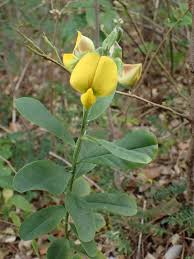
Crotalaria retusa is an erect, annual or short-lived perennial herb that can grow up to 1.5 meters in height. The plant has a robust, woody stem and branches that are covered with fine hairs. The leaves are simple, oblong to lanceolate, and arranged alternately along the stem. Each leaf is typically 5-10 cm long and 2-4 cm wide, with a smooth margin and a pointed tip.
The flowers of Crotalaria retusa are its most striking feature. They are bright yellow and borne in dense, terminal racemes. Each flower is about 1.5-2 cm long and has a typical pea-flower structure, with a large, upright banner petal, two lateral wing petals, and two lower keel petals that are fused together. The flowering period usually occurs in the late summer to early fall.
The fruit is a cylindrical pod, 3-5 cm long, that turns brown and becomes papery as it matures. Inside the pod are several small, hard seeds that rattle when the pod is shaken, giving the plant its common name.
Habitat and Distribution
Crotalaria retusa is native to tropical and subtropical regions of Africa, Asia, and the Americas. It thrives in a variety of habitats, including grasslands, open woodlands, and disturbed areas such as roadsides and agricultural fields. The plant prefers well-drained soils and can tolerate a range of soil types, from sandy to clayey.
Due to its adaptability, Crotalaria retusa has become naturalized in many parts of the world, including Australia, the Pacific Islands, and the southeastern United States. In some regions, it is considered an invasive species because it can outcompete native vegetation and disrupt local ecosystems.
Ecological and Agricultural Importance
Crotalaria retusa plays a significant role in its native and introduced habitats. As a legume, it has the ability to fix atmospheric nitrogen through a symbiotic relationship with root-dwelling bacteria. This process enriches the soil with nitrogen, making it more fertile and beneficial for other plants.
In agriculture, Crotalaria retusa is sometimes used as a cover crop or green manure. Its nitrogen-fixing ability helps improve soil fertility, and its dense foliage can suppress weeds and reduce soil erosion. However, care must be taken to manage its growth, as it can become invasive.
Toxicity and Uses
While Crotalaria retusa has some beneficial uses, it is also known for its toxicity. The plant contains pyrrolizidine alkaloids, which are toxic to livestock and humans if ingested. These compounds can cause liver damage and other health issues. Therefore, it is important to prevent grazing animals from consuming the plant and to handle it with care.
Despite its toxicity, Crotalaria retusa has been used in traditional medicine in some cultures. Extracts from the plant have been used to treat various ailments, including skin infections and respiratory issues. However, such uses should be approached with caution due to the potential for toxicity.
Conservation and Management
In regions where Crotalaria retusa is considered invasive, management strategies are necessary to control its spread. These strategies may include mechanical removal, the use of herbicides, and the promotion of native vegetation to outcompete the invasive species. Public awareness and education are also important to prevent the unintentional spread of the plant.
In its native range, conservation efforts focus on preserving the natural habitats where Crotalaria retusa plays a beneficial ecological role. Protecting these habitats ensures the continued availability of the plant's ecological services, such as soil enrichment and habitat provision for various insects and animals.