Common yellow monkeyflower
Energetics: Neutral to Cool, Sl. Moist
Actions: Relaxant nervine, anti-depressant, anti-inflammatory, vulnerary, anodyne
Wikipeda
Mimulus guttatus, with the common names Seep monkeyflower and Common yellow monkeyflower, is a yellow bee-pollinated annual or perennial plant.
DISTRIBUTION
It is a herbaceous wildflower that grows along the banks of streams and seeps in western North America. Both annual and perennial forms occur throughout the species' range.
It is found in a wide range of habitats including the splash zone of the Pacific Ocean, the chaparral of California, Western U.S. deserts, the geysers of Yellowstone National Park, alpine meadows, serpentine barrens, and even on the toxic tailings of copper mines.
It is sometimes aquatic, its herbage floating in small bodies of water.
DESCRIPTION
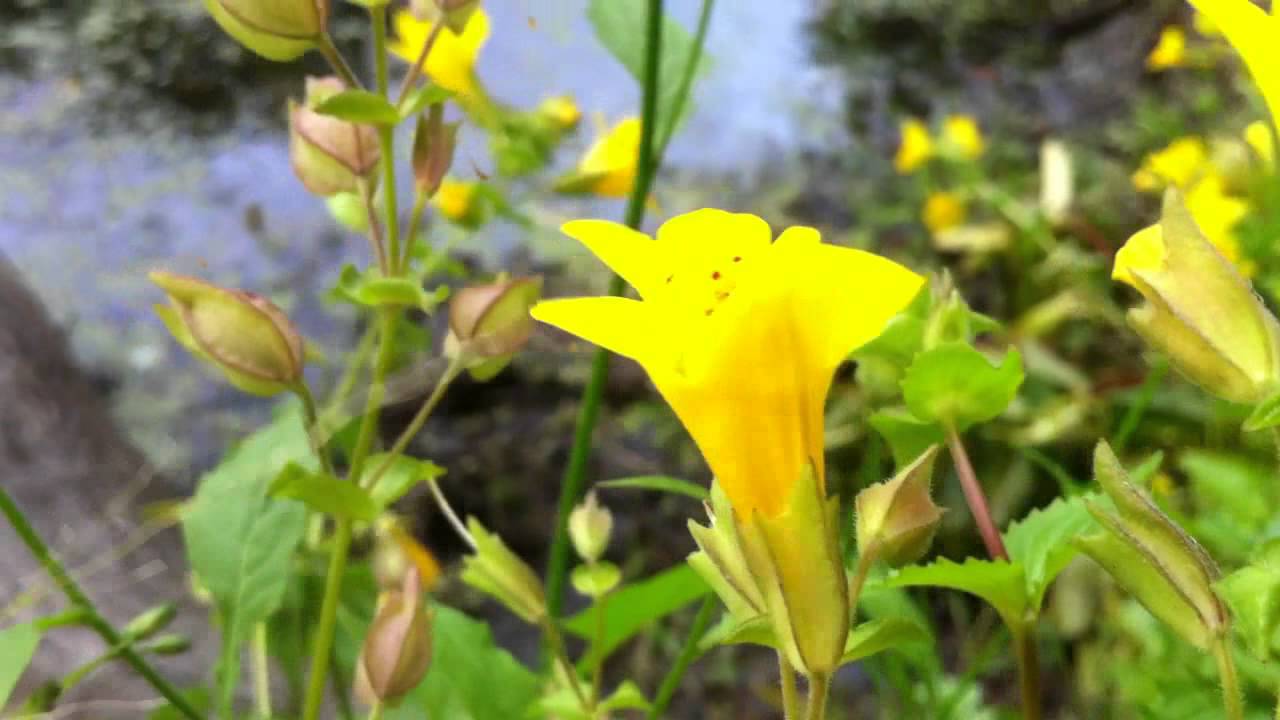
The lower lip may have one large to many small red to reddish brown spots. The opening to the flower is hairy.
A highly variable plant, taking many forms, Mimulus guttatus is a species complex in that there is room to treat some of its forms as different species by some definitions.
Mimulus guttatus is 10 to 80 cm tall with disproportionately large, 20 to 40 mm long, tubular flowers. The perennial form spreads with stolons or rhizomes. The stem may be erect or recumbent. In the latter form, roots may develop at leaf nodes. Sometimes dwarfed, it may be hairless or have some hairs.
Leaves are opposite, round to oval, usually coarsely and irregularly toothed or lobed. The bright yellow flowers are born on a raceme, most often with five or more flowers.
The calyx has five lobes that are much shorter than the flower. Each flower has bilateral symmetry and has two lips. The upper lip usually has two lobes; the lower, three. The lower lip may have one large to many small red to reddish brown spots. The opening to the flower is hairy.
Taxonomy
Mimulus guttatus has been a model organism for studies of evolution and ecology. There may be as many as 1000 scientific papers focused on this species. The genome is (as of 2012) being studied in depth.
EDIBLE USES
The leaves are edible raw or cooked, usually as a mild, slightly bitter salad green or pot herb.
CULTIVATION
Mimulus guttatus is cultivated in the specialty horticulture trade and available as an ornamental plant for: traditional gardens; natural landscape, native plant, and habitat gardens.