Ground Tissue System
The ground tissue of plants includes all tissues that are neither dermal nor vascular. It can be divided into three types based on the nature of the cell walls. Its responsible for the photosynthetic layer in leaves.
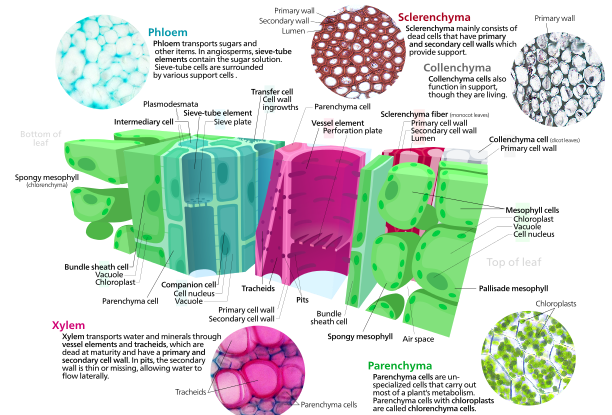
- Parenchyma are the most abundant and versatile cell type in plants. They have primary cell walls which are thin and flexible, and most lack a secondary cell wall. Parenchyma cells are totipotent, meaning they can divide and differentiate into all cell types of the plant, and are the cells responsible for rooting a cut stem. Most of the tissue in leaves is comprised of parenchyma cells, which are the sites of photosynthesis, and parenchyma cells in the leaves contain large quantities of chloroplasts for phytosynthesis. In roots, parenchyma are sites of sugar or starch storage, and are called pith (in the root center) or cortex(in the root periphery). Parenchyma can also be associated with phloem cells in vascular tissue as parenchyma rays. Parenchyma cells have thin primary walls and usually remain alive after they become mature. Parenchyma forms the "filler" tissue in the soft parts of plants, and is usually present in cortex, pericycle, pith, and medullary rays in primary stem and root.
- Collenchyma cells have thin primary walls with some areas of secondary thickening. Collenchyma provides extra mechanical and structural support, particularly in regions of new growth. Collenchyma, like parenchyma, lack secondary cell walls but have thicker primary cells walls than parenchyma. They are long and thin cells that retain the ability to stretch and elongate; this feature helps them provide structural support in growing regions of the shoot system. They are highly abundant in elongating stems. The “stringy” bits of celery are primarily collenchyma cells.
- Sclerenchyma cells have thick lignified secondary walls and often die when mature. Sclerenchyma provides the main structural support to a plant. Schlerenchyma cells have secondary cell walls composed of lignin, a tough substance that is the primary component of wood. Schelrenchyma cells therefore cannot stretch, and they provide important structural support in mature stems after growth has ceased. Interestingly, schlerenchyma cells are dead at functional maturity. Schlerenchyma give pears their gritty texture, and are also part of apple cores. We use sclerenchyma fibers to make linen and rope.
Cross section of a leaf showing various ground tissue types: