Yellow Dock, Prep & Dose
The Yellow (or sometimes Curled) Dock is so ubiquitous (grassland, field margins and waste ground) that cultivation is unlikely to be necessary. The roots should ideally be dug up from August to October. They can be quite tough, but rough slicing with secateurs will suffice if you opt for long maceration.
Decoction and fluid extract and tincture serve best for internal and external use. Gargles, fomentations, washes, salves are all excellent ways of treating mouth, gum, throat, skin and joint conditions.
Red dock may be used instead of this herb with similar, though weaker, effects
Standard Decoction put 1-2 tsp of root in a cup of water. bring to the boil and simmer gently for 10-15 mins.- 2-4 ounces 2 times daily
Tincture: Fresh root (1:2, 95% alcohol); dried root (1:5, 60% alcohol); 10 drops to 2 ml 3 times daily
Fluid Extract2.0-4.5 ml of 1:2 liquid extract per day (Bone).
Powder or Capsule 100 mg 3 times daily; the looser the stool, the smaller the dose
Combinations: Dandelion, Burdock and Cleavers (Hoffman)
Physio-Medical Therapeutics, Materia Medica and Pharmacy BY T. J. LYLE, A.M.M. 1897
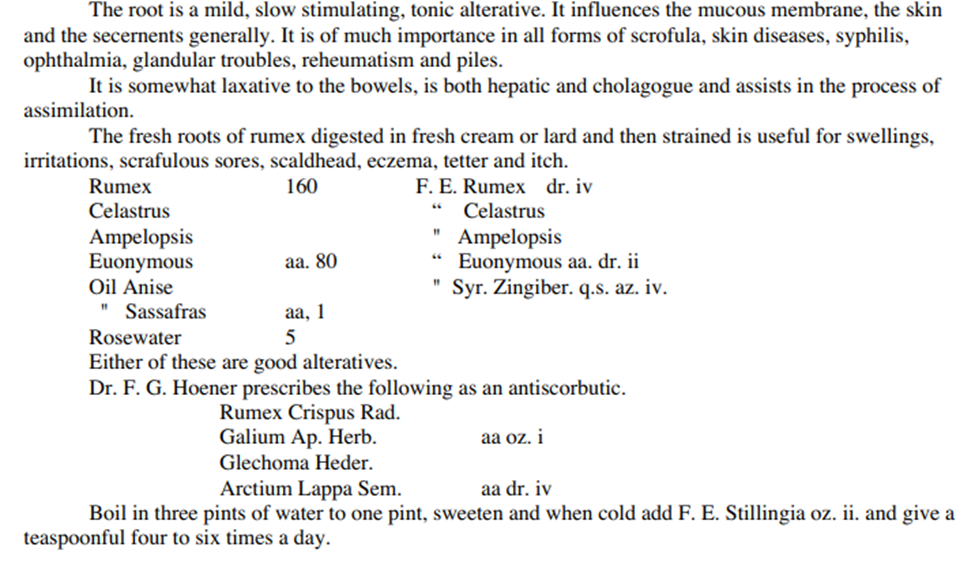
The Physiomedical Dispensatory by William Cook, M.D., 1869
Pharmaceutical Preparations: I. Decoction. Boil two ounces of the dried and crushed root, for ten minutes, in a pint of water; strain with pressure, and give one to two fluid ounces four times a day.
II. Extract. A common extract is made with water, and a hydro-alcoholic extract is also made, in the usual manner. They are seldom used internally, though some physicians use them in the formation of their rumex sirups; but while such a preparation may be made conveniently, it is not elegant. The principal use made of the extract, is in the formation of ointments.
III. Ointment. The most elegant ointment is formed by mashing four ounces of the fresh roots, digesting them at a low heat in pure cream or lard, and straining when the roots begin to get crisp. It is a soothing and strengthening application for salt rheum, tetter, eczema, itch, scrofulous sores, scald head, and other irritable skin diseases. An ointment may also be formed by softening half an ounce of the hydro-alcoholic extract with a sufficient quantity of seventy percent alcohol, and triturating it with two ounces of simple cerate and a few drops of olive oil. That with cream and the fresh roots is best, but is not easily preserved beyond two or three days.
IV. Compound Sirup. Root of rumex, two pounds; celastrus scandens, scrophularia marilandica, each, one pound; guaiacum chips, gentiana ochroleuca, each, four ounces. Macerate in a close vessel with a pint of alcohol and two quarts of water, for two days; transfer to a percolator, and add water, setting aside the first quart that passes; continue the percolation with water till the drugs are exhausted, add fourteen pounds of sugar, and evaporate to seven quarts. When cold add the quart of tincture first obtained; and then triturate and add ten drops of oils of anise and sassafras, and an ounce of rose water. This is different from the common sirup of this name; and is a far more efficient preparation for scrofula, cutaneous affections, secondary syphilis, etc. Dose, two to four fluid drachms three times a day. The common sirup prepared under this name, is composed of two pounds rumex, one pound celastrus, and half a pound each ampelopsis and scrophularia, made into two gallons of sirup. It is a good preparation; but is made up of so many relaxants as to lack the sustaining vigor that is secured by the above formula.
Rumex enters into combination with a large number of alterants and alterant tonics, and is everywhere valued as one of the best of its class.