Fire pink
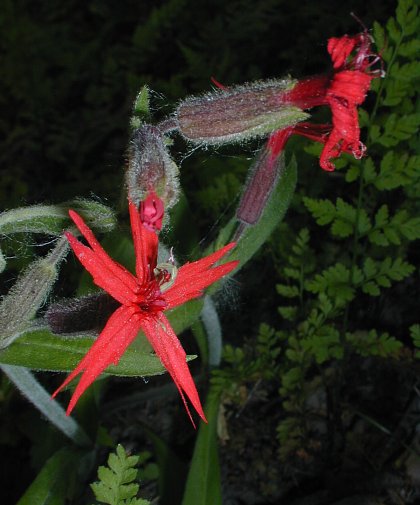
The Fire Pink, scientifically known as Silene virginica, is a striking perennial wildflower native to the eastern United States. Known for its vibrant red blooms, this plant is a favorite among gardeners and nature enthusiasts alike. Its vivid color and unique structure make it a standout in any natural setting.
Description
Fire Pink is a member of the Caryophyllaceae family, commonly referred to as the pink or carnation family. This herbaceous perennial typically grows to a height of 12 to 24 inches. The plant is characterized by its slender, hairy stems and lance-shaped leaves, which are arranged oppositely along the stem. The leaves are a bright green, providing a perfect backdrop for the plant's most notable feature: its flowers.
The flowers of the Fire Pink are a brilliant scarlet red, with each bloom measuring about 1 to 1.5 inches across. The petals are deeply notched, giving them a star-like appearance. This unique shape, combined with the flower's vivid color, makes it highly attractive to pollinators, particularly hummingbirds and butterflies.
Habitat and Distribution
Fire Pink is native to the eastern United States, with its range extending from New York and Pennsylvania in the north, down to Georgia and Alabama in the south, and as far west as Missouri and Arkansas. It thrives in open woodlands, rocky slopes, and along roadsides, preferring well-drained soils and partial to full sun exposure.
This plant is often found in areas with limestone or sandstone bedrock, which provide the alkaline conditions it favors. Its ability to grow in rocky, less fertile soils makes it an excellent choice for naturalizing in challenging garden sites.
Cultivation and Care
For gardeners interested in cultivating Fire Pink, it is important to mimic its natural habitat as closely as possible. Here are some tips for successful cultivation:
- Soil: Ensure well-drained soil, preferably with a slightly alkaline pH. Adding lime can help achieve the desired soil conditions.
- Light: Plant in an area that receives partial to full sun. While Fire Pink can tolerate some shade, too much can reduce flowering.
- Watering: Water regularly during dry spells, but avoid overwatering, as the plant is susceptible to root rot in overly moist conditions.
- Propagation: Fire Pink can be propagated by seed or division. Seeds should be sown in the fall or early spring, while division is best done in the spring.
Ecological Importance
Fire Pink plays a significant role in its ecosystem. Its bright red flowers are specifically adapted to attract hummingbirds, which are its primary pollinators. The tubular shape of the flowers is perfectly suited to the long bills of hummingbirds, facilitating efficient pollination.
In addition to hummingbirds, Fire Pink also attracts various species of butterflies and bees, contributing to the biodiversity of its habitat. By providing nectar and pollen, it supports these pollinators, which in turn help maintain the health of the ecosystem.
Conservation Status
While Fire Pink is not currently listed as threatened or endangered, its populations can be affected by habitat loss and environmental changes. Conservation efforts focus on preserving its natural habitats and promoting native plant gardening to ensure its continued presence in the wild.
Interesting Facts
- The name "Fire Pink" is derived from the plant's fiery red flowers and its membership in the pink family, despite the flowers not being pink in color.
- The plant's scientific name, Silene virginica, is believed to be derived from Silenus, a character in Greek mythology known for his association with the god Dionysus and his love of wine, possibly referencing the plant's intoxicating beauty.
- Fire Pink is sometimes confused with its close relative, the Royal Catchfly (Silene regia), which also features red flowers but is generally taller and has a more robust growth habit.