Forest Layers
See also: Forest Gardens
Permaculture:
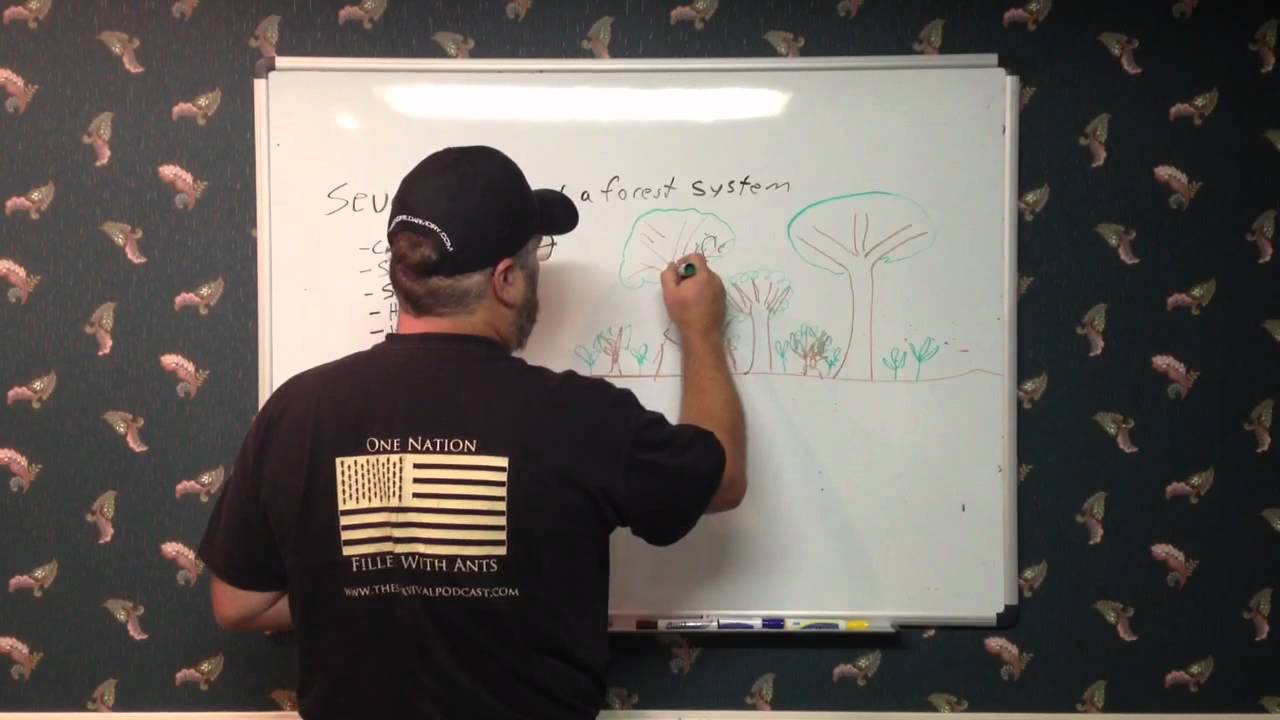
The Layers of a Forest From Floor to Canopy
Species Composition
The species composition of a forest is often unique to that forest, with some forests consisting of many hundreds of species of trees while others consist of just a handful of species. Forests are constantly changing and progress through a series of successional stages during which species composition changes within the forest.
Thus, making general statements about forest habitats can be difficult. Yet despite the variability of our planet's forests, there are some basic structural characteristics that many forests share—characteristics that can help us to better understand both forests and the animals and wildlife that inhabit them.
The Layers of a Forest
Mature forests often have several distinct vertical layers. These include:
- Forest floor layer: The forest floor is often blanketed with decaying leaves, twigs, fallen trees, animal scat, moss, and other detritus. The forest floor is where recycling occurs, fungi, insects, bacteria, and earthworms are among the many organisms that break down waste materials and ready them for reuse and recycling throughout the forest system.
- Herb layer: The herb layer of the forest is dominated by herbaceous (or soft-stemmed) plants such as grasses, ferns, wildflowers, and other ground covers. Vegetation in the herb layer often gets little light and in forests with thick canopies, shade tolerant species are predominant in the herb layer. This layer contains mostly non-woody vegetation, or ground cover, growing in the forest with heights of up to about one and a half metres. The herb layer consists of various herbaceous plants (therophytes, geophytes, cryptophytes, hemicryptophytes), dwarf shrubs chamaephytes) as well as young shrubs or tree seedlings. In forests, early flowering plants appear first before the canopy fills out. Thereafter, the amount of light available to plants is significantly reduced and only those that are suited to such conditions can thrive there. By contrast, grassland consists of only moss and herb layers. Sometimes, a shrub layer builds up in grasslands as part of a process of spontaneous reforestation (ecological succession).
- Shrub layer: The shrub layer is characterized by woody vegetation that grows relatively close to the ground. Bushes and brambles grow where enough light passes through the canopy to support shrub growth. The shrub layer is the stratum of vegetation within a habitat with heights of about 1.5 to 5 metres. This layer consists mostly of young trees and bushes, and it may be divided into the first and second shrub layers (low and high bushes). The shrub layer needs sun and little moisture, unlike the moss layer which requires a lot of water. The shrub layer only receives light filtered by the canopy, i.e. it is preferred by semi-shade or shade-loving plants that would not tolerate bright sunlight. Small to medium sized birds sometimes known as bush nesters are often found in the shrub layer where their nests are protected by foliage. European examples include blackbird, song thrush, robin or blackcap. In addition to shrubs, such as elder, hazel, hawthorn, raspberry and blackberry, clematis may also occur while, in other parts of the world, vines and lianas may form part of this stratum. At the edge of a woodland the shrub layer acts as a windbreak close to the trees and protects the soil from drying out.
- Understory layer: The understory of a forest consists of immature trees and small trees that are shorter than the main canopy level of the tree. Understory trees provide shelter for a wide range of animals. When gaps form in the canopy, often times understory trees take advantage of the opening and grow to fill in the canopy. The understory is the underlying layer of vegetation in a forest or wooded area, especially the trees and shrubs growing between the forest canopy and the forest floor. Plants in the understory comprise an assortment of seedlings and saplings of canopy trees together with specialist understory shrubs and herbs. Young canopy trees often persist in the understory for decades as suppressed juveniles until an opening in the forest overstory permits their growth into the canopy. In contrast understory shrubs complete their life cycles in the shade of the forest canopy. Some smaller tree species, such as dogwood and holly, rarely grow tall and generally are understory trees
The canopy of a tropical forests are typically about 10m thick, and intercepts around 95% of the sunlight. The understory therefore receives less intense light than plants in the canopy and such light as does penetrate is impoverished in wavelengths of light that are most effective for photosynthesis. Understory plants therefore must be shade tolerant—they must be able to photosynthesize adequately using such light as does reach their leaves. They often are able to use wavelengths that canopy plants cannot. In temperate deciduous forests towards the end of the leafless season, understory plants take advantage of the shelter of the still leafless canopy plants to "leaf out" before the canopy trees do. This is important because it provides the understory plants with a window in which to photosynthesize without the canopy shading them. This brief period (usually 1–2 weeks) is often a crucial period in which the plant can maintain a net positive carbon balance over the course of the year.
As a rule forest understories also experience higher humidity than exposed areas. The forest canopy reduces solar radiation, so the ground does not heat up or cool down as rapidly as open ground. Consequently, the understory dries out more slowly than more exposed areas do. The greater humidity encourages epiphytes such as ferns and mosses, and allows fungi and other decomposers to flourish. This drives nutrient cycling, and provides favorable microclimates for many animals and plants, such as the pygmy marmose
- Canopy layer: The canopy is the layer where the crowns of most of the forest's trees meet and form a thick layer.
- Emergent layer: Emergents are trees whose crowns emerge above the rest of the canopy.
Mosaic of Habitats
These different layers provide a mosaic of habitats and enable animals and wildlife to settle into various pockets of habitat within the overall structure of a forest. Different species use the various structural aspects of the forest in their own unique ways. Species might occupy overlapping layers within a forest but their use of those layers might occur at different times of the day so that they do not compete with one another