Smooth Sumac
Videos
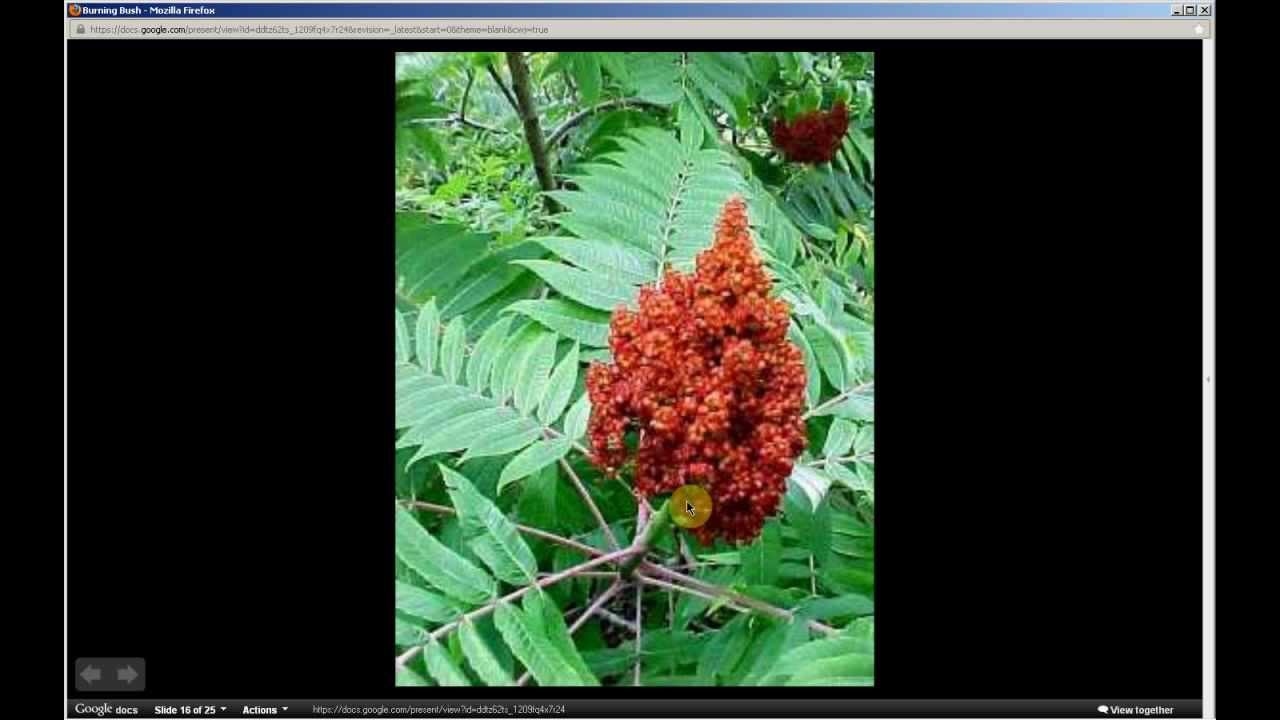

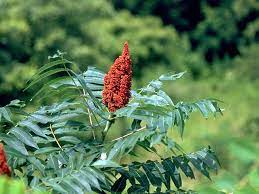
Smooth sumac is a deciduous shrub which occurs on prairies, fields, abandoned farmland, clearings and along roads and railroads throughout the United States and Canada. A large, open, irregular, spreading shrub which typically grows 8-15' tall and spreads by root suckers to form thickets or large colonies in the wild. Very similar to staghorn sumac (R. typhina), except the young stems of staghorn are densely pubescent whereas those of this species are smooth, hence the common name. Large, compound pinnate, shiny, dark green leaves (each with 9-27 leaflets) grow to 18" long with a fern-like appearance and turn attractive shades of bright orange to red in autumn. Tiny, yellowish-green flowers bloom in terminal panicles (5-10" long) in late spring to early summer, with separate male and female flowers appearing on separate plants (dioecious). Female plants produce showy, erect, pyramidal fruiting clusters (to 8" long). Each cluster contains numerous hairy, berry-like drupes which ripen red in autumn, gradually turning maroon-brown as they persist through most of the winter. Fruit is attractive to wildlife.
Constituents
- Listing on Duke's Database
- Antimicrobial constituents of Rhus glabra
- Antimicrobial Activity, Cytotoxicity and Phytochemical Analyses of Rhus aromatica, Rhus glabra and Sanguinaria canadensis Native to South Dakota
Rhus glabra, commonly known as Smooth Sumac, is a shrub native to North America. For centuries, indigenous cultures have revered this plant for its medicinal and nutritional properties. In recent years, scientific research has begun to unveil the bioactive compounds and therapeutic potential of Rhus glabra, corroborating and expanding upon the traditional knowledge associated with this remarkable botanical.
Rhus glabra, also known as Smooth Sumac, has been used medicinally by various Native American tribes to treat a variety of complaints. The plant is valued for its astringent and antiseptic qualities. A tea made from the bark or root bark is alterative, antiseptic, astringent, galactogogue, haemostatic, rubefacient and tonic. It is used in the treatment of diarrhea, fevers, general debility, sore mouths, rectal bleeding, uterine prolapse etc. It is used as a gargle to treat sore throats and applied externally to treat excessive vaginal discharge, burns and skin eruptions. The powdered bark can be applied as a poultice to old ulcers.
Native American Uses
CHEROKEE-blisters
CREEK-dysentery-The roots are boiled and the decoction is drunk to cure dysentery.
This has astringent, alterative and tonic properties, and is useful in dysentery, diarrhea and leucorrhea.
The combination of Rhus glabra and Rhus copallina makes a very strong astringent application for blisters.
Physio-Medical Therapeutics, Materia Medica and Pharmacy BY T. J. LYLE, A.M.M. 1897
The leaves, berries and bark are all more or less positive astringents. The leaves are the least astringent, but are valuable in dysentery and hemorrhage of lungs or uterus.
The bark is more stimulating, astringing and toning, and is valuable for leucorrhoea, inflammation of the bladder, and for rectal troubles, chronic diarrhoea and rectal hemorrhages. A hot infusion gives a somewhat fuller outward circulation. It is a good wash for aphthous sore mouth and spongy gums:
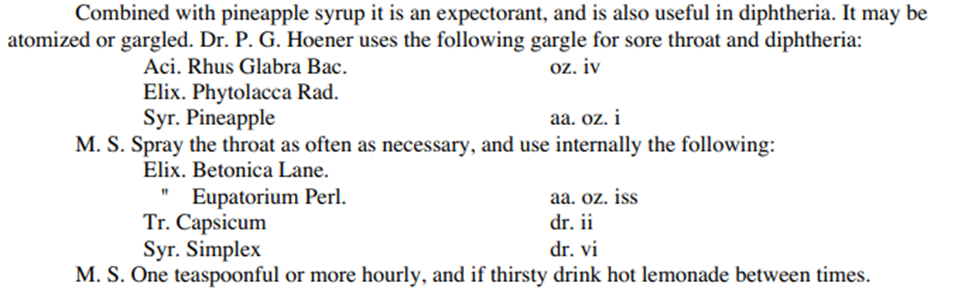
Dr. F. G. Hoener has with this agent cured several cases of prolapsus ani, and several cases of prolapsus uteri that had by others been pronounced incurable. The berries are a pleasant acid astringent. Fill a vessel full of berries. cover with boiling water and steep a half hour. Then strain and sweeten to suit the taste. This is a good beverage to allay irritation of the bladder and in the treatment of diabetes and for the relief of bloody urine.
The Physiomedical Dispensatory by William Cook, M.D., 1869
This species of sumach is common on thin and sandy soils in all parts of the United States, forming a shrub from six to twelve feet high, with numerous nearly horizontal branches; sometimes forming a small and bushy-topped tree fifteen feet high. Leaves compound, of eleven to thirty-one pinnate leaflets, winch are oblong-lanceolate acuminate, sharply serrate, very smooth, green above, pale beneath, turning bright red in autumn. Flowers polygamous, in oval and thyrsoid panicles, terminal; sepals five; petals five greenish- white, inserted on the calyx. Fruit a single dry drupe (called berry) to each flower, globular, clothed with acid and crimson hairs, with a smooth and hard stone. Blooming in June and July.
This species of sumach is readily distinguished by its light grayish-red and smooth bark; and by the large, oval cluster of brilliant red berries which ripen in early autumn, and sometimes remain nearly all winter. There are three poisonous species of rhus, (used by Allopathists, Homeopathists, and Eclectics,) which are distinguished by bearing their flowers in loose and slender panicles in the axils of leaves–rhus toxicodendron being a vine with trifoliate leaves, and rhus venenata (the more poisonous) a shrub with seven to thirteen pinnae in each leaf. The fruit of the poisonous species is of a whitish dun color, and is not covered with hairs.
Properties and Uses: The leaves are a very pure astringent of the same soothing character as the leaves of hamamelis, but much stronger and more drying. They may be used for the same general purposes as the hamamelis; and also make a good wash in light cases of aphthous sores. They are seldom used but deserve much consideration in leucorrhea, and prolapsus spongy gums, capillary hemorrhage, and other cases where a reliable local astringent is needed. Small excrescences are often found upon them, which are nearly equal to the nut galls.
The bark of the root is a stimulating astringent, of tonic action and moderately antiseptic powers. Its chief action is upon the mucous membranes; and is of much greater power than is generally supposed in laxity of the bowels, chronic and camp diarrhea, and intestinal hemorrhage. Acute and sub-acute diarrhea are cases in which it should not be employed; but in camp diarrhea, and other cases of liquid and offensive stools, an infusion is of much value for giving due tone to the mucous structures and fullness to their capillary circulation. Also of superior excellence as a wash in foul leucorrheal discharge and chronic prolapsus; and a gargle in aphthous sores, in diphtheria, and scarlatina, and in mercurial sore mouth. It may also be applied in powder to flabby and ichorous ulcers, and those of a phagedaenic tendency, but not to sensitive or dry ones; and I have found much benefit from it in phagedaenic chancres and buboes. As an astringent, it acts upon the assimilative organs much as myrica does; and may be added to tonics in the treatment of scrofulous maladies with diarrhea; and in constitutional mercurial and mercurio-syphilitic maladies, may be used with alterants. An infusion, combined with such diffusives as zingiber and caulophyllum, is of much value in uterine and pulmonary hemorrhage; and it is an agent that promises well in hemorrhagia purpurea, and other forms of the hemorrhagic diathesis. Half an ounce to a quart of boiling water, simmered for ten minutes in other than an iron vessel, forms an ordinary decoction; of which from one to two fluid ounces may be given every three hours in chronic difficulties, or every half hour in hemorrhages. A fluid extract is prepared as in myrica.
The berries, or more properly the hairs which cover the fruit, are of a very pleasant though rather transient acid taste, moderately stimulating and astringent. They act on the kidneys as well as mucous membranes; are of service as a gargle in quinsy, and mild forms of sore throat and aphthous sores; are sometimes used as a drink in bilious and bilious remitting fever; and have been commended as a good remedy in diabetes, though probably not on good grounds. The acidity of these berries is said to depend upon malic acid.
A gum exudes from the bark on its being slit; and this is a soothing and demulcent remedy, which promises to be of service in irritable bowels, kidneys, and lungs.