Brain-Gut-Microbiome System
Return to Nervous System Menu
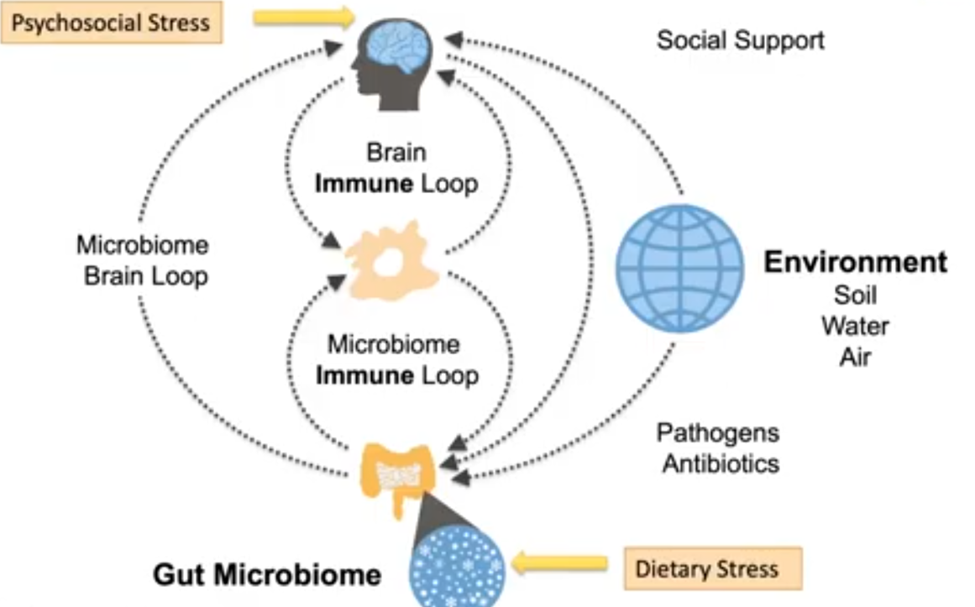
The gut microbiome communicates to the brain via the vagus nerve, through the production of neurotransmitters and via its communication with the immune system. This is a bidirectional multi-lane highway between gut microbiome and brain.
A very important role of the microbiome is in depression and anxiety.
The gut has a complex nervous system, which interfaces directly with the brain and allows bidirectional information flow between the microbiota and the brain. This close interaction suggests that aspects of brain development, function, mood, and cognition may be influenced by our gastrointestinal contents.
There is evidence for multiple pathways of communication from the intestinal microbiota to the CNS including vagal afferent nerves, immune and HPA axis modulation, and production of active metabolic products.
Accumulating evidence, largely from animal studies, suggests that different types of psychological stress can affect the composition of the gut microbiota. For example, maternal separation, restraint conditions, crowding, heat stress, and acoustic stress all alter the composition of the gut microbiota (Bailey et al., 2011; De Palma et al., 2014; Moloney et al., 2014). In addition, a growing body of data suggests that the microbiota may be involved in controlling behaviors relevant to stress-related disorders. Bacterial metabolites include many neuroactive agents.
Interestingly, there is now a growing appreciation of the role of epigenetic mechanisms in shaping brain and behavior, and it is worth noting that many bacterial metabolites can act as epigenetic modifiers (Stilling et al., 2014a).
Several specific strains of gut bacteria have been shown to produce and secrete neurotransmitters locally, including biologically active compounds such as GABA, serotonin, catecholamines and histamine.
In health, it is presumed that other less dramatic interactions between the gut and brain occur via this route as metabolites such as short chain fatty acids, biogenic amines, neurotransmitters and neurotransmitter precursors produced by the microbiota gain access to the systemic circulation. Examples include the production of short chain fatty acids, which may affect satiety signals, or tryptophan production, which could influence circulating serotonin levels and mood. Anxiety related metabolic profiles in blood and urine were demonstrated by Martin et al., to be consistent with altered microbial activity. They found that daily intake of dark chocolate, often reported to have positive effects on mood, decreased two specific products of gut microbial activity, hippurate and p-creso sulfate, though changes in subjective mood states were not reported.
Videos
Why science says to listen to your gut
The Gut Brain Connection
The gut-brain axis: Grow your gut, Expand your mind
The Gut-Brain Axis - Gut Microbiome Influences on Neurological Disease
Mind-altering microbes: how the microbiome affects brain and behavior
Heribert Watzke: The brain in your gut
Serotonin and the Gut Brain Connection
Seminar: "Stress and the Brain-Gut-Microbiota Axis" (prof. John F. Cryan, PhD)
How to optimize your gut and brain bacteria | Dave Asprey
Chronic Pain in the Brain-Gut Axis
Dr. John Bergman - The Gut Brain Connection & Your Health Questions Answered
Cross Talk Between Gut & Brain 0 A. Fasano, MD
Proving Causality in the Brain Gut Axis
The Mind-Gut Connection - A Woman's Journey
Articles/Studies
- Brain-to-gut connections traced Using rabies virus injected into the stomach of rats, researchers trace the nerves back to the brain and find distinct 'fight or flight' and 'rest and digest' circuits. These results explain how mental states can affect the gut, and present new ways to treat gastrointestinal problems.
- How the gut communicates with the brain New research has discovered how the enteric nervous system -- or 'second brain' -- can communicate with both the brain and spinal cord, which up until now had remained a major mystery. The study found specialized cells within the gut wall release serotonin when stimulated by food, which then acts on the nerves to communicate with the brain. The authors say as there is a direct connection between serotonin levels in our body and depression and how we feel, understanding how the gut communicates with the brain is of major importance.
- Mind-altering microorganisms: the impact of the gut microbiota on brain and behavior
• Germ free animals have decreased BDNF compared with controls (hippocampus and cortex)
• Depressed hippocampal BDNF levels in mice reversed with Bifidobacterium longum treatment
- Editorial for Special issue on Microbiome in neurological and psychiatric disease
- How Gut Neurons Communicate With the Brain to Control Thirst
- Mind-altering with the gut: Modulation of the gut-brain axis with probiotics
- Modulation of Gut Microbiota-Brain Axis by Probiotics, Prebiotics, and Diet There exists a bidirectional communication system between the gastrointestinal tract and the brain. Increasing evidence shows that gut microbiota can play a critical role in this communication; thus, the concept of a gut microbiota and brain axis is emerging. Here, we review recent findings in the relationship between intestinal microbes and brain function, such as anxiety, depression, stress, autism, learning, and memory. We highlight the advances in modulating brain development and behavior by probiotics, prebiotics, and diet through the gut microbiota-brain axis. A variety of mechanisms including immune, neural, and metabolic pathways may be involved in modulation of the gut microbiota-brain axis. We also discuss some future challenges. A deeper understanding of the relationship between the gut bacteria and their hosts is implicated in developing microbial-based therapeutic strategies for brain disorders.
- Fecal microbiota transplantation: a new therapeutic attempt from the gut to the brain.
- Gut microbiota is an impact factor based on the brain-gut axis to Alzheimer's disease.
- Gut-Brain Connection: Specific Bacteria in the Gut Prompt Mother Mice To Neglect Their Pups
- Butyrate, neuroepigenetics and the gut microbiome: Can a high fiber diet improve brain health? - PubMed
- The microbiota-gut-brain axis may provide novel approaches for prevention and treatment of mental illness, including anxiety and depression.
- New gut-brain link: How gut mucus could help treat brain disorders
- How Your Gut Controls Your Mind and What to Do About It
- For The First Time, Gut Bacteria Has Been Spotted Eating Chemicals In The Brain
- Vagal Gut-brain Axis Stimulation Produces Reward Behaviors
- Visceral Inflammation and Immune Activation Stress the Brain
- Necrotizing Enterocolitis, Gut Microbiota, and Brain Development: Role of the Brain-Gut Axis
- Kefir can signal through the microbiota-gut-immune-brain axis and modulate host behaviour.
- Gut/brain axis and the microbiota -
- Is GABA a link between gut and brain?
- Gut bacteria spotted eating brain chemicals for the first time
- Psychobiotics and the gut–brain axis: in the pursuit of happiness
- Gut to Brain Dysbiosis: Mechanisms Linking Western Diet Consumption, the Microbiome, and Cognitive Impairment
- Ingestion of *Lactobacillus* strain regulates emotional behavior and central GABA receptor expression in a mouse via the vagus nerve
- The gut-brain axis: influence of microbiota on mood and mental health.
- This reviews the potential mechanisms by which the gut microbiota may regulate the brain-gut axis and influence behaviour.
- The gut-immune-brain axis in autism spectrum disorders. -
- Gut-brain axis: Role of lipids in the regulation of inflammation, pain and CNS diseases
- The models suggest possible bidirectional communication between the gut and the brain for the genesis of PD-like phenotype and pathology.
- The microbiota-gut-brain axis is a modulator of host metabolism and appetite.
- Microbiota-gut-brain axis and the central nervous system.
- Adaptive Cytoprotection and the Brain-Gut Axis
- Dysfunction of the brain-gut axis could lead to both inflammatory and functional diseases of the gastrointestinal tract.
- The brain-gut axis contributes to neuroprogression in stress-related disorders.
- Curcumin** attenuates collagen-induced inflammatory response through the “gut-brain axis”
- Our Gut-Brain Connection Revealed by “Organs-on-a-Chip” System
- Gut-Brain Axis: Role of Gut Microbiota on Neurological Disorders and How Probiotics/Prebiotics Beneficially Modulate Microbial and Immune Pathways to Improve Brain Functions
- Lactobacillus rhamnosus GG colonization in early life regulates gut-brain axis and relieves anxiety-like behavior in adulthood.
- Dose-dependent action of cordycepin on the microbiome-gut-brain-adipose axis in mice exposed to stress.