Eastern Redbud
See also: Cercis (genus)
Videos
Identification during the Winter
Constituents
Chemical composition of the bark essential oil of *Cercis canadensis*L.(Fabaceae)
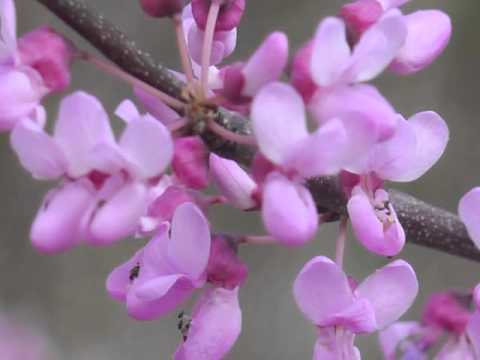
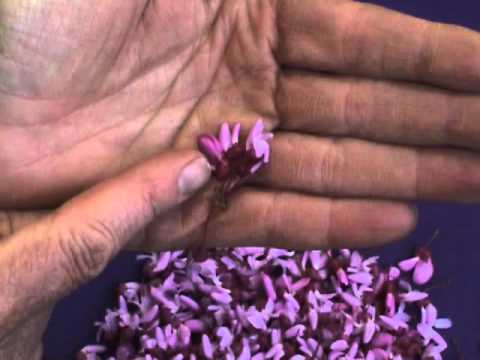
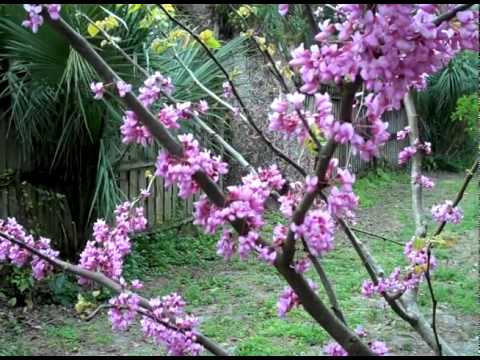
This favorite North American shrub or small tree grows up to about 30 feet tall and is characterized by its profuse and bright display of pink flowers early in the Spring through early Summer. The Eastern Redbud makes a beautiful ornamental plant, with all-year round interest. In the Spring it has its display of flowers, in the Summer it has heart-shaped leaves which in the Fall turn bright yellow, and then drop leaving the 2-4 inch long brown seed pods hanging on the branches into Winter. Also known as “Spicewood Tree” in Appalachia, the green twigs are used as a seasoning for wild game. The bark of the young shoots was also used by Native Americans for basketmaking. The flowers of the Redbud are edible and can be consumed fresh or dry. Native Americans consumed the flowers and roasted seeds. The flower buds are also edible and can be pickled like capers, making a gourmet treat!
Analysis of the flowers has found it contain antioxidant anthocyanins, as one would expect from the color of the blooms, and also vitamin C. The green seedpods also contained antioxidant proanthocyanidins, and the seeds contained linolenic, alphal-linolenic, oleic and palmitic acids. The inner bark was also used medicinally for its astringent properties, used for fever, diarrhea, coughs and dysentery. (Source)
Native American Uses
ALABAMA-congestion-The roots and inner bark are put into water. The resulting solution is drunk when there is congestion and fever. This congestion is supposed to be fatal unless relieved.
The bark is an active astringent.
The Physiomedical Dispensatory by William Cook, M.D., 1869
Description: Natural Order, Leguminosae. Genus CERCIS: The red-bud tree is quite common on hill-sides throughout the Middle and Western States; and is well known by its peculiarity of thickly covering the branches with small pink-red flowers before the leaves appear in Spring. Calyx five-toothed. Corolla scarcely papilionaceous, the petals being distinct; wing and keel petals long. Stamens ten, distinct. Fruit a compressed legume several inches long. Leaves broadly ovate-cordate, acuminate. Height twenty to thirty feet. Flowers appearing in early May, in small clusters along the branches, and giving the tree the appearance of being covered with small red leaves. The twigs will dye wool a nankeen color; and the wood is finely veined with black and green, and receives a good polish.
Properties and Uses: The leaves of this tree possess stimulating and astringing properties, and give promise of making a good tonic alterant. Several practitioners have told me they use it to advantage in low scrofulous conditions, and in secondary syphilis. It slightly binds the bowels; but may be used to advantage in company with menispermum and euonymus. Dr. Bratcher, of Eastern Kentucky, informs me that he makes external use of them in white swelling, especially where the vital action is quite indolent; and that they deserve much esteem in such cases. The article evidently deserves attention.
UNITED STATES DISPENSATORY - 1918
The bark of this beautiful leguminous tree, indigenous and well-known throughout the Eastern and Central United States on account of its brilliant red-purple flowers, which appear before the leaves, has been highly recommended by Wm. R. Smith as a mild but very active astringent in the treatment of chronic diarrhea and dysentery. Dose, of the
fluid extract, from half to one fluid-drachm (1.8-3.75 mils).
Physio-Medical Therapeutics, Materia Medica and Pharmacy BY T. J. LYLE, A.M.M. 1897
The leaves are a moderately stimulating, astringent tonic. The chief influence of this remedy is toward the mucous membrane and glandular system. It is valuable in scrofula when the bowels are weak and inclined to diarrhoea, or dysentery. Locally it forms a good wash for sores and swellings.