Alexandrian Senna
See Senna Leaf
Generally, commercially sold senna is this species.
Video

Overview
It's a well-studied cathartic from ancient times. A small shrub reaching 3-9 feet in height, forming pretty racemes of yellow flowers throughout the year, Senna is a native of tropical Africa, up through the Arabian Peninsula and India. Today, Senna is cultivated in other areas, including throughout Egypt, Sudan and India. Senna tolerates drought, as well as moderate irrigation, but requires well-drained soil. The Senna wood is sometimes used to make farm tools. However, Senna’s main use is as a laxative.
Since ancient times, Senna has been used as a laxative and purgative, as it contains the well-characterized anthraquinone derivatives that are known stimulant laxatives, including sennosides A and B. In the USA, Senna is an FDA approved over-the-counter drug for short-term treatment of constipation for adults and children over 2 years of age. When used short-term, Senna is safe, but can lead to dependency or liver toxicity if taken long-term or at too high doses. With the increasing geriatric population, gut issues due to the Standard American Diet and increasing numbers of people suffering from constipation associated with opioid dependence, the use and market for Senna continues to expand at a high rate.
Constituents
The active ingredients in Alexandria senna include a number of unique acids that have a range of effects on the human body. Some of these organic compounds include Chrysophanic acid and Cathartic acid, among other uncommon components. While the range of uses is relatively narrow, and in traditional times, almost exclusively included purgative treatments, the powerful effects of the plant are being used in many new ways.
Uses
Evidence-based Uses
Purgative
The foul taste of Alexandria senna and its almost instantaneous effect on the stomach can induce vomiting. For people who have consumed something toxic or need to essentially clear their stomach out in a hurry, Alexandria senna can help very quickly. This detoxifying effect, although quite extreme, can be helpful for clearing out the stomach, while the powerful laxative effects can clear out your colon. Essentially, Alexandria senna gives your body a complete cleanse. This can be very effective rather than the powerful drugs typically prescribed before a colonoscopy. For other medicinal uses, mixing senna with cloves, cinnamon, or other strong-tasting herbs can counter this nauseating effect. ^[3]
Parasite Cleaning
In many parts of the world, parasites are still a major threat to public health. The laxative effects of Alexandria senna are also anthelmintic, meaning that it helps to eliminate any worms or parasites in the gut. ^[4]
Anti-inflammatory Properties
Aside from its laxativeproperties, it can also help to soothe inflammation for people suffering from hemorrhoids. By softening stool to such a degree, it prevents painful bowel movements, which might often happen for those with anal fissures or severe hemorrhoids. ^[5]
Promotes Weight Loss
Some research suggests that Alexandria senna is able to prevent the absorption of calories into the blood due to how quickly it causes food to pass through the body. While this is certainly not a healthy long-term solution for weight loss, it can result in rapid weight loss over a short period of time. ^[6]
Boosts Immunity
A paste made of Alexandria senna can be applied to the skin to alleviate a wide range of skin irritation conditions, including psoriasis, acne, eczema, and pimples. There is an antibacterial element to Alexandria senna which boosts the immune system against these types of conditions. ^[7]
Protects Your Hair
Some of the compounds in Alexandria senna bindto the keratin in your hair, thereby protecting it from ultraviolet radiation to keep it looking healthy and strong as you age. ^[8]
Physio-Medical Therapeutics, Materia Medica and Pharmacy BY T. J. LYLE, A.M.M. 1897
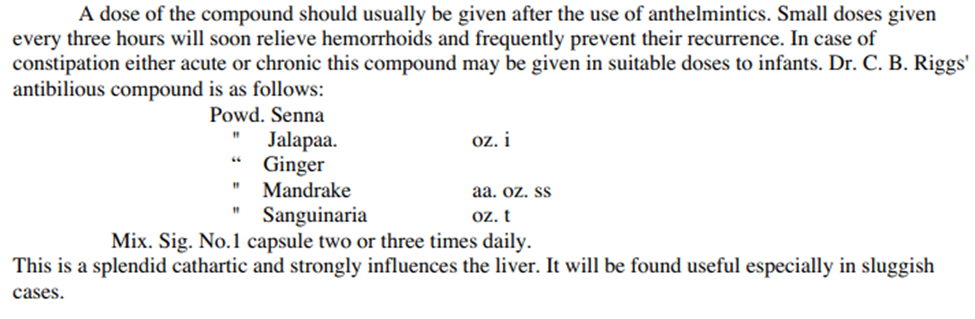
The root, leaves and pods are a prompt stimulating cathartic. They are antibilious, antiperiodic and tonic. Catharsis is usually produced in two to four hours, thoroughly influencing intestinal peristalsis. Mentha piperita or zingiber prevents griping. Small doses may be continued for some time without tiring the system.
This is an excellent aptibilious physic. It may be given in such doses as may be required by the conditions present. If quick catharsis is needed give a large dose and the patient, advise to recline and keep quiet. It will thoroughly cleanse the alvine canal in two or three hours, and will assist in relieving engorgement of the liver and gall ducts. But should you desire its action less upon the alvine canal and more upon the liver, give small doses every three hours. I have aborted many a case of Tonsillitis by a large dose of this compound, and in diphtheria and many other acute cases where the bowels are constipated this is my first dose. I have treated successfully many a case of typhoid fever with no other hepatic than this compound in small doses every 3 hours. It stimulates and cleanses the alvine mucous membrane.
In jaundice where the overflow is not from gall stone it gives good success. In all eruptive diseases you will find a less virulent course and a more favourable termination by the use of a good dose of this compound in the beginning. In the treatment of chronic constipation there are few compounds that will do their work more completely and of which the system will become less weary.
At first give dose sufficient to procure a complete evacuation, then give smaller doses and gradually decrease the frequency and quantity. During the time of this temporary treatment strive to educate the system to habitual regularity. In the treatment of remittents and intermittents this compound is very important; regulate the doses as required to keep the alvine canal free, but not too free.
Many a case may be aborted by the use of this compound, taken in time. Cassia is an excellent antiperiodic. Many a time a good size dose of antibilious physic will anticipate and prevent a chill, and frequently will do it more permanently than quinine. It will certainly prevent the necessity for giving so much quinine as would otherwise be required. In giving large doses of this compound let the patient recline for an hour. This will usually prevent nausea and vomiting which may otherwise occur. It may be given in capsule or in fluid extract form, but neither are so good.