Water caltrop
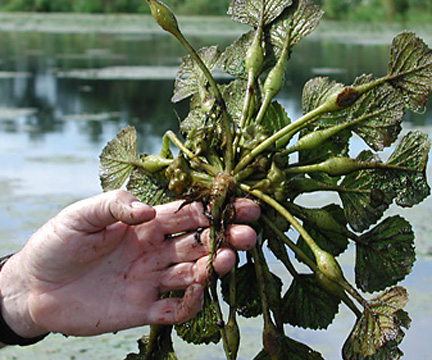
The water chestnut, scientifically known as Trapa natans, is an aquatic plant native to Europe, Asia, and Africa. It is known for its distinctive floating rosettes of leaves and its hard, spiny fruits.
Description
Physical Characteristics
- Leaves: The water chestnut has two types of leaves. The submerged leaves are feathery and whorled around the stem, while the floating leaves are triangular or diamond-shaped, forming a rosette on the water's surface.
- Flowers: The plant produces small, white, four-petaled flowers that bloom above the water surface.
- Fruits: The fruits are nut-like, with a hard shell and four sharp spines. These fruits can remain viable for up to 12 years, making them particularly resilient.
Growth and Reproduction
Trapa natans is an annual plant, meaning it completes its life cycle in one growing season. It reproduces both sexually, through seeds, and vegetatively, through fragmentation. The seeds germinate in the spring, and the plant grows rapidly, often forming dense mats that can cover large areas of water.
Habitat and Distribution
Native Range
The water chestnut is native to parts of Europe, Asia, and Africa. It thrives in slow-moving or still freshwater bodies such as ponds, lakes, and rivers.
Introduced Range
Trapa natans has been introduced to North America, where it has become an invasive species in several states, including New York, Massachusetts, and Virginia. It was first introduced in the United States in the late 1800s as an ornamental plant.
Ecological Impact
Positive Aspects
In its native range, the water chestnut plays a role in the ecosystem by providing habitat and food for various aquatic organisms. The dense mats can offer shelter for fish and invertebrates.
Negative Aspects
In areas where it is invasive, Trapa natans can have significant negative impacts:
- Biodiversity: The dense mats formed by the plant can outcompete native vegetation, reducing biodiversity.
- Water Quality: The decomposition of large amounts of plant material can deplete oxygen levels in the water, harming fish and other aquatic life.
- Recreation: The thick mats can impede boating, fishing, and swimming, affecting recreational activities.
- Economic Impact: Managing and controlling the spread of water chestnut can be costly for local governments and organizations.
Control and Management
Mechanical Control
Mechanical methods include hand-pulling, cutting, and harvesting. These methods can be effective but are labor-intensive and may need to be repeated multiple times during the growing season.
Chemical Control
Herbicides can be used to control water chestnut, but they must be applied carefully to avoid harming non-target species and water quality. Commonly used herbicides include glyphosate and 2,4-D.
Biological Control
Research is ongoing to identify potential biological control agents, such as insects or pathogens, that can specifically target Trapa natans without affecting native species.
Integrated Management
An integrated approach that combines mechanical, chemical, and biological methods is often the most effective way to manage water chestnut populations. Public education and awareness are also crucial components of management strategies.
Cultural and Economic Importance
In some cultures, the fruits of Trapa natans are harvested and consumed. They are known as water caltrops or singhara and are used in various culinary dishes. The nuts are rich in carbohydrates and can be eaten raw, boiled, or roasted.