Netleaf Hackberry
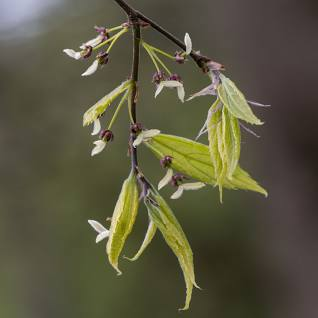
Netleaf Hackberry (Celtis reticulata)
Celtis reticulata, also known as netleaf hackberry, is a small to medium-sized deciduous tree native to western North America.
It is a water-loving tree that grows near rivers and springs in the Southwest.
It can grow to be 15–30 feet tall, but may reach 50 feet.
It has a spreading canopy and twisted branches.
The tree's small red berries are a calorie-packed staple food that can be used to feed people for long periods of time in an emergency. Birds also feed on the tree's small orange-red fruit.
The tree is hardy to -20°F. It can tolerate full sun, reflected heat, infertile soils, and is resistant to Texas root rot. It can also tolerate periodic flooding and drought.
The tree's scientific name is Celtis laevigata Willd. var. reticulata (Torr.).
It is also known by the common names:
Netleaf hackberry, Western hackberry, Douglas hackberry, Netleaf sugar hackberry, Palo blanco, Acibuche, Sugar hackberry, Texas sugarberry
Identification
- Habit: Small to medium deciduous tree; 15–30 ft typical, occasionally to 50 ft. Often with a crooked or twisted trunk and irregular branching.
- Bark: Gray to brown, often warty or ridged with age.
- Leaves:
- Simple, alternate, broadly ovate to lanceolate
- Distinctive netted (reticulate) venation on the underside—hence “netleaf”
- Margin usually serrate toward the tip, more entire toward the base
- Rough texture on upper surface in many specimens
- Flowers:
- Small, inconspicuous, greenish
- Appearing in spring with or just before the leaves
- Typically wind- or insect-pollinated
- Fruit:
- Small drupes (often called “berries”) maturing to orange-red or reddish-purple
- Thin sweet pulp surrounding a relatively large hard seed
- Persistent on the tree into winter, important wildlife food
Habitat & Ecology
- Native range: Western North America; common in the U.S. Southwest and adjacent regions.
- Typical sites:
- Riparian corridors, canyon bottoms, arroyos
- Springs, seeps, floodplains
- Also found on rocky slopes and mesas where roots can access subsurface moisture
- Soil & climate tolerance:
- Withstands infertile, rocky, and alkaline soils
- Tolerates periodic flooding as well as significant drought once established
- Hardy to about -20°F
- Performs in full sun, heat, and reflected light (urban / desert environments)
- Wildlife value:
- Fruits are eaten by many birds and small mammals
- Provides cover and nesting sites; host for various insect species
Edible & Nutritional Uses
- Edible part: Ripe fruits (drupes).
- Flavor & texture:
- Sweet, date-like flavor in some populations
- Thin layer of sugary pulp around a crunchy, calcium-rich seed
- Food uses:
- Eaten fresh off the tree
- Dried for later use as a trail food or emergency ration
- Ground (whole fruit including seed) into a meal or paste for porridges, breads, or desserts
- Caloric density:
- High-calorie due to combination of sugars and fats/protein in the seed
- Traditionally noted as a compact, long-keeping survival food suitable for sustained travel or lean seasons
Traditional & Therapeutic Aspects
- Traditional use themes (various hackberries, including C. reticulata where known):
- Nutritive tonic food during winter or scarcity
- Mild astringency from bark/leaf in some traditions (general hackberry group)
- Potential actions to research further:
- Nutritive, demulcent, mild astringent, gastro-protective (food as medicine)
- Mineral-rich seeds (calcium, etc.) contributing to structural support (bones/teeth)
- Therapeutic notes (preliminary):
- As a staple food: supports energy, resilience, and blood sugar stability on the move
- Gentle, child-friendly wild food once ID is secure and fruits are fully ripe
Harvesting & Processing
- Harvest time:
- Late summer through fall, sometimes into winter, depending on elevation and latitude.
- Ethical harvest:
- Leave ample fruit for birds and mammals—hackberry can be crucial winter forage.
- Favor heavily loaded trees; avoid stressing marginal individuals in drought.
- Processing ideas:
- Eat fresh or dry whole fruits on trays or screens.
- Grind whole dried berries (including seeds) in a sturdy mill or mortar.
- Sift if you prefer finer flour; or use the coarse meal in:
- porridges
- puddings
- “energy ball”–style mixes with fat and honey
- Storage:
- Thoroughly dried fruits keep well in sealed containers in a cool, dry place.
- Protect from pantry moths and rodents.
Safety & Cautions
- Correct identification is essential—verify leaf venation, fruit, bark, and habitat.
- As with all novel wild foods, introduce slowly and observe for:
- digestive upset
- idiosyncratic reactions (rare but possible)
- Hard seeds can be a choking hazard for very young children if eaten whole.
Horticultural / Ecological Use
- Landscape roles:
- Shade tree for arid or hot sites
- Windbreak or shelterbelt component
- Riparian stabilization and erosion control
- Resilience traits:
- Tolerant of heat, drought, poor soils, and urban conditions
- Resistance to Texas root rot makes it valuable in disease-prone regions.
- Design notes:
- Excellent candidate for edible native plantings and food-forest edges in dry climates.
- Supports birds and insects while providing human food.