Specific and non-specific components to pathogenesis
(Return to Intro to Herbalism Menu)
A traditional example of specific pathogenesis is immune reaction (although specificity of antibodies or T-cell receptors should not be overestimated – because there are cross-reactions and non-organospecific antibodies).
On the non-specific end of a scale are responses of universal or broad application (inflammation, stress, hypoxia). Their manifestations one can register in many different diseases.
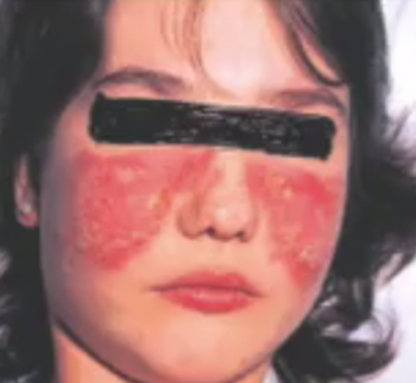
The butterfly rash on the face seen in Lupus is an example of specific pathogenesis, the main mechanism is autoantibodies. The most characteristic kind in this disease are autoantibodies against double-strand DNA. Action between antibody and antigen is highly specific - but not entirely because the specificity of immunoglobulin and T-cell receptors include cross-reactions and the antibodies are absolutely non-specific because double-strand DNA exists in every nucleated cell. That's why, in systemic Lupus, not only skin is involved, so is the brain, lung, joints, heart, abdominal organs....everything is involved and the symptoms vary greatly. Although antibodies of concrete specificity are responsible for a major part of the symptoms.
Why? Because, although the interaction is specific but distribution of auto-antigen is universal. So the gradation between specific and non-specific pathogenesis is relative, although it is of some worth because its obvious that certain components of disease like stress, which exists in the beginning of every disease; like hypoxia, which sooner or later manifests in every severe disease for some organ or tissues; like inflammation which is embedded in pathogenesis of very different disorders - many components of pathogenesis are universal and versatile. Some components depend on specific interactions.
Such traditional division between specific and non-specific components is relative and conditional. It is not possible to act or to signal “generally” –every signal and action in an organism requires more or less specific intermolecular recognition (ligand-receptor, enzyme-substrate, etc.) They are very helpful in diagnosis.
The father of immunology, Paul Ehrlich, coined a principle: bodies cannot act in any other manner than fixing each other. This means nothing can act in any other way than to pin to something. The basis for specific interaction is pinning between molecules, ligands and receptors, and most diseases this principle is responsible for specific manifestations.
Example: Generalized myasthenia, a severe disease with progressive respiratory failure, a person experiences severe muscular weakness. There's a specific antibody against nicotine cholinergic receptors in skeletal muscle. An overwhelming majority of somatic disorders we can find some specific interaction which is responsible.
In all ‘non-specific’ processes (like stress) – we can find complementary specific interactions (hormone-receptor, enzyme-substrate, Ag-Ab, etc.)