Confounding
A beginner’s guide to confounding
Confounding in epidemiological studies
Causation and Confounding
Validity, Bias, & Confounding
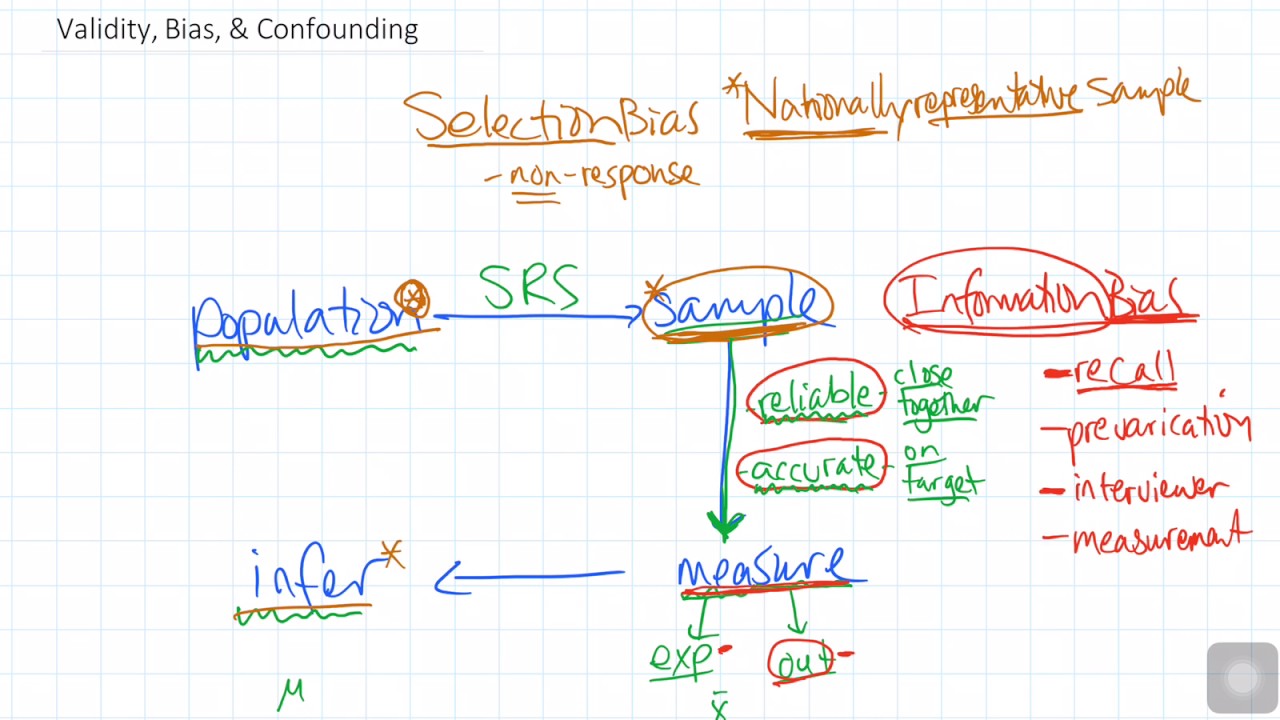
In the realm of medical research, the concept of confounding plays a critical role in the interpretation of study results. Confounding occurs when the relationship between an exposure and an outcome is distorted by the presence of another variable, known as a confounder. This can lead to erroneous conclusions about the causal relationship between the exposure and the outcome.
What is Confounding?
Confounding is a type of bias that occurs when a third variable influences both the independent variable (exposure) and the dependent variable (outcome), creating a spurious association. This third variable, the confounder, can either exaggerate or mask the true relationship between the exposure and the outcome.
Example of Confounding
Consider a study investigating the relationship between coffee consumption and heart disease. If the study finds that coffee drinkers have a higher incidence of heart disease, one might conclude that coffee increases the risk of heart disease. However, if smoking is more prevalent among coffee drinkers and is a known risk factor for heart disease, smoking acts as a confounder. The observed association between coffee consumption and heart disease may be due to the confounding effect of smoking.
Identifying Confounders
To identify potential confounders, researchers must consider variables that are associated with both the exposure and the outcome. These variables should not be on the causal pathway between the exposure and the outcome. In the coffee and heart disease example, smoking is associated with both coffee consumption and heart disease but is not a result of coffee consumption.
Criteria for a Confounder
- Association with the Exposure: The confounder must be associated with the exposure of interest.
- Association with the Outcome: The confounder must be associated with the outcome, independent of the exposure.
- Not an Intermediary: The confounder should not be an intermediary step in the causal pathway from exposure to outcome.
Controlling for Confounding
Researchers employ several strategies to control for confounding in their studies:
Study Design
- Randomization: In randomized controlled trials (RCTs), randomization helps ensure that confounders are equally distributed between the treatment and control groups, minimizing their impact.
- Matching: In observational studies, researchers can match participants in the treatment and control groups based on confounding variables, ensuring that these variables are equally represented in both groups.
Statistical Methods
- Stratification: This involves analyzing the data within strata (subgroups) of the confounder to assess the exposure-outcome relationship within each stratum.
- Multivariable Analysis: Techniques such as multiple regression allow researchers to adjust for confounders by including them as covariates in the analysis.
- Propensity Score Matching: This method involves creating a score that represents the probability of receiving the exposure, based on observed confounders, and matching participants with similar scores.
Residual Confounding
Despite efforts to control for confounding, residual confounding may still occur. This happens when not all confounders are identified or measured accurately. It is important for researchers to acknowledge the possibility of residual confounding and interpret their findings with caution.
Importance in Medical Research
Confounding is a significant concern in medical research because it can lead to incorrect conclusions about the effectiveness or safety of treatments. Understanding and addressing confounding is essential for:
- Accurate Causal Inference: Ensuring that the observed associations reflect true causal relationships.
- Policy and Practice: Informing clinical guidelines and public health policies based on reliable evidence.
- Ethical Research: Upholding the integrity of research by minimizing bias and ensuring valid results.