False Boneset
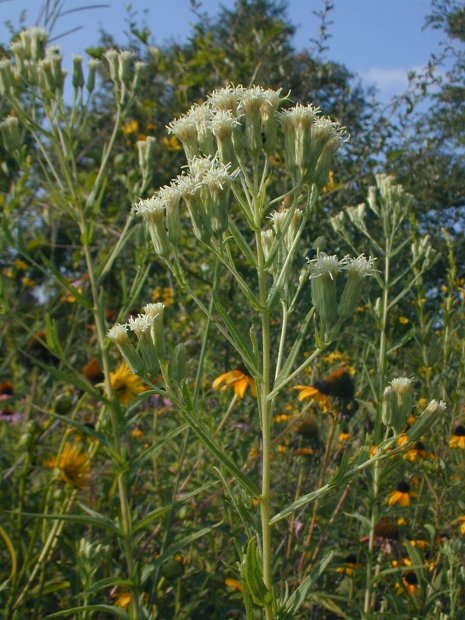
False Boneset, scientifically known as Brickellia eupatorioides, is a perennial herbaceous plant belonging to the Asteraceae family. This plant is native to North America and is commonly found in prairies, open woodlands, and along roadsides. It is known for its medicinal properties and its role in native ecosystems.
Botanical Description
False Boneset typically grows to a height of 1 to 3 feet. The plant has a branching habit with slender, erect stems that are often covered in fine hairs. The leaves are alternate, lanceolate to ovate in shape, and have serrated margins. They are usually 1 to 4 inches long and 0.5 to 1 inch wide. The leaves are also covered in fine hairs, giving them a somewhat rough texture.
The flowers of False Boneset are small and white, arranged in dense, flat-topped clusters called corymbs. Each flower head contains numerous tiny florets, which are tubular and have five lobes. The blooming period typically occurs from late summer to early fall, attracting a variety of pollinators, including bees, butterflies, and other insects.
Habitat and Distribution
False Boneset is widely distributed across North America, particularly in the central and eastern United States. It thrives in well-drained soils and is commonly found in prairies, savannas, open woodlands, and along roadsides. The plant prefers full sun to partial shade and can tolerate a range of soil types, including sandy, loamy, and clay soils.
Ecological Importance
False Boneset plays a significant role in native ecosystems. It provides nectar and pollen for a variety of pollinators, including bees, butterflies, and moths. The plant also serves as a host for several species of caterpillars, which feed on its leaves. Additionally, False Boneset can help stabilize soil and prevent erosion due to its extensive root system.
Medicinal Uses
Historically, False Boneset has been used in traditional medicine by Native American tribes and early settlers. The plant was commonly used to treat fevers, colds, and respiratory ailments. It was also used as a diuretic and to relieve pain and inflammation. The leaves and flowering tops were typically harvested and used to make teas, tinctures, and poultices.
Modern herbalists continue to use False Boneset for its medicinal properties. It is believed to have anti-inflammatory, diaphoretic, and diuretic effects. However, it is important to note that the plant contains pyrrolizidine alkaloids, which can be toxic to the liver if consumed in large quantities. Therefore, it should be used with caution and under the guidance of a qualified healthcare professional.
Cultivation and Propagation
False Boneset is relatively easy to cultivate and can be grown from seeds or cuttings. The seeds should be sown in the fall or early spring, as they require a period of cold stratification to germinate. The plant prefers full sun to partial shade and well-drained soils. It is drought-tolerant once established and requires minimal maintenance.
To propagate False Boneset from cuttings, take 4 to 6-inch stem cuttings in the spring or early summer. Remove the lower leaves and dip the cut end in rooting hormone before planting in a well-draining potting mix. Keep the cuttings moist and in a shaded area until they develop roots, which usually takes 4 to 6 weeks.
Physio-Medical Therapeutics, Materia Medica and Pharmacy BY T. J. LYLE, A.M.M. 1897
This plant grows on dry hillsides. The leaves are lighter coloured than the true Boneset, but the flowers are very similar. The leaves have the same shape, but are loose around the stem, and gummy to the touch.
Dr. F. G. Hoener says he has employed this for many years with good success in typhoid and typhus fevers especially where there was much tympanitis, also in typhoid pneumonia and meningitis. He recommends the following for typhoid fever, to be taken in dessertspoonful doses every two or three hours:
