Quorum Sensing
Videos
How bacteria “talk”

Quorum sensing in the soil
Manipulating Quorum Sensing

Quorum Sensing in Dental Plaque
Inhibition of quorum-sensing signals by essential oils
Quorum sensing: A less known mode of communication among fungi.
Wikipedia
Quorum sensing is a system of stimuli and response correlated to population density. Many species of bacteria use quorum sensing to coordinate gene expression according to the density of their local population. In similar fashion, some social insects use quorum sensing to determine where to nest. In addition to its function in biological systems, quorum sensing has several useful applications for computing and robotics.
Quorum sensing can function as a decision-making process in any decentralized system, as long as individual components have: (a) a means of assessing the number of other components they interact with and (b) a standard response once a threshold number of components is detected.
Bacteria
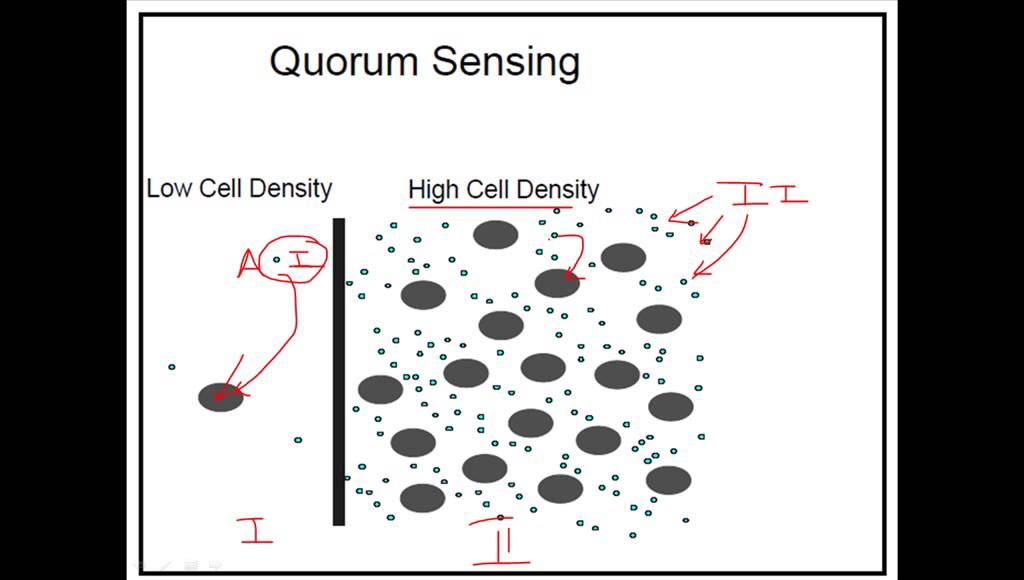
Some of the best-known examples of quorum sensing come from studies of bacteria. Bacteria use quorum sensing to coordinate certain behaviors such as biofilm formation, virulence, and antibiotic resistance, based on the local density of the bacterial population. Quorum sensing can occur within a single bacterial species as well as between diverse species, and can regulate a host of different processes, in essence, serving as a simple indicator of population density or the diffusion rate of the cell's immediate environment. A variety of different molecules can be used as signals. Common classes of signaling molecules are oligopeptides in Gram-positive bacteria, N-acyl homoserine lactones (AHL) in Gram-negative bacteria, and a family of autoinducers known as autoinducer-2 (AI-2) in both Gram-negative and Gram-positive bacteria.
Mechanism
Bacteria that use quorum sensing constitutively produce and secrete certain signaling molecules (called autoinducers or pheromones). These bacteria also have areceptor that can specifically detect the signaling molecule (inducer). When the inducer binds the receptor, it activates transcription of certain genes, including those for inducer synthesis. There is a low likelihood of a bacterium detecting its own secreted inducer. Thus, in order for gene transcription to be activated, the cell must encounter signaling molecules secreted by other cells in its environment. When only a few other bacteria of the same kind are in the vicinity, diffusion reduces the concentration of the inducer in the surrounding medium to almost zero, so the bacteria produce little inducer. However, as the population grows, the concentration of the inducer passes a threshold, causing more inducer to be synthesized. This forms a positive feedback loop, and the receptor becomes fully activated. Activation of the receptor induces the up-regulation of other specific genes, causing all of the cells to begin transcription at approximately the same time. This coordinated behavior of bacterial cells can be useful in a variety of situations. For instance, the bioluminescent luciferase produced by Vibrio fischeri would not be visible if it were produced by a single cell. By using quorum sensing to limit the production of luciferase to situations when cell populations are large, V. fischeri cells are able to avoid wasting energy on the production of useless product.
In recent research, the direction for activating or deactivating nature of a wave of gene expression is predicted experimentally which control bacterial populations subject to a diffusing autoinducer signal. On the other hand, it has been observed that the accumulation of the quorum sensing molecules leads to a negative diffusion coefficient in the solution of governing differential equation.[2]
Examples
Aliivibrio fischeri
Quorum sensing was first observed in Aliivibrio fischeri, a bioluminescent bacterium that lives as a mutualistic symbiont in thephotophore (or light-producing organ) of the Hawaiian bobtail squid. When A. fischeri cells are free-living (or planktonic), the autoinducer is at low concentration, and, thus, cells do not luminesce. However, when they are highly concentrated in the photophore (about 1011 cells/ml), transcription of luciferase is induced, leading to bioluminescence.
Escherichia coli
In the Gram-negative bacterium Escherichia coli (E. coli), cell division may be partially regulated by AI-2-mediated quorum sensing. This species uses AI-2, which is produced and processed by the lsr operon. Part of it encodes an ABC transporter, which imports AI-2 into the cells during the early stationary (latent) phase of growth. AI-2 is then phosphorylated by the LsrK kinase, and the newly produced phospho-AI-2 can be either internalized or used to suppress LsrR, a repressor of the lsr operon (thereby activating the operon). Transcription of the lsr operon is also thought to be inhibited by dihydroxyacetone phosphate (DHAP) through its competitive binding to LsrR. Glyceraldehyde 3-phosphate has also been shown to inhibit the lsr operon through cAMP-CAPK-mediated inhibition. This explains why, when grown with glucose, E. coli will lose the ability to internalize AI-2 (because ofcatabolite repression). When grown normally, AI-2 presence is transient.
E. coli and Salmonella enterica do not produce AHL signals commonly found in other Gram-negative bacteria. However, they have a receptor that detects AHLs from other bacteria and change their gene expression in accordance with the presence of other "quorate" populations of Gram-negative bacteria.
Salmonella enterica
Salmonellaencodes a LuxR homolog, SdiA, but does not encode an AHL synthase. SdiA detects AHLs produced by other species of bacteria including Aeromonas hydrophila, Hafnia alvei, and Yersinia enterocolitica. When AHL is detected, SdiA regulates the rck operon on the Salmonella virulence plasmid (pefI-srgD-srgA-srgB-rck-srgC) and a single gene horizontal acquisition in the chromosome srgE. Salmonella does not detect AHL when passing through the gastrointestinal tracts of several animal species, suggesting that the normal microbiota does not produce AHLs. However, SdiA does become activated when Salmonella transits through turtles colonized with Aeromonas hydrophila or mice infected with Yersinia enterocolitica. Therefore, Salmonella appears to use SdiA to detect the AHL production of other pathogens rather than the normal gut flora.
Pseudomonas aeruginosa
The opportunistic pathogen Pseudomonas aeruginosa uses quorum sensing to coordinate the formation of biofilms, swarming motility, exopolysaccharideproduction, virulence, and cell aggregation. These bacteria can grow within a host without harming it, until they reach a threshold concentration. Then they become aggressive, developing to the point at which their numbers are sufficient to overcome the host's immune system, and form a biofilm, leading to diseasewithin the host as the biofilm is a protective layer encasing the bacteria population. Another form of gene regulation that allows the bacteria to rapidly adapt to surrounding changes is through environmental signaling. Recent studies have discovered that anaerobiosis can significantly impact the major regulatory circuit of quorum sensing. This important link between quorum sensing and anaerobiosis has a significant impact on production of virulence factors of this organism. Garlic and ginseng experimentally block quorum sensing in Pseudomonasaeruginosa. It is hoped that the therapeutic enzymatic degradation of the signaling molecules will prevent the formation of such biofilms and possibly weaken established biofilms. Disrupting the signalling process in this way is called quorum sensing inhibition.
Acinetobacter sp.
It has recently been found that Acinetobacter sp. also show quorum sensing activity. This bacterium, an emerging pathogen, produces AHLs. Interestingly,Acinetobacter sp. shows both quorum sensing and quorum quenching activity. It produces AHLs and also, it can degrade the AHL molecules as well.
Aeromonas sp.
This bacterium was previously considered a fish pathogen, but it has recently emerged as a human pathogen. Aeromonas sp. have been isolated from various infected sites from patients (bile, blood, peritoneal fluid, pus, stool and urine). All isolates produced the two principal AHLs, N-butanoylhomoserine lactone (C4-HSL) and N-hexanoyl homoserine lactone (C6-HSL). It has been documented that Aeromonas sobria has produced C6-HSL and two additional AHLs with N-acyl side chain longer than C6.
Yersinia
The YenR and YenI proteins produced by the gammaproteobacterium Yersinia enterocoliticaare similar to Aliivibrio fischeri LuxR and LuxI. YenR activates the expression of a small non-coding RNA, YenS. YenS inhibits YenI expression and acylhomoserine lactone production. YenR/YenI/YenS are involved in the control of swimming and swarming motility.
Molecules involved in quorum sensing
Three-dimensional structures of proteins involved in quorum sensing were first published in 2001, when the crystal structures of three LuxS orthologs were determined by X-ray crystallography In 2002, the crystal structure of the receptor LuxP of Vibrio harveyi with its inducer AI-2 (which is one of the few biomolecules containing boron) bound to it was also determined. Many bacterial species, including E. coli, an enteric bacterium and model organism for Gram-negative bacteria, produce AI-2. A comparative genomic and phylogenetic analysis of 138 genomes of bacteria, archaea, and eukaryotes found that "the LuxS enzyme required for AI-2 synthesis is widespread in bacteria, while the periplasmic binding protein LuxP is present only in Vibrio strains," leading to the conclusion that either "other organisms may use components different from the AI-2 signal transduction system of Vibrio strains to sense the signal of AI-2 or they do not have such a quorum sensing system at all." Farnesol is used by the fungus *Candida albicans* as a quorum sensing molecule that inhibits filamentation.
A database of quorum-sensing peptides is available under the name Quorumpeps.
Certain bacteria can produce enzymes called lactonases that can target and inactivate AHLs. Researchers have developed novel molecules which block the signalling receptors of bacteria. mBTL is a compound that has been shown to inhibit quorum sensing and decrease the amount of cell death by a significant amount. Additionally, researchers are also examining the role of natural compounds (such as caffeine) as potential quorum sensing inhibitors. Research in this area has been promising and could lead to the development of natural compounds as effective therapeutics.
Evolution
Sequence analysis
The majority of quorum sensing systems that fall under the "two-gene" (an autoinducer synthase coupled with a receptor molecule) paradigm as defined by the Vibrio fischerisystem occur in the Gram-negative Proteobacteria. A comparison between the Proteobacteria phylogeny as generated by 16S ribosomal RNAsequences and phylogenies of LuxI-, LuxR-, or LuxS-homologs shows a notably high level of global similarity. Overall, the quorum sensing genes seem to have diverged along with the Proteobacteria phylum as a whole. This indicates that these quorum sensing systems are quite ancient, and arose very early in the Proteobacteria lineage.
Although examples of horizontal gene transfer are apparent in LuxI, LuxR, and LuxS phylogenies, they are relatively rare. This result is in line with the observation that quorum sensing genes tend to control the expression of a wide array of genes scattered throughout the bacterial chromosome. A recent acquisition by horizontal gene transfer would be unlikely to have integrated itself to this degree. Given that the majority of autoinducer–synthase/receptor occurs in tandem in bacterial genomes, it is also rare that they switch partners and so pairs tend to co-evolve.
The phylogeny of quorum sensing genes in Gammaproteobacteria (which includes Pseudomonas aeruginosa and Escherichia coli) is especially interesting. The LuxI/LuxR genes form a functional pair, with LuxI as the auto-inducer synthase and LuxR as the receptor. Gamma Proteobacteria are unique in possessing quorum sensing genes, which, although functionally similar to the LuxI/LuxR genes, have a markedly divergent sequence. This family of quorum-sensing homologs may have arisen in the gamma Proteobacteria ancestor, although the cause of their extreme sequence divergence yet maintenance of functional similarity has yet to be explained. In addition, species that employ multiple discrete quorum sensing systems are almost all members of the gamma Proteobacteria, and evidence of horizontal transfer of quorum sensing genes is most evident in this class.
Controversy
As quorum sensing implies a cooperative behavior, this concept has been challenged by the evolutionary implication of cooperative cheaters. This is circumvented by the concept of diffusion sensing, which has been an alternative and complementary model to quorum sensing. However, both explanations face the problems of signalling in either complex (multiple species sharing the same space) or simple (one single cell confined to a limited volume) environments where the spatial distribution of the cells can be more important for sensing than the cell population density. A new model, efficiency sensing, which takes into account both problematics, population density and spatial confinement, has been proposed as an alternative. One of the probable reasons for controversy is that current terminologies (quorum sensing, diffusion sensing, efficiency sensing) arise from different models of how natural selection has acted to shape and maintain the process. Since each of the various models does apply under some circumstances but not others, a sensible resolution to these controversies could be to return the terminology of the process to autoinduction, as originally described by Hastings and coworkers, as this term does not imply understanding of the function of the process.
Interaction of quorum-sensing molecules with mammalian cells and its medical applications
Next to the potential antimicrobial functionality, quorum-sensing derived molecules, especially the peptides, are being investigated for their use in other therapeutic domains as well, including immunology, central nervous system disorders and oncology. Quorum-sensing peptides have been demonstrated to interact with cancer cells, as well as to permeate the blood-brain barrier permeation reaching the brain parenchyma.