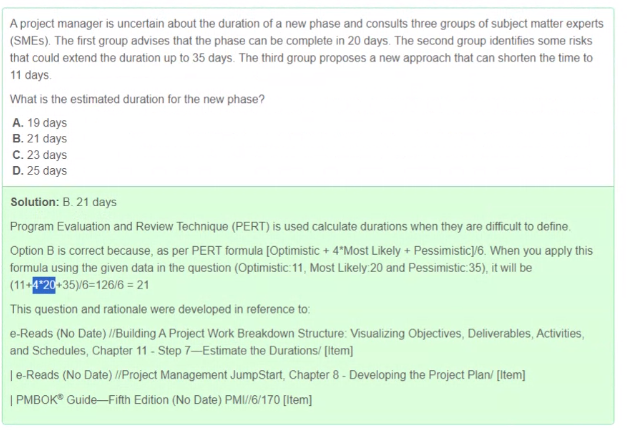
PERT Formula
What is the PERT formula
Understanding the PERT Formula
The Program Evaluation and Review Technique (PERT) is a project management tool used to estimate the time required to complete a project. It is particularly useful for complex projects with multiple interdependent tasks. The PERT formula is an essential component of this technique, allowing project managers to calculate the expected time for project completion and identify critical paths that may affect the overall schedule.
The PERT formula takes into account three time estimates for each task: the optimistic time (O), the most likely time (M), and the pessimistic time (P). These estimates help project managers understand the range of time required for each task and account for uncertainties and risks. By considering multiple estimates, the PERT formula provides a more realistic projection of project completion time.
To calculate the expected time (TE) for a task using the PERT formula, the following formula is used:
TE = (O + 4M + P) / 6
In this formula, the optimistic time represents the best-case scenario, assuming everything goes according to plan without any delays or issues. The pessimistic time represents the worst-case scenario, considering potential problems and obstacles that may arise during task execution. The most likely time is an estimate based on the project manager's experience and knowledge. By combining these three estimates, the PERT formula provides a balanced projection that considers both optimistic and pessimistic scenarios.
Once the expected time for each task is calculated using the PERT formula, project managers can determine the critical path. The critical path is the sequence of tasks that must be completed in the shortest possible time to prevent project delays. It is essential to identify the critical path as any delay in these tasks will directly impact the overall project completion time. By focusing on the critical path, project managers can allocate resources and manage priorities effectively to ensure timely project delivery.
Moreover, the PERT formula allows for the calculation of project variance. Variance helps project managers gauge the level of uncertainty associated with each task's completion time. It is calculated using the following formula:
Variance = ((P - O) / 6)2
The variance value indicates the spread or dispersion of possible outcomes for each task. A higher variance implies greater uncertainty, while a lower variance suggests a more predictable task. By analyzing the variances, project managers can identify tasks that require extra attention and allocate resources accordingly.
One of the advantages of the PERT formula is its flexibility in handling uncertainty. It recognizes that projects are prone to unforeseen problems and delays, providing a range of time estimates rather than a single fixed value. This approach allows project managers to factor in risks and uncertainties, making the PERT formula particularly suitable for projects with high complexity and uncertainty.
However, it is important to note that the PERT formula relies on accurate time estimates for each task. If the estimates are inaccurate or overly optimistic, the overall project schedule may be compromised. Therefore, project managers must ensure that the estimates are realistic and based on reliable data and expert judgment. Regular review and adjustment of estimates throughout the project lifecycle are also crucial to maintain accuracy.
In conclusion, the PERT formula is a valuable tool for project managers to estimate project completion time and identify critical paths. By considering multiple time estimates and calculating the expected time, project managers can better understand the range of possible outcomes and allocate resources effectively. The PERT formula's flexibility in handling uncertainty makes it a useful technique for managing complex projects. However, accurate and realistic time estimates are essential for the formula to provide reliable projections.